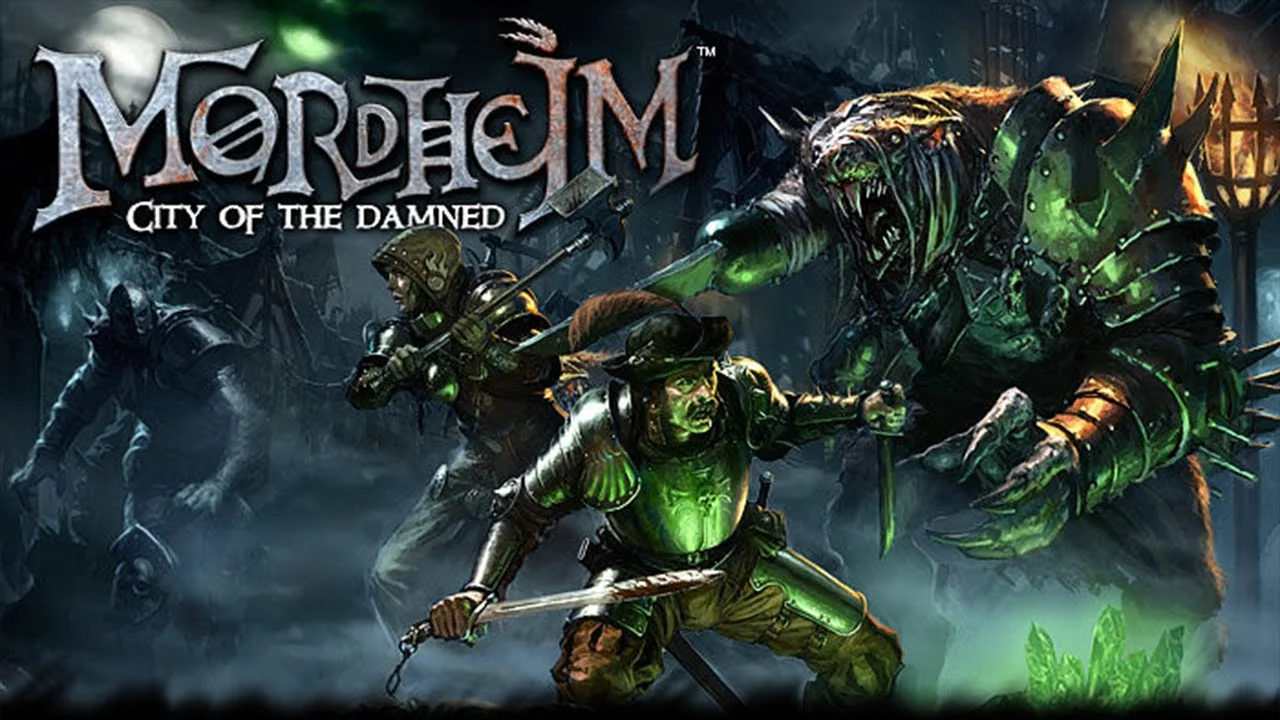
Out, Out, Damned City: A Mordheim: City of the Damned review
Unfortunately, City of the Damned isn't anywhere near as fun as the original product, and that's important to recognize. It tries so hard to get there, and maybe it even does in places-- the atmosphere, setting, and presentation are all fantastic-- but in the end, the mechanics are so byzantine and the gameplay choices are so confusing that it really doesn't make the end product particularly appetizing. Add to this an unfair learning curve that kind of shrugs and says "This is a difficult game and you're supposed to learn from your mistakes," and what you have is less a fun game, and more a byzantine slog for people who find Darkest Dungeon charming and too easy.
When I was younger, my brother and I got into the Warhammer games. We were already huge into board games (me less, since I lost frequently and would sometimes throw away a winning strategy I didn't even know I had) and Warhammer was just a bigger and more complex board game for us to waste away the hours on. But as I never had a head for large-scale tactics, I found myself drawn to the skirmish-based small-scale cousin to the Warhammer family of games, a game called Mordheim.
When the Mordheim: City of the Damned computer game was announced, I was ecstatic. Finally, a way to bring the gang warfare of the Old World's most wretched hive to a venue where I wouldn't have to keep track of all the rules. It looked excellent, too, with a variety of warbands and races, a massive city map, and a squad-based campaign feature. I couldn't wait to load up with a few of the people I played miniatures with and have at it.
Unfortunately, City of the Damned isn't anywhere near as fun as the original product, and that's important to recognize. It tries so hard to get there, and maybe it even does in places-- the atmosphere, setting, and presentation are all fantastic-- but in the end, the mechanics are so byzantine and the gameplay choices are so confusing that it really doesn't make the end product particularly appetizing. Add to this an unfair learning curve that kind of shrugs and says "This is a difficult game and you're supposed to learn from your mistakes," and what you have is less a fun game, and more a byzantine slog for people who find Darkest Dungeon charming and too easy.
So the basics. Mordheim takes place in the city of Mordheim, a wretched pre-industrial European hive where people grew corrupt and decadent while the lands around them fell to a state of total war between the forces of Chaos, the Orks, and numerous other factions. That was, until the massive twin-tailed comet known as "Sigmar's Hammer" struck the earth in the center of the city, making it an even worse hive, a home to violent cults and sickening Chaos abominations, and a haven for treasure hunters and those seeking the valuable mineral known as Warpstone, able to release massive amounts of magical power and energy.
You play a band of these hunters from one of five factions: The Sisters of Sigmar, there to cleanse the city; the Church of the Pit, a Chaos-worshipping cult that formed around the comet's crater; human bounty hunters; the Skaven, rat-people driven above-ground by the city losing its grip on sanity; or Witch Hunters, driven to remove the supernatural influence from Mordheim and have a fun time doing so. The game is split into two sections, the "camp" screen, where you recruit and outfit your squad to take on missions, and the "mission" section, where you deploy into the city to do battle with other warbands and scavenge for goods. Each skirmish has an objective and a series of sub-objectives that you can complete if you so wish, strengthening your gang and your position in the city.
And here's where it starts to go wrong. The game is played in a style similar to Valkyria Chronicles: You move your characters around in real-time third-person viewpoint using their movement points, then place them into stances, take actions, or attack enemies if there are any in range spending action points. While there is a tutorial, a lot of it is unclear on what each action actually does, requiring you to navigate a confusing series of stats and menus to figure out how to carry out actions on your turn.
Complicating issues immensely is the lack of a minimap, forcing you to zoom out to a larger map that doesn't seem to record your place in the city whatsoever. You can see the general area of things on the map, but finding your own people and planning moves is an exercise in frustration. While this helps with the "desperate struggle" atmosphere, as a game mechanic it's just another arbitrary hindrance in the way of enjoying the game.
But in the end, it's just that there was a better way to do this. A turn-based tactical over-map way. XCOM2 showed how much fun a gang-based skirmish game where you have to scrabble and squabble and desperately fight for resources could be. With racial modifiers, multilevel terrain, and an RPG-style system of advancement, this could be the game to blow the doors off the entire tactical genre. At the very least, it'd give us one of the few interesting Warhammer Fantasy games, a thing that hasn't happened since Shadow of the Horned Rat, or maybe Blood Bowl: Chaos Edition if we wanted to get technical.
While Mordheim: City of the Damned tries very, very hard, in the end, it just falls short. It's a game with a ton of great atmosphere and ideas, but the frustrating mechanics, dense barrier of entry, and low reward for a high level of effort make this completely missable. By the end of my time in the city, I just wished I could leave these people to their squabbles, and maybe pick up Valkyria or XCOM again.
Final Score: 3/5. There is so much right about this game, and then the barrier of entry just knocks it down from perfect. It's a game I want to play, but not necessarily a game I can play.
The Reviewer received a copy of this game for review
Warhammer 40,000: Regicide Review
I will give the twisted minds behind the Warhammer 40,000 universe credit, they at least know what they're doing with atmosphere. The series, a reductio ad absurdam of pretty much all science fiction and a little fantasy, is known for its rich atmosphere and utterly insane character designs. (Well, and codex creep, but that's for another article) It's a huge, bombastic setting of spaceships the size of former Soviet republics and ten foot tall warriors with six lungs and specially made ribs.
Regicide, by comparison, is a tactical strategy game taking some of the elements of Chess and mixing them with XCOM and Warhammer 40,000. It's not nearly as expansive or as utterly batshit as the source material it takes from, but in its own weird, restrained way, it does manage to be a lot of fun.
More, as always, below.
I will give the twisted minds behind the Warhammer 40,000 universe credit, they at least know what they're doing with atmosphere. The series, a reductio ad absurdam of pretty much all science fiction and a little fantasy, is known for its rich atmosphere and utterly insane character designs. (Well, and codex creep, but that's for another article). It's a huge, bombastic setting of spaceships the size of former Soviet republics and ten foot tall warriors with six lungs and specially made ribs.
Queen takes Bishop. Check.
Regicide, by comparison, is a tactical strategy game taking some of the elements of chess and mixing them with XCOM and Warhammer 40,000. It's not nearly as expansive as the source material it takes from, but in its own weird, restrained way, it does manage to be a lot of fun.
Given the blitz of games in the Warhammer universe lately, I don't feel as much of a need to recap the plot, but I'll give a primer for those who are unfamiliar. In the year 40,000, humans have expanded all over the place due to the ability to travel through "the Warp," a terrifying dimensional layer filled with things that literally make people's heads explode just by looking at them. This has taken them all over space, and put them into contact with hyper-aggressive race after hyper-aggressive race, all of which they want to kill for various reasons, and who want to kill them in kind. That's all. That's the plot.
A Blood Angel captures an Orc
But chances are, if you've picked up this game, you haven't picked it up for the rich campaign, so allow me to get into the mechanics: This game is weird. It requires a few games to develop a good tactical strategy, as playing with traditional chess tactics and doing things like attempting to weaken the back rank and truck through the opponent's specialized pieces will end your strategy in a hail of bullets. The game's strategy requires more finesse, using good tactical moves and a variety of special abilities to brutally slaughter the enemy's pieces and win the day.
Every turn is divided into two phases. The first is the movement phase, which plays exactly like chess. You move one piece a turn, and are allowed to capture pieces if they can move on to an enemy space. But where it gets interesting is the Initiative phase. Every turn, you're given a certain number of action points to spend on things like defenses, grenades, and firing on the enemy. What could be a brilliant chess move suddenly turns into a rout when your piece is left within firing range of three or four enemies that then tear you apart. Similarly, I'm a terrible chess player, but with the added dimensions of being able to fling hand grenades at your opponent's well-developed center, I found myself winning a lot more often. (I may have also had the thing on novice difficulty...shhh...)
There's also an added level of complexity with abilities and orders that advance as you win more matches. Some of these can shield your units from damage, add movement, and restrict your opponent's movement around the field. A lot of these, at the beginning, minimize damage for the most part.
However, there are two issues I have with the game right now, possibly because it's just been released. First, the boards and backgrounds are kind of boring. As far as I've gotten (played a few games to get the mechanics down), I haven't unlocked many more, and wasn't too interested in getting heavy into online play (losing constantly isn't really something that excites me). Second, it can be a little difficult even with the tutorials to find a good balance on the game. This barrier of entry goes away after a few games, but it is there, and it can be difficult to get used to the strategies. More than once, I found myself winning by a hair after concentrating fire on the enemy King, my board devastated.
In the end, though, it's definitely worth it. It's an interesting take on a classic game, and it has just enough replayability to keep it interesting.
4/5
Full Disclosure: Reviewer received early-access version of this game