Harmony: The Fall of Reverie Review
Unfortunately, while Harmony: The Fall of Reverie is a gorgeous, finely tuned visual novel with an affecting story and clear care put into every inch of the game, dissonant mechanics and sometimes confusing narrative choices are that more glaring. The result is, frustratingly, an excellent game dragged down by some of the same things that make it so excellent.
Harmony: The Fall of Reverie
Developed by: DON’T NOD
Published by: DON’T NOD
Platforms: PC and Switch (June 8), PS5 and XBOX Series X|S (June 22nd)
MSRP: unavailable at time of review
A well-made game like Harmony: The Fall of Reverie walks a dangerous tightrope. On one side, the time and care put into a game can make players instantly fall in love with its plot, characters, visuals, and narrative design. On the other, the unfortunate cracks (as we’ve seen with other titles this year) become glaringly obvious in a well-made game where they might be forgiven in jankier ones. The level of quality is high, but so are the standards. Unfortunately, while Harmony: The Fall of Reverie is a gorgeous, finely tuned visual novel with an affecting story and clear care put into every inch of the game, dissonant mechanics and sometimes confusing narrative choices are that more glaring. The result is, frustratingly, an excellent game dragged down by some of the same things that make it so excellent.
Polly returns to her childhood home after a few years abroad to look for her mother Ursula, who’s vanished without a trace. Finding only a strange necklace, Polly puts it on only to be transported to Reverie, a place where representations of humanity’s drives and underlying desires called Aspirations live and influence the human world of Brittle. Upon her arrival in Reverie, Polly takes up the role of Harmony, an oracle who can flip between worlds at will and see a little ways into the future. Harmony is meant to stabilize Reverie, leading it forward through a new cycle and aiding both worlds. As both the search for Ursula and Polly’s duties as Harmony continue, Polly finds her family drawn into an interlocking web of conspiracies surrounding old friends, enemies, and a sinister corporation called Mono Konzern. The time to choose the next cycle is at hand, but Polly must navigate both worlds to ensure that neither falls to chaos.
Harmony: The Fall of Reverie takes the form of a visual novel with a decision tree. In the story segments, you play Polly/Harmony as she learns about Reverie and bands together with family and friends to take the island and Reverie back from the evil corporation of Mono Konzern. In between story segments, you choose different paths through the Augural, a decision map that shows you potential consequences for your choices in a limited view. Navigating the Augural unlocks more choices, showing you the results of immediate decisions while offering hints for future ones. Decisions on the Augural also give out egregore crystals, a kind of currency that strengthens your connections with the various Aspirations, allowing you to choose the direction Harmony (and by extension Brittle) eventually take. It’s sort of like a narrative board game— you make decisions, move along the map, collect your crystals, and manage your relationship meter with the Aspirations. This leads to larger act-defining choices based on which of the Aspirations you support, and eventually the final choice of how to remake Reverie and save Brittle.
Harmony is gorgeous. The visual novel scenes are fully animated, with characters actually speaking their (fully voiced) lines. Reverie is a suitably bizarre landscape of mazes, floating houses, and in one case a motel that looks like a neon collage, while the island the characters call home is equally as vibrant, if a little more mundane. The cast is on point, with each voice actor bringing their A game, and absolutely no one sounds generic or phoned-in. Each character is unique, the various demesenes of Reverie are distinct and match the personalities of the Aspirations, and you get a greater sense of the world just by playing. There’s also an in-game codex that fills in the more information you get, informing you of history and backstory without info-dumping on you.
Your first-ever node. I didn’t want to spoil too much
The main interface of the game is similarly gorgeous. The Augural is set against a background the color of the night sky, with blue-violet nodes and any pathways and highlights laid out in gold. When you mouse over them, the choices light up, connecting past nodes to future nodes, and even giving you information on what choices are available. It’s an absolute joy to navigate, and it’s useful to see what consequences your choices will have. Want to plan out a path through the act for your desired outcome? You can scroll up and down the Augural and figure out what you want. Similarly, the relationships with the Aspirations are tied to how many crystals you collect, and how many of their decisions you enact. It’s an easy visual reference, even if the nature of the decisions does take some left turns now and then.
The problem with this approach is that you’re fighting the mechanics even as they’re supposed to help you make more informed decisions. Choices aren’t always telegraphed, and it’s unclear which direction you’re headed at times. It’s also sometimes not immediately clear which choices are blocked off, with some choices becoming “inevitable” nodes that you’re forced to play when you get to them, and some pathways looking like they’re multiple choices leading to multiple outcomes, only to lock you into specific outcomes instead. While there are some novel uses of the choice-based approach (one act sees you navigate an Augural map specifically mirroring Polly’s mental state at the time), it’s difficult to figure out somtimes which choices lead where. One map in particular had me following what I thought was a pathway to go with Truth and Chaos’s option for an act, only to end the act with Power instead and no idea how I got there. Similarly, the field of vision leads to issues figuring out where a choice will lead— A choice can arc off into the distance, but once you move your mouse, the links between choices will disappear, leaving you to figure out where it led on its own.
This also leads to an odd way of playing, where you spend more time planning out your choices, managing your crystals, and checking your route through the map than actually paying attention to the story. After all, the individual choices have no weight, just the outcome. It almost makes more sense for there to be a little more ambiguity in the augural, a little more uncertainty about the choices being made. Otherwise, the loop becomes just clicking nodes and collecting crystals, sacrificing investment in the plot for route planning.
Tied to this, (and unusual for a visual novel) there’s also no particular emphasis on playing the game multiple times. Your save file ends at the last choices you make unless you want to start over again, opening phases and all. It’d be a lot better if, like many others in the genre, you were able to fast-forward through the parts you’d already seen, or go through a chapter select after playing the game through once. In a game about seeing potential futures, it seems like an oversight to not go through multiple times and find out more about the plot without going through the process of a new game.
Which is a shame, because this is a great visual novel, one with a lovely story, engaging characters, excellent art direction, and one especially spoilery use of mechanics that’s absolutely brilliant. It’s imaginative, the node map is novel and well designed, and I would love nothing more than to recommend this game without caveats.
The longer I spent with Harmony, though, the more fragile it all seemed.
The Good
- Beautiful graphics
- Fully-voiced and animated visuals
- Distinct visual style
- Novel and intriguing choice mechanic
The Bad
- Route-based choice system means you spend more time plotting routes than caring about story
- No real encouragement to play the game more than once
- Occasional confusing pathways mean choices aren’t telegraphed even when they should be.
Final Score:
An excellent game with one glaring flaw, but an excellent game nonetheless
Book of Hours Preview/Demo Impressions: The Thinnest, Tastiest Vertical Slice
Book of Hours arrives in full resplendence this June for PC. If this is the (admittedly thin) vertical slice we’re getting so far, I for one can’t wait to dive in.
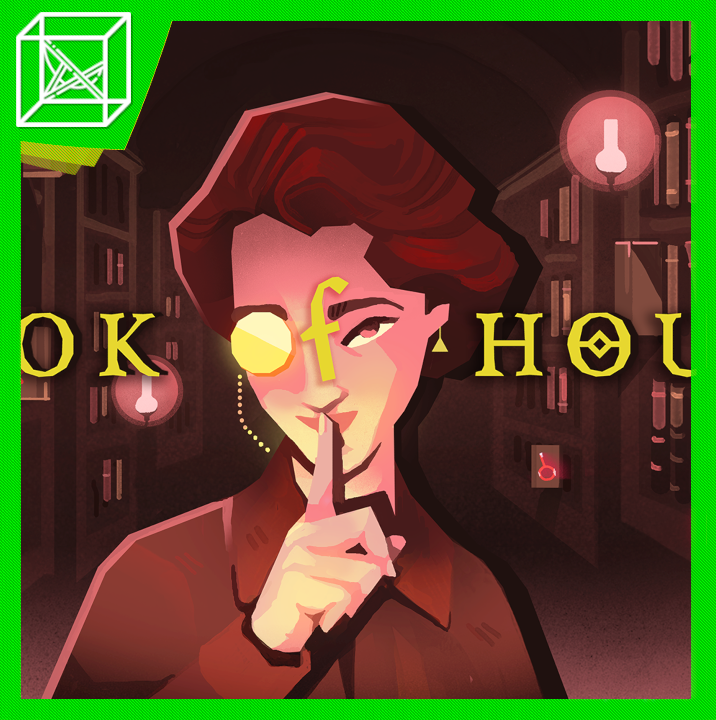
Credit: Title Art from Book of Hours
Book of Hours
Platform: PC
Developer: Weather Factory
Publisher: Weather Factory
Release Date: June 2023
Book of Hours, the latest upcoming game from bizarre art collective/writing duo/indie game studio Weather Factory, has tantalized fans with brief glimpses over the past few years, finally dropping a small playable demo during Steam NextFest. The game, which promises to be something like an “occult librarian simulator” with a similar interface and art style to previous indie smash Cultist Simulator, casts you as the Librarian of a mysterious clifftop library called Hush House, a punishment for some nebulous crime. In your capacity as Librarian, you catalog books, read forbidden knowledge, make nice with the townsfolk, and uncover secret Wisdoms that might lead you down dangerous pathways or cost you your sanity while giving you new skills.
The demo begins with you washing up on the shores of Brancrug Isle, home to the clifftop library of Hush House and the town of Brancrug Village. The Village is a town of suspicious people, requiring you to gain an introduction from an old friend before you continue your journey towards the Library. From there, you unlock a few locations— the local post office where you can send and receive letters, the local pub where you can hire laborers, and one of three places in town where you can gain favors and help: the local blacksmith, the rectory where the Vicar lives, and the curious duplex where the local Midwife and the Undertaker live together. Your goal (as much as there is one in the demo) is to rescue yourself from the beaches of Brancrug, find your way up through the Village, and eventually make your way into Hush House itself, where the demo ends.
The Wisdom Map from Book of Hours. Credit: The Gamer’s Lounge/Screenshot
There’s a lot to love here. The expressionistic visual style, rendering everything out of blocks of color in a way that feels one part painting and one part collage. The return of Weather Factory’s unique adventure-game system, one that sees you collecting cards and slotting them into various actions around the map. Even the newer elements of the work, which include a scrollable map and the ability to arrange objects inside the individual rooms of your library. It’s very impressive, and the way the game handles larger map elements with progress bars beneath each location is a novel way to deal with the constantly advancing clock, letting the player see what’s going on as they zoom in and out of the map.
Credit: The Gamer’s Lounge/Screenshot
The problem is that the demo is very short, comprising barely the beginning of the game (in fact, the demo ends when you get to Hush House, where the meat of the game supposedly takes place). It makes it difficult to get too many impressions from it. Book of Hours hints a lot at interlocking systems, from the simple (telling fortunes at the local pub for money) to the complicated (the upgrade tree is a dizzying web that dwarfs Cultist Simulator’s Mansus screen, with cryptic hints as to what you need to upgrade). Even getting off the opening beach requires careful and slow consideration of your options. What you get is fantastic and finely tuned, though, in spite of being abrupt.
Maybe that was the idea? Hint at something grand, show what you have for now in a sort of playable alpha format, and get people on board for the rest? If so, it’s certainly intriguing. Given the degree of control in the demo, one can only hope that the full game is as promising and broad as the demo suggests, the systems as deep as Weather Factory promises.
Regardless, we won’t have long to wait, as Book of Hours arrives in full resplendence this June for PC. If this is the thin vertical slice we’re getting so far, I for one can’t wait to dive in.
Giants Uprising Review
I wish this game was better.
There’s a power fantasy everyone’s had at some point in their lives of just destroying things. Stomping over buildings, squishing people you don’t like, roaring at the top of your lungs, and just straight-up destroying whole cities. It’s an excellent fantasy, a perfect way to release tension and get your feelings out on some tiny pixelated villagers. That’s what this game promises— a large, cathartic brawl through a medieval fantasy world as a huge, lumbering giant. You stomping your way through a cast of horrid villains and destroying siege machinery. While the promise of such a game is in there, Giants Uprising fails to deliver on a meaningful level. Not just with its laundry list of bugs, but with some fundamental issues that might not be solved. And that is possibly the most disappointing part.

Giants Uprising
Platform: PC
Publisher/Developer: VARSAV Game Studios SA
MSRP: 19.99
Release Date: Released to Early Access
Giants Uprising is a game in early access, and this review in no way reflects what will hopefully be the finished product.
The Giants, accepting a deal similar to the one I did by playing this game
I wish this game was better.
There’s a power fantasy everyone’s had at some point in their lives of just destroying things. Stomping over buildings, squishing people you don’t like, roaring at the top of your lungs, and just straight-up destroying whole cities. It’s an excellent fantasy, a perfect way to release tension and get your feelings out on some tiny pixelated villagers. That’s what this game promises— a large, cathartic brawl through a medieval fantasy world as a huge, lumbering giant. You stomping your way through a cast of horrid villains and destroying siege machinery. While the promise of such a game is in there, Giants Uprising fails to deliver on a meaningful level. Not just with its laundry list of bugs, but with some fundamental issues that might not be solved. And that is possibly the most disappointing part.
Giants Uprising casts you as, well, a giant. Years in the past, giants and humans managed to coexist with each other, but the humans soon betrayed the giants, enslaving and tormenting them and taking their power and lands for themselves. At the start of Giants Uprising, you play one of these giants, enslaved and forced to fight to the death in gladiatorial combat. You and your human friend Kielbasa manage to fight your way free from the fight pits, starting a rampage all over the countryside. Your job is simple: rampage across the countryside, slam through buildings, wreck the enemy structures, and smash their armies to death. All very simple, all very violent, and all very fun, supposedly. As you rampage, you can also eat local wildlife and destroy buildings to regain health, pick up debris and throw it at others, and generally wreck most of the countryside.
Sounds fun, right? Well, it should be, for all intents and purposes. When you throw something and it connects, it’s beautiful how the scenery explodes and falls apart. You can stomp your way through whole armies as you cut a swath of destruction through the countryside. When it works, it’s really cool, and you can get some excellent effects out of it.
When it works.
Unfortunately, a lot of the game is sluggish and floaty. You spend your time trudging from place to place, even when you’re sprinting. Your stomp feels like you’re slamming your leg down through custard. That seems like a weird way to describe it, but it honestly looks and feels more like you’re swimming than anything else. Things feel disconnected, like you throw a punch and then the onscreen character decides whether or not they’re going to do it accurately. It’s honestly a frustrating way to deal with combat, which, when combined with the floaty controls and what seems like RNG-based hits, just makes everything a slog. Being a giant should feel like you’re a force for destruction, not a weird, floaty mess that can’t control its limbs all that well.
If this were an isolated problem, fine, but this combines with systems that just don’t really work all that well. You’re supposed to stomp on people and buildings to regain health, but in the heat of combat, the health gains you get are negligible. Picking up debris to throw it at your enemies sounds cool in theory, but in practice requires just too many movements and too much concentration to actually get right. You can quickly get shot down or overwhelmed by the constant swarm of enemies and projectiles while fighting the controls to get any kind of offense. Sure, a giant is big and slow, but a giant is also dangerous, and nothing about Giants Uprising feels particularly dangerous.
You might not have all day, but you’ll see this day a lot
Well, except for the checkpointing. In my time with Giants Uprising, I found myself having to play the tutorial over and over and over again. This wasn’t through any fault of my own skill (or lack thereof), but because the game’s malicious habit of crashing to desktop, combined with the godawful checkpointing that would sometimes put me back half a whole stage or force me to redo sections of the tutorial, just made it difficult to make any progress. When added atop the regular problems the game has, it just becomes too much. A slog on top of a slog.
Which also goes hand-in-hand with the game’s sense of scale. Nothing actually feels all that big, to be honest. You can stomp on buildings, but they come up pretty high on the character. You can stomp on and even pick up humans, but they just seem like, well, somewhat shorter versions of you. What should be an epic struggle feels like a punchup just outside a small town. A huge arena battle just feels claustrophobic. Sure, your sidekick during story mode is perched on your shoulder, but if the world just feels small, all the things meant to feel big and awesome just feel like set dressing.
All of this wouldn’t be so annoying if the game weren’t actually trying to produce something cool. The look of the game is fantastic, with its rough-hewn aesthetic, unique art style, and an interesting backstory that manages to completely subvert itself to Hell and back. When it actually tries to do something, the game could be said to be an accomplishment— the aesthetic is fantastic, the idea of finding creative ways to use the environment and your huge size against armies of foes, and the story that strikes the right balance between snarky and serious are all excellent and beyond reproach— but when actually playing the game is such an exercise in slow-paced frustration, you begin to wonder why you even bothered.
Fear this bridge
As they continue to patch the game, Giants Uprising has seen some improvements. Hopefully, by the time it comes completely out of Early Access, it’ll be more playable. But with the current state of things backing up a game that just…doesn’t really leap off the screen, this one’s far from a recommendation.
The Good:
- Interesting setting and rough-hewn “stonepunk” aesthetics
- Tone that strikes a balance between snarky and serious
- A lot of good ideas in combat decisions
The Bad:
- Frequent crashes to desktop
- Awful checkpointing means you play the same section over and over and over and over
- Sluggish controls
- No real sense of hit detection
Perfectly Fine: A Koihime Enbu Review
Roger Ebert once said "Of each thing, ask, who is it for?" He was of course talking about the medium of film, but it's a useful metric for criticism in general. For instance, critiquing a racy visual novel on the quantity of fanservice is kind of useless, since that's exactly why people are playing it. Similarly, critiquing a fighting game for average fighting game things isn't really intuitive to the people who want to know if a fighting game's any good, regardless of whether or not the reviewer is actually any good at fighting games.
So with this in mind, I decided to figure out whether or not Koihime Enbu, the 2D fighting game based on the Koihime Musou visual novel series, is a good fighting game, regardless of whether or not I like fighting games all that much.
Roger Ebert once said "Of each thing, ask, who is it for?" He was, of course, talking about the medium of film, but it's a useful metric for criticism in general. For instance, critiquing a racy visual novel on the quantity of fanservice is kind of useless, since that's exactly why people are playing it. Similarly, critiquing a fighting game for average fighting game things isn't really intuitive to the people who want to know if a fighting game's any good, regardless of whether or not the reviewer is actually any good at fighting games.
So with this in mind, I decided to figure out whether or not Koihime Enbu, the 2D fighting game based on the Koihime Musou visual novel series, is a good fighting game, regardless of whether or not I like fighting games all that much.
For those not familiar, Koihime Musou is essentially Romance of the Three Kingdoms, except every character is actually a cute girl. The visual novel involves the usual ordinary Japanese high school student who is yanked into this world and gains an unwanted harem of strategists, generals, rules, and the like. Koihime Enbu's story is that this same cast of cute strategists and generals and the like have decided to have a fighting tournament for a mystical seal of power. That's all there really is to the plot. Which is more or less okay, because unless you're Mortal Kombat or something, fighting games don't have an immense wealth of plot. It's basically an excuse to get characters to kick the crap out of each other.
As a fighting game, however, it's decidedly okay. While there isn't a lot of information or a bevy of practice modes a la Skullgirls, the game has a low difficulty curve, each character has a small and very manageable list of supermoves, and mashing buttons doesn't feel like a bad strategy, just one that needs to be curtailed. While the game barely explains the concepts to people who have never played a fighting game before, I didn't feel like I was in over my head, the same way I am every time I pick up a copy of Marvel Vs. Capcom or something similar. It's manageable, and manageable is good. There's really only one mechanic you need to master, and that's the Tactician system, where a companion you pick from one or two choices is able to give you a conditional special move to immobilize or otherwise open your opponent to attack.
Yeah. About right.
The character variety is also fairly decent, though the simplified controls mean that pretty much every character will play the same way. Sure, there are occasional minor variations in moveset or whatever, but each character will more or less work the same, with only super moves (which I myself find hard to get off, but that's a personal problem, not a mechanical one) to differentiate between them. Compared to other fighting games, where the style and tone can differ wildly from character to character, or at least more than aesthetics and one or two moves. It made me feel like my choice in character was a little meaningless. It's a shame, because the designs are really cool, if anime characters are your thing at all.
In the end, though, while it's a good game, it's also a game where you won't get very much out of it you can't get elsewhere. Skullgirls, the current high-water mark for fighting games on the PC, is much better. Mortal Kombat, even at its weakest, is much better. If you're a fan of Koihime Musou, maybe this might be for you. But otherwise, it's just too plain and bare-bones to recommend.
Final Score: 3/5
Full Disclosure: The reviewer received a free copy of this game for the purposes of review.
Zombasite Preview
Zombasite, currently in beta from Soldak Entertainment, is the most fun you will have not knowing what it is you're doing.
And before that sounds too much like faint praise, allow me to explain, it is a lot of fun.
Zombasite, currently in beta from Soldak Entertainment, is the most fun you will have not knowing what it is you're doing.
And before that sounds too much like faint praise, allow me to explain, it is a lot of fun.
Zombasite is an isometric action RPG similar to Soldak's earlier game, Depths of Peril. In it, you control a clan in a small settlement. You and other clans are fighting for control of a world on the brink of total collapse, thanks to a twisted necrotic parasite known as the "Zombasite." While you attempt to keep control of your clan and stop the various members from killing each other whenever they get bored or angry enough, a bar at the bottom slowly rises, showing the growth and infection rate of the parasites.
And so, a desperate struggle emerges between you and the various forces. While clans will try to raid you and your enemies below and above ground will send gruesome monsters to attack you, you also have to protect your clan from zombies and research ways to slow down or stop the parasite. You will find yourself focusing on a billion different systems and subsystems in an attempt to keep your clan from collapsing. Even at the lower difficulty levels, I can tell you it is going to be an uphill battle to keep that from happening. I have put several hours into the game, and trying to do everything at once is going to leave you wandering the wasteland and wondering just how your illustrious clan wound up being two people in a fort with no doors.
But that isn't to say the barrier of entry is all that high. In fact, quite the opposite is true. Zombasite provides its players with many more ways to win than to lose: simply killing all the opposing clans (military victory), having an alliance with the remaining clans left on the map (diplomacy), to completing all the quests on the map. The game also tracks your knowledge and lore about the parasite, making the zombies and infection more manageable as you discover more things about the world. Most enemies are fairly easy to kill early on provided you know what you're doing, while giving you a game experience with a very slow difficulty curve, to its benefit.
The world is also dynamic and persistent. You can start a new game in an already-generated world, with all that would entail, and as you go along, the world will change. Sometimes people will kill your targets before you can get to them. Clans are constantly shifting in alliance and loyalty between each other, and will go out on raids. Your own clanmates have specific weapon and armor preferences, all of which impact how well they'll be able to fend off invasion and join you on raids. Clans may leave you alone, or they might rush full-on towards you, or spawn demon gates, or any number of things. When you pop someone into a new instance of the world, they take up a new region, but use the same lore and other features of the older space.
But while the game is in good form currently, it still has a long way to go before it's out of early access. The systems are a little obtuse, and while the help system is helpful, it's also a row of icons along the bottom of the screen that are easy to miss and don't always contain the most useful of information. The sound design also sometimes borders on oppressive, especially in larger battles. When coupled with a skill system that's obtuse even at the best of times, this can make things incredibly frustrating as enemies skill upward.
Overall, though, I'm looking forward to seeing what Zombasite gets with a full version. It's original, unique, and very complex in spite of its basic trappings, and with a few kinks worked out, should be a new classic.
The Reviewer was given a copy of the game in exchange for this review. The game is still in early access and is subject to change.
Warhammer 40,000: Regicide Review
I will give the twisted minds behind the Warhammer 40,000 universe credit, they at least know what they're doing with atmosphere. The series, a reductio ad absurdam of pretty much all science fiction and a little fantasy, is known for its rich atmosphere and utterly insane character designs. (Well, and codex creep, but that's for another article) It's a huge, bombastic setting of spaceships the size of former Soviet republics and ten foot tall warriors with six lungs and specially made ribs.
Regicide, by comparison, is a tactical strategy game taking some of the elements of Chess and mixing them with XCOM and Warhammer 40,000. It's not nearly as expansive or as utterly batshit as the source material it takes from, but in its own weird, restrained way, it does manage to be a lot of fun.
More, as always, below.
I will give the twisted minds behind the Warhammer 40,000 universe credit, they at least know what they're doing with atmosphere. The series, a reductio ad absurdam of pretty much all science fiction and a little fantasy, is known for its rich atmosphere and utterly insane character designs. (Well, and codex creep, but that's for another article). It's a huge, bombastic setting of spaceships the size of former Soviet republics and ten foot tall warriors with six lungs and specially made ribs.
Queen takes Bishop. Check.
Regicide, by comparison, is a tactical strategy game taking some of the elements of chess and mixing them with XCOM and Warhammer 40,000. It's not nearly as expansive as the source material it takes from, but in its own weird, restrained way, it does manage to be a lot of fun.
Given the blitz of games in the Warhammer universe lately, I don't feel as much of a need to recap the plot, but I'll give a primer for those who are unfamiliar. In the year 40,000, humans have expanded all over the place due to the ability to travel through "the Warp," a terrifying dimensional layer filled with things that literally make people's heads explode just by looking at them. This has taken them all over space, and put them into contact with hyper-aggressive race after hyper-aggressive race, all of which they want to kill for various reasons, and who want to kill them in kind. That's all. That's the plot.
A Blood Angel captures an Orc
But chances are, if you've picked up this game, you haven't picked it up for the rich campaign, so allow me to get into the mechanics: This game is weird. It requires a few games to develop a good tactical strategy, as playing with traditional chess tactics and doing things like attempting to weaken the back rank and truck through the opponent's specialized pieces will end your strategy in a hail of bullets. The game's strategy requires more finesse, using good tactical moves and a variety of special abilities to brutally slaughter the enemy's pieces and win the day.
Every turn is divided into two phases. The first is the movement phase, which plays exactly like chess. You move one piece a turn, and are allowed to capture pieces if they can move on to an enemy space. But where it gets interesting is the Initiative phase. Every turn, you're given a certain number of action points to spend on things like defenses, grenades, and firing on the enemy. What could be a brilliant chess move suddenly turns into a rout when your piece is left within firing range of three or four enemies that then tear you apart. Similarly, I'm a terrible chess player, but with the added dimensions of being able to fling hand grenades at your opponent's well-developed center, I found myself winning a lot more often. (I may have also had the thing on novice difficulty...shhh...)
There's also an added level of complexity with abilities and orders that advance as you win more matches. Some of these can shield your units from damage, add movement, and restrict your opponent's movement around the field. A lot of these, at the beginning, minimize damage for the most part.
However, there are two issues I have with the game right now, possibly because it's just been released. First, the boards and backgrounds are kind of boring. As far as I've gotten (played a few games to get the mechanics down), I haven't unlocked many more, and wasn't too interested in getting heavy into online play (losing constantly isn't really something that excites me). Second, it can be a little difficult even with the tutorials to find a good balance on the game. This barrier of entry goes away after a few games, but it is there, and it can be difficult to get used to the strategies. More than once, I found myself winning by a hair after concentrating fire on the enemy King, my board devastated.
In the end, though, it's definitely worth it. It's an interesting take on a classic game, and it has just enough replayability to keep it interesting.
4/5
Full Disclosure: Reviewer received early-access version of this game
Victor Vran Review
I previewed this game in my first article ever for the site. I played it, and it was full of promise and life and all kinds of exciting potential. In short, while it was definitely rough, at the same time, it was a lot of fun to play.
I don't know what they did to it to take that game so full of potential, a game with a decent premise, and drop it off a cliff, but I intend to find out in great detail. Because this is not the game I previewed way back in the spring. This is a game that is significantly not that game, and it bothers me.
I previewed this game in my first article ever for the site. I played it, and it was full of promise and life and all kinds of exciting potential. In short, while it was definitely rough, at the same time, it was a lot of fun to play.
I don't know what the developers did, to take that game so full of potential, a game with a decent premise, and drop it off a cliff, but I intend to find out in great detail. Because this is not the game I previewed way back in the spring. This is a game that is significantly not that game, and it bothers me.
The plot, such as it is: Victor Vran, a renowned monster hunter, comes to the walled city of Zagoravia looking for a fellow hunter. Instead, he finds the entire city overrun by monsters and under attack from some kind of demonic force. Using the palace of Queen Katarina as his home base, Vran sets out to liberate the town and destroy the monsters bit by bit.
All of this is kind of an excuse plot for a Diablo-like (or, since it's more Victorian gothic horror, a Van Helsing-like) where your demonically powered generic hunter, with the generic voice that sounds like he's been gargling two pounds of driveway gravel, battles his way through spiders, skeletons, and other baddies that one might find decorating a front door on Halloween. In addition to the usual isometric gameplay, Victor Vran adds another dimension to the mix: Height.
Yes, in Victor Vran, you can actually leap on to high obstacles, wall jump, and in one area solve a maze by jumping over its walls. You can use these abilities to maneuver around the battlefield, keep from being overrun, or even gain the high ground over your opposition. In theory, anyway. In fact, I'll go one better, that is exactly what it was like in the preview and what made me like it so much.
Unfortunately, the released version of Victor Vran is somewhat hampered. Many of the areas I could previously jump to are now railed-- you can jump over the hedges in the maze in the first part of the game, but can no longer run along them shotgunning enemies to your heart's content. The weapon ranges are also changed-- no more shooting across gaps or nice area control situations any more. In fact, much of what has been changed is meant to get you into combat more, something which rubs against my play style. I never liked the "hordes of enemies" approach, and Vran lured me in with the premise of something fresh, only to show it kept it as a pretense, not the reality.
What's left is kind of bland. The environments are colorful, to be sure, but the gameplay is kind of samey. While challenges help mitigate the blandness a little and add some dimensions of play, your achievements shouldn't be doing all the heavy lifting, and what else there is of the game feels unsatisfying. Instead of a skill tree, you gain equippable cards that take the place of such things. Each level you gain unlocks new things: levels, abilities, extra weapon slots, and extra item slots. Instead of an overworld you can travel and explore, you get a map with level select and a rating of stars and secrets in terms of completion.
I do like the streamlined level process out of all those things, but at times I wish it were more customizable. It's a game about hitting things, it makes that very obvious from the first step. It's not as interested in magic or area control or strategy, it's very much about combat. Head-to-head combat. It's also got a lot more rails than the pre-release version, forcing me to change my strategies but...not leaving me very much to change them to.
Enough about what this version subtracts. What it adds are some very nice visuals and pieces of art, and full (unneeded) voice overs. This is especially egregious as the ultimate evil has some kind of taunting voice in the protagonist's head, but the writing staff didn't bother to make him particularly funny. There's also more of a story than previously, but the story isn't really the point here.
So in the end, if you want a game that reaches for innovation with a ton of action, and some interesting choices in height, then this is definitely a game you should watch out for. But be warned, it doesn't really do anything out of the ordinary, and even the few charms it has aren't really worth the full price of admission. Wait for a sale.
2/5
Full Disclosure: Reviewer received a review copy of the game.
The Red Solstice Review
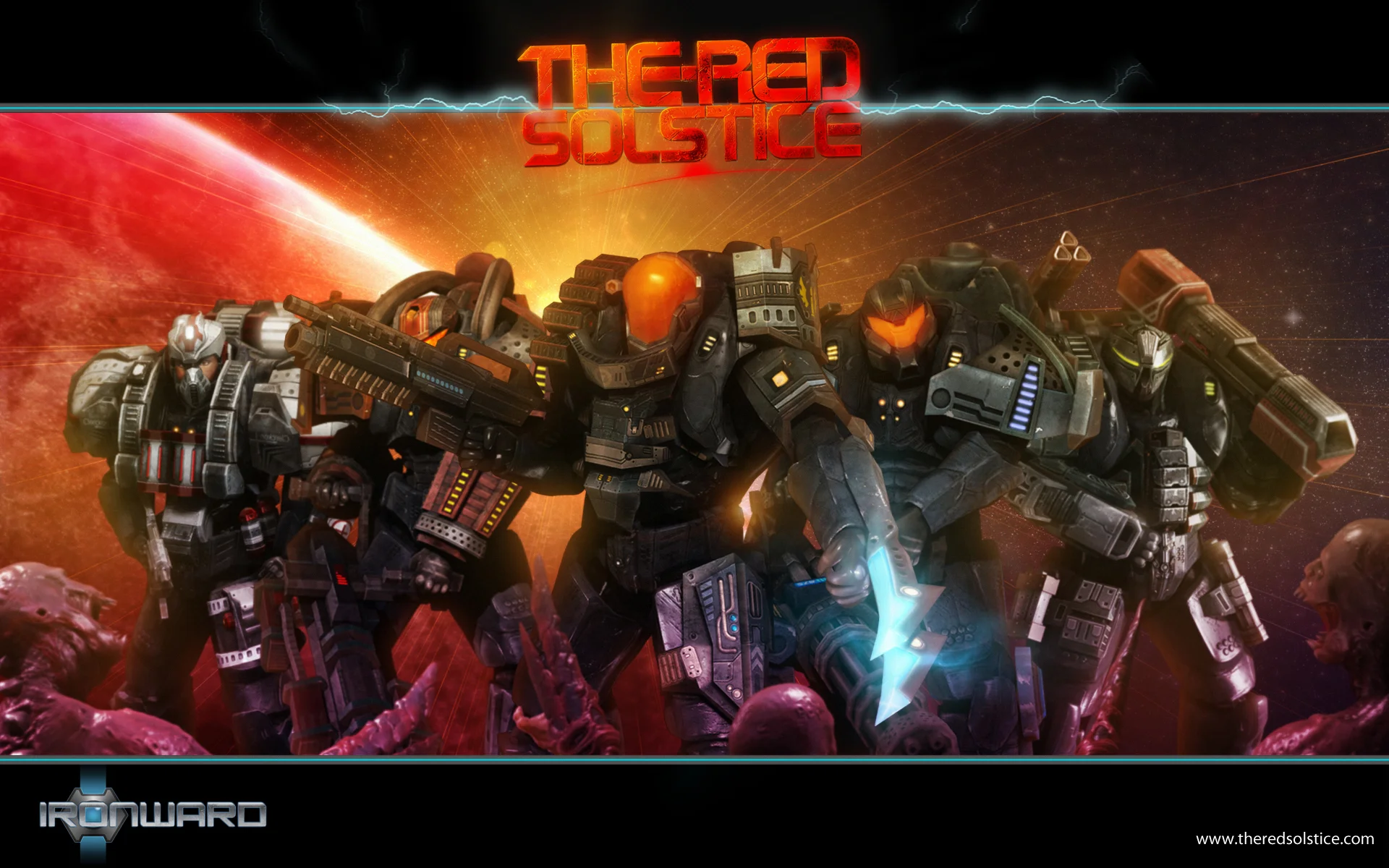
The Red Solstice is a tactical 8 player co-op survival game set in the distant future on Mars. I can see how, in the heat of the moment, with all cylinders firing and everyone trying to figure out a tactical position against the alien hordes, it could be pretty cool. I'm sure there are guilds out there who would do great, shouting orders to one another and locking down a position, mowing down shrieking monsters as they run straight at you. But then there's a part of me that thinks it really missed the boat. A big part of me, actually. And it has to do with independence.
I can see how this might be fun in multiplayer.
I can see how, in the heat of the moment, with all cylinders firing and everyone trying to figure out a tactical position against the alien hordes, it could be pretty cool. Hell, I'm sure there are guilds out there who would do great, shouting orders to one another and locking down a position, mowing down shrieking monsters as they run straight at you.
Then, there's a part of me that thinks it really missed the boat. A big part of me, actually. And it has to do with independence.
The Red Solstice doesn't seem to have very much in the way of independence. The game takes place in dark, monster-filled corridors where you guide four soldiers through an overrun base on Mars. It's a real-time tactical game where you can pick various equipment, stats, and skills, but there isn't much more than that. You and your team wander through cramped corridors on a relatively linear path filled with monsters. Occasionally, you hold a position against an onslaught of creatures, with your marines holding off wave after wave until you can collapse the lair for good. Then you move on, towards the next objective and another hole.
And...that's all there is to it. While the game does have differentiation between classes as you go forward, the entire thing's kind of...samey. Hold position, move, hold position, move, mow down the STROL (their name for the insane mutants), move further, mow down more STROL, complete objectives. I don't feel like there's any real independence or method to stationing my bulky dudes at a choke point and then letting them fire until I need them to move to another choke point. That isn't a game to me. Or particularly fun.
The controls are kind of wonky, too. More than once, I moved my soldiers into position, only to have them then stay there when I needed to move again. The tutorial is incredibly noncommittal on the subject of what to do about things, instead choosing to tell you how to move, and then leaving the rest up to you. Worse still, the controls choose to work at times, and then choose not to work at other times. More than once, I was left in the lurch because the game just decided the explosives hotkeys were no longer necessary.
The game also conflates difficulty with "more monsters," throwing more and more enemies in your way. I'd have liked an enemy variety, and maybe that happens in the part of the game I didn't give up on, but the same two or three enemy types were boring. I'd also have liked different behaviors than "Run at the PCs from all directions."
In fact, most of the aesthetics were pretty boring. Your marines look like chiseled spam in helmets and I honestly wasn't able to tell the various types of enemies apart (nor did I care to), and the exteriors all blurred together. Not that there was much to see, given that it was all kind of "generic space" and the usual low horror lighting, but there was really no distinction.
In the end, I'm sure that, had I powered through the boring, repetitive, bland, passive gameplay, I would have found a game that might have been a rewarding experience. But when the part of the game I can play is supposed to be a backdrop to the part I can't, it isn't worth the price of admission.
Final score: 2/5
Full disclosure: The reviewer received a copy of the game to review.
Galactic Inheritors Review
I don't like having to pontificate on things like this. I get that it's my job, but it's kind of annoying when I can see the game for what it is, see where it could possibly be, and then be forced to lament that it wound up like this.
Galactic Inheritors is a game that seems like its ambitions exceeded its grasp. It might just be the way the game presents itself, or it may be that it seems like a very intelligent 4X game with some definite perks to it. That those perks are weighted down with a variety of bugs, strange design choices, and just in general failure to seem like an interesting game is more of a tragedy than a delight.

I don't like having to pontificate on things like this. I get that it's my job, but it's kind of annoying when I can see the game for what it is, see where it could possibly be, and then be forced to lament that it wound up like this.
Galactic Inheritors is a game that seems like its ambitions exceeded its grasp. It might just be the way the game presents itself, or it may be that it seems like a very intelligent 4X game with some definite perks to it. That those perks are weighted down with a variety of bugs, strange design choices, and just in general failure to seem like an interesting game is more of a tragedy than a delight.
Galactic Inheritors is more or less a standard low-budget empire builder with a space setting. You have a number of different races at your disposal, including Humans, cat people, frog people, and the like. You choose a race, galaxy size, distribution, and difficulty for your game, and then you're unleashed into the galaxy to conquer, plunder, and colonize to your heart's content. The game starts you off on a large galaxy map, and for the first few turns, the issues with the game are far from obvious.
For the most part, there are some interesting and innovative touches. You can't immediately start building warships, as you don't have the tech at the start of the game. Instead, you have to buy the warships from various corporations, and then pay a certain amount of upkeep each turn to keep them running. There's also an entire "media" feature to play around with, where you manage your image both internally and towards other empires. Skilfully manipulating your PR gives you bonuses with diplomacy, causes other empires to leave you alone out of fear, or grants other perks.
I also like the way the advantages and disadvantages are worked into the setting of the game. Each race has a several-paragraph write-up on the character selection screen, and the bonuses and penalties they have are worked into their setting information. Most 4X games I've seen tend to boil these down to the most basic of traits rather than give the complex history, and it's good to see the complex history get its place somewhere other than the flavor text.
But the game commits a rather large sin. It's boring. It doesn't feel like anything's moving at all. To compare, even in the slowest-paced 4X games, ending a turn feels like something is happening for you. Even if it's just research, even if it's waiting around for your ships, there's a sense of pacing. For all Galactic Inheritors does, you might as well be playing in a vacuum. This is immediately cut with sudden bursts of tension as the various other races in the galaxy make themselves known, usually by suddenly colonizing everywhere near you.
Despite this, the game slows down again moments after making contact. You just sit there, watching your opponents explore the universe and colonize stuff. There's nothing particularly satisfying, and eventually I got bored and turned it off. It felt like I was just waiting for things to happen, like I had absolutely no stake in the game. For a game to have no stakes is pretty much a death knell as far as I'm concerned.
I've spent hours building colonies on gigantic sentient planets in Alpha Centauri. I've spent days micromanaging a burgeoning empire in Civilization. Hell, I'm even a decent hand at Master of Orion, as far as that goes. But I guess I'll have to leave someone else to inherit this galaxy.
Final score: 2/5
Full disclosure: The reviewer received a copy of this game via Steam
A Review of The Charnel House Trilogy
I want to like The Charnel House Trilogy, really, I do.
It's an atmosphere-heavy point-and-click adventure game by a small indie company. It's got a strange plot like nothing else I've really played, except maybe for Downfall. The art has a handmade feel to it that reminds me of older adventure games, so it has the nostalgia factor going for it. And let's be honest, as someone who enjoys Jacob's Ladder and horror games a little more than anyone would ever admit, there is really no reason that I shouldn't have had an amazing time with The Charnel House Trilogy.
But as much as I'd love to trumpet Charnel House to the heavens, I found that the game falls a little short of what it could possibly deliver. While there are some great ideas overall in The Charnel House Trilogy, there's too much here for me to suggest giving this anything but a miss.
Well, whatever you do, don't play The Charnel House Trilogy. You don't need more incoherent weirdness in your life.
I want to like The Charnel House Trilogy, really, I do.
It's an atmosphere-heavy point-and-click adventure game by a small indie company. It's got a strange plot like nothing else I've really played, except maybe for Downfall. The art has a handmade feel to it that reminds me of older adventure games, so it has the nostalgia factor going for it. And let's be honest, as someone who enjoys Jacob's Ladder and horror games a little more than anyone would ever admit, there is really no reason that I shouldn't have had an amazing time with The Charnel House Trilogy.
But as much as I'd love to trumpet Charnel House to the heavens, I found that the game falls a little short of what it could possibly deliver. While there are some great ideas overall in The Charnel House Trilogy, there's too much here for me to suggest giving this anything but a miss.
The Charnel House Trilogy is three linked adventure games in one: "Inhale", the first chapter, introduces the character of Alex, a young woman living in New York City who is about to take a train voyage to a place known as Augur Peak. Before her big trip, a series of mysterious events occurs in her apartment, including a blackout, a strange apparition, and sudden panic attacks.
"Sepulchre", which can be downloaded for free from Owl Cave's website, picks up sort of where the first game left off, with Professor Harold Lang, Alex's fellow passenger on the late train to Augur Peak, as he wakes up after a nap to find the train completely empty save two members of the staff. From there, he is drawn into a surreal investigation that hinges on his past, and the massive black bags present on every room of the train but his.
And "Exhale" concludes both the story of the train and Alex's story, revealing some (but not all) of the truth of what is actually going on. In this segment, Alex awakes on the train to discover that while it isn't deserted, there is something strangely familiar about all the denizens of the train and its compartments...
So first, this is a game that gets what a lot more horror games should get about horror: Horror trades on atmosphere. Entirely on atmosphere. Horror is the hardest-working genre out there because it has to unsettle you from the norm. It has to get into your head. It has to disturb you. And The Charnel House Trilogy gets that. The game starts out with an oddly subdued feeling that everything is slightly off. The feeling only grows as the story progresses, beginning with a few gently surreal quirks and then building to full-on disturbance by the final scenes. In terms of mood and setting, the story is fantastic.
The setting is great, too. The three chapters take place in very confined spaces-- the first in Alex's apartment, and the second two on the train. Because there isn't a huge diversity of setting, the places in the game begin to feel familiar. Like you've been there for a while. When the plot really kicks into high gear, it affected me because these were places and people I remembered. It also made backtracking a little easier. But even with a lack of people, the train had a great sense of place.
But there are some serious issues that have to be addressed.
The least of this game's worries is Alex's out-of-nowhere poetry about New York City
First, I strongly suggest that you go into the advanced settings menu for the game and disable the voice pack. I wouldn't disable the music, because in spite of the annoying radio (and the even more annoying DJ) during "Inhale", the music is actually pretty good. But the voice acting ranges from "Pretty decent for an indie game" to "a script read for the first time in the recording booth at knifepoint", with all but maybe three roles congregating near the bottom end of the spectrum. And the few roles where they got someone who did sound good aren't worth the ones where they didn't. It got so bad that the voice acting actually started to pull me from the narrative, rather than draw me in, and I made a neat metagame of guessing whether the characters weren't supposed to be reacting to the things going on around them, or whether the actors were just doing a bad job of conveying emotion.
Second, speaking of things that break immersion, there were a a few in-jokes that, even knowing what they were talking about, felt forced and took me out of the experience. The big one is a scene near the beginning that talks about drama involving a game reviewer giving a game a low score. I'd be fine with this if it were something optional, something you could click through, something you could find as you go through the game.
GET IT? GET IT? IT'S TOPICAL! Now only if it had, um, ANY BEARING ON THE GAME
But making it something you have to see to progress through the game, forcing me to read your comment on modern game criticism and drama, isn't going to start me out on your side. I also thought the Phantasmagoria references in the later segments were a little forced.
Finally, while repeated play-throughs did clear up some of the less coherent story elements, the plot winds up going...nowhere. The story picks up speed as it goes along, and there's no way I'd want everything tied up in a nice neat little bow, but the pacing is way off. Most of Alex's character arc is resolved by a single villain's monologue, a lot of the story threads are left dangling, and then the story ends on a cliffhanger that sets up the sequel...a year from now. I'd like to stress, I'm fine with the central mysteries being somewhat open to speculation or unsolved. But even the most feverish droppings from Suda51's brain-anus are going somewhere. They're saying something.
Hope you like a lot of rants and monologues basically saying this.
They're doing something other than shrugging. There's obscuring, and there's having to play a game multiple times to figure out something where the plot points tend to obfuscate for no reason, come out of nowhere at times, and wind up ending on a big question mark and the words "to be continued". The second one shouldn't be done.
Another issue with this is that "Sepulchre", arguably the strongest chapter of the three by virtue of its self-containment, is kind of orphaned amidst Alex's story. It feels like a side-plot while "Inhale" and "Exhale" are going on, something that reveals more of the train's nature, but ultimately doesn't matter when taking the story holistically. Doctor Lang is barely introduced as a side-character to Alex's plot in "Inhale", and is only seen sleeping at the end of "Exhale", while "Sepulchre" focuses on him. I'd have liked to see him interact more in the plot during the "Exhale" chapter, which, while it might have diminished Alex's story a little, would have made the connections between the two characters seem a little stronger.
In the end, it's a good game weighted down by its own self-indulgence, and I can't in good conscience give it a positive review when that's the case. But, since it's not entirely a bad game, I have a solution. If you really feel like playing this, either download Sepulchre from the link above, or simply play the "Sepulchre" and "Exhale" chapters with the voices turned off. You miss nothing by skipping "Inhale", there's a chapter-select screen on the main menu, so there are ways to make it work.
But as a whole package, this is one train I'm glad left me at the station.
Score: 3 out of 5
Full Disclosure: The writer of this review received a review copy of this game.
Victor Vran Preview
Victor Vran , the new game from Tropico developer Haemimont Games, is an ARPG like Diablo or The Incredible Adventures of Van Helsing. It's set in a crumbling castle somewhere in Europe, filled with all manner of creepy and crawly creatures. While many people have noted similarities to other ARPGs out there, Victor Vran adds a new element to action-RPGs that most other games have ignored: Height.
What sets Victor Vran apart from the other games mentioned above is the ability to jump over walls, wall-bounce to hard-to-reach points, and otherwise navigate the battlefield in a wholly different way. It adds an element of platforming to the game, as well as a level of tactical control-- Why get swarmed by a horde of spiders when you can get to higher ground above them, or stand on a nearby hedge to avoid their attacks? Why not leap over your enemies and get the drop on them from another angle?
Victor faces down a horde of the undead.
While the game is still in early access and so there's placeholder art and enemy variety is a little low, the game's combat system is completely functional at this point, and many of the levels are finished, so you can go tearing through castle gardens, crypts, and caves with a variety of swords, scythes, hammers, guns, and demonic powers. Adding some variety to things, there are a series of challenges for each mission, urging players to consider exploring all of an area to hunt down secrets, chests, and bonus bosses to defeat.
Two area of effect attacks clash
I'm excited to see how Victor Vran develops into a full-fledged game, and while I know there's definitely some missing pieces right now, what they have already is reason enough to keep watching this.