Book of Hours Review
If you let this game in, you will lose whole weeks to its engrossing depth and complex interactions. It’s a beautiful expanse of a game that stretches outward from the vertical slice seen during NextFest, and it demands you invite it in.
Book of Hours
Developer and Publisher: Weather Factory
Platform: PC
Release Date: August 17, 2023
MSRP: 24.99
There’s mindbending games, and then there’s Weather Factory. The small indie studio headed by surrealists Lottie Bevans and Alexis Kennedy have put out a variety of games, everything from a bizarre digital card game about losing your mind while forming a cult (Cultist Simulator) to immersive experiences, to their own tabletop game (The Lady Afterwards). Building on their previous work, they’ve unleashed another unusual but nonetheless engrossing offering, Book of Hours. It’s a strange mix of virtual furniture rearranging, gameplay based around gaining forbidden knowledge and hidden skills, and navigating your visitors and neighbors as you explore a massive house and attempt to craft a great work. It’s also vast, deep, and the kind of game you can lose weeks to. All in all, it’s an exciting new entry into their canon, and a worthy successor to their first sleeper hit.
Because of an unspecified incident, you are appointed the Librarian of Hush House, a sprawling Gothic library on the cliffs of Brancrug Isle. After a storm washes you up on the beach, you get yourself acquainted with Brancrug and your new environs, restoring the rooms of Hush House with the assistance of the locals and cataloguing any books you find. You have bigger ambitions for the forbidden knowledge hidden in these halls, however, and it will take all the skills and unusual gifts you gain from your books to achieve the transcendence you secretly seek.
Credit: The Gamer’s Lounge/Screenshot
Book of Hours is played out on a huge and expansive map of Brancrug and Hush House. Using a variety of skills, powers, items, and other help represented by cards, you perform various actions across the map— unlocking new rooms of the house that might do different things with your abilities, cataloguing (and studying) the vast library of randomly-generated books, dealing with visitors and locals alike, and upgrading your skills to further access forbidden knowledge on the “Tree of Knowledge” map. More skills and more abilities allow you access to a larger range of powers and knowledge, propelling you further up the tree and gaining more stats. The game works on a day-night cycle, where everything refreshes (and all temporary cards vanish) at daytime, and different actions are available at morning, and evening.
Credit: The Gamer’s Lounge/Screenshot
It sounds vast and complex, and it sort of is, but the presentation helps keep it simple. The game begins with your arrival on the beach with only a waterlogged journal and a memory of the storm, and teaches you the concepts of the game from there, with your first challenge being to choose your stats and then get off the beach. From there, you move into the town, and then set about opening up the town and the labyrinthine environs of Hush House itself. New mechanics have a barrier of entry (move to the next area, learn the right skill, generate enough resources) to get over, but once you get over that barrier, you find yourself integrating what you learned into the next set of mechanics. It’s vast and complex, but it’s understandable in a very specific way.
Credit: The Gamer’s Lounge/Screenshot
It also expands into a dizzying amount of depth. Apart from unlocking the rooms of Hush House, you can craft occult items, pump the townspeople for any recent omens they saw, enlist the help of townsfolk and visitors, and use the rooms for a variety of savory (and unsavory) purposes. Each new room you unlock comes with its own new set of abilities, uses and decorations. There are secrets (what do those busts on the grand staircase mean), a ton of flavor text and narration to get into, and a number of ways to craft. You can even start exploring the Moors, the Beach, and the Tree, the last of which is a map that, in classic Weather Factory fashion, exposes itself beneath the main game screen as a bizarre network of lines and pathways all leading to…something. The further you go down the rabbit hole, the more you understand, and the further you can get, leading to a sense of accomplishment as you learn the game’s ins and outs. Book of Hours makes you work hard for its secrets, but it does want you to find them, and you don’t usually find yourself waiting for the next thing to do.
That said, the game moves at its own pace, and it’s a slow and relaxing one. While there are clocks to keep track of, they’re long enough that you can figure things out slowly, and the day-night cycle lets the player know you’re going at your own pace, as long as you keep that pace slow. It’s a game about figuring things out and getting to know your area— there’s no obvious lose condition, Book of Hours is generous on time, and while the requirements for some tasks and progress seem daunting, you have more than enough time to work things out. After all, a library is a place for quiet, methodical contemplation and research, not a desperate race against the clock.
Helping all of this, the map and the corresponding Tree are gorgeous. Building on the stained glass/art deco style of Cultist Simulator and Lady Afterwards, Book of Hours features a lavish but abstract view of Brancrug Isle, Cucurbit Bridge, and the all-important Hush House. The rooms are also excessively detailed, with a variety of different furniture and components you can move around to your heart’s content, all of which also have properties you can further use in your work. As you get into the interlocking systems, half the fun is seeing what card will come up next, or what new room will open up, or what new item you can place in the library. Everything also changes with the seasons and weather, shifting to snow-covered skeletal trees and hilltops for Winter, autumn leaves, or…well, that would be a spoiler. It’s just another way the game integrates the environment as part of what it does.
Credit: Weather Factory
While the game is an absolute delight for the senses and mind, it does have a few caveats here and there. You have to constantly zoom in and out around the map, as it’s huge and you’re quickly able to lose track of what you’re doing. There’s also not really a way to keep track of all the processes you initiate, so occasionally something will go off, sending you scrolling back and forth around the map to find the exact point. Sometimes you’ll even misclick on the background or something else, closing the window you opened and opening a different one, or bringing up another tutorial message. It’s a problem quickly solved by zooming in, but it can be exhausting to navigate, especially later in the game when you have multiple processes running.
Credit: The Gamer’s Lounge/Screenshot
The game can also be somewhat daunting in scope. Something might happen before you’re completely ready, leaving you wondering how you’re supposed to come up with 5 Forge to fix something that might be a problem down the road. Finding specific categories means sorting through a tremendous amount of clutter— and while sorting the clutter and organizing the rooms and redecorating is the point of the game to some degree, the somewhat inaccurate placement mechanics and sheer vast amount of space you can open up can be somewhat mind-boggling.
But Book of Hours is in an early state. There’s plenty of time to fix these minor bugs, and gazing into the infinite while rearranging your sprawling library is kind of the point of the game. While it might be a little sprawling, that’s very much the point, and it’s a welcome new addition to Weather Factory’s bizarre universe. If you let this game in, you will lose whole weeks to its engrossing depth and complex interactions. It’s a beautiful expanse of a game that stretches outward from the vertical slice seen during NextFest, and it demands you invite it in.
The Good:
- Beautiful artwork and top-notch integration between theme and gameplay
- Vast, sprawling game of interlocking systems to explore
- Tons of flavor and setting
- Simple but deep card-based gameplay
The Bad:
- Sprawling and vast game means scrolling across the map multiple times to find that one card you placed
- Becomes difficult to keep track of things in the mid-game with too many pieces moving around
Final Score:
It’s got its rough spots and a very specific audience, but you’ll never play another game like it.
Giants Uprising Review
I wish this game was better.
There’s a power fantasy everyone’s had at some point in their lives of just destroying things. Stomping over buildings, squishing people you don’t like, roaring at the top of your lungs, and just straight-up destroying whole cities. It’s an excellent fantasy, a perfect way to release tension and get your feelings out on some tiny pixelated villagers. That’s what this game promises— a large, cathartic brawl through a medieval fantasy world as a huge, lumbering giant. You stomping your way through a cast of horrid villains and destroying siege machinery. While the promise of such a game is in there, Giants Uprising fails to deliver on a meaningful level. Not just with its laundry list of bugs, but with some fundamental issues that might not be solved. And that is possibly the most disappointing part.
Giants Uprising
Platform: PC
Publisher/Developer: VARSAV Game Studios SA
MSRP: 19.99
Release Date: Released to Early Access
Giants Uprising is a game in early access, and this review in no way reflects what will hopefully be the finished product.
The Giants, accepting a deal similar to the one I did by playing this game
I wish this game was better.
There’s a power fantasy everyone’s had at some point in their lives of just destroying things. Stomping over buildings, squishing people you don’t like, roaring at the top of your lungs, and just straight-up destroying whole cities. It’s an excellent fantasy, a perfect way to release tension and get your feelings out on some tiny pixelated villagers. That’s what this game promises— a large, cathartic brawl through a medieval fantasy world as a huge, lumbering giant. You stomping your way through a cast of horrid villains and destroying siege machinery. While the promise of such a game is in there, Giants Uprising fails to deliver on a meaningful level. Not just with its laundry list of bugs, but with some fundamental issues that might not be solved. And that is possibly the most disappointing part.
Giants Uprising casts you as, well, a giant. Years in the past, giants and humans managed to coexist with each other, but the humans soon betrayed the giants, enslaving and tormenting them and taking their power and lands for themselves. At the start of Giants Uprising, you play one of these giants, enslaved and forced to fight to the death in gladiatorial combat. You and your human friend Kielbasa manage to fight your way free from the fight pits, starting a rampage all over the countryside. Your job is simple: rampage across the countryside, slam through buildings, wreck the enemy structures, and smash their armies to death. All very simple, all very violent, and all very fun, supposedly. As you rampage, you can also eat local wildlife and destroy buildings to regain health, pick up debris and throw it at others, and generally wreck most of the countryside.
Sounds fun, right? Well, it should be, for all intents and purposes. When you throw something and it connects, it’s beautiful how the scenery explodes and falls apart. You can stomp your way through whole armies as you cut a swath of destruction through the countryside. When it works, it’s really cool, and you can get some excellent effects out of it.
When it works.
Unfortunately, a lot of the game is sluggish and floaty. You spend your time trudging from place to place, even when you’re sprinting. Your stomp feels like you’re slamming your leg down through custard. That seems like a weird way to describe it, but it honestly looks and feels more like you’re swimming than anything else. Things feel disconnected, like you throw a punch and then the onscreen character decides whether or not they’re going to do it accurately. It’s honestly a frustrating way to deal with combat, which, when combined with the floaty controls and what seems like RNG-based hits, just makes everything a slog. Being a giant should feel like you’re a force for destruction, not a weird, floaty mess that can’t control its limbs all that well.
If this were an isolated problem, fine, but this combines with systems that just don’t really work all that well. You’re supposed to stomp on people and buildings to regain health, but in the heat of combat, the health gains you get are negligible. Picking up debris to throw it at your enemies sounds cool in theory, but in practice requires just too many movements and too much concentration to actually get right. You can quickly get shot down or overwhelmed by the constant swarm of enemies and projectiles while fighting the controls to get any kind of offense. Sure, a giant is big and slow, but a giant is also dangerous, and nothing about Giants Uprising feels particularly dangerous.
You might not have all day, but you’ll see this day a lot
Well, except for the checkpointing. In my time with Giants Uprising, I found myself having to play the tutorial over and over and over again. This wasn’t through any fault of my own skill (or lack thereof), but because the game’s malicious habit of crashing to desktop, combined with the godawful checkpointing that would sometimes put me back half a whole stage or force me to redo sections of the tutorial, just made it difficult to make any progress. When added atop the regular problems the game has, it just becomes too much. A slog on top of a slog.
Which also goes hand-in-hand with the game’s sense of scale. Nothing actually feels all that big, to be honest. You can stomp on buildings, but they come up pretty high on the character. You can stomp on and even pick up humans, but they just seem like, well, somewhat shorter versions of you. What should be an epic struggle feels like a punchup just outside a small town. A huge arena battle just feels claustrophobic. Sure, your sidekick during story mode is perched on your shoulder, but if the world just feels small, all the things meant to feel big and awesome just feel like set dressing.
All of this wouldn’t be so annoying if the game weren’t actually trying to produce something cool. The look of the game is fantastic, with its rough-hewn aesthetic, unique art style, and an interesting backstory that manages to completely subvert itself to Hell and back. When it actually tries to do something, the game could be said to be an accomplishment— the aesthetic is fantastic, the idea of finding creative ways to use the environment and your huge size against armies of foes, and the story that strikes the right balance between snarky and serious are all excellent and beyond reproach— but when actually playing the game is such an exercise in slow-paced frustration, you begin to wonder why you even bothered.
Fear this bridge
As they continue to patch the game, Giants Uprising has seen some improvements. Hopefully, by the time it comes completely out of Early Access, it’ll be more playable. But with the current state of things backing up a game that just…doesn’t really leap off the screen, this one’s far from a recommendation.
The Good:
- Interesting setting and rough-hewn “stonepunk” aesthetics
- Tone that strikes a balance between snarky and serious
- A lot of good ideas in combat decisions
The Bad:
- Frequent crashes to desktop
- Awful checkpointing means you play the same section over and over and over and over
- Sluggish controls
- No real sense of hit detection
The Last Door Season 2 Review
So first, a disclaimer. Because of the episodic nature of the game, and because this is The Last Door: Season 2, I strongly suggest you go to either the website or Kongregate and play The Last Door: Season 1. It's not the most necessary thing in the world, but it'll fill in the blanks as to Devitt, the weird eye motif, the Four Witnesses, and the secret society known as The Playwright. While the prologue chapter can answer one or two of the questions, a lot of them will be answered by just playing season 1.
But with that out of the way, if you're looking for a surreal horror game with a ton of atmosphere and a lo-fi aesthetic that manages to play perfectly with the player's imagination and delivers old-school adventure without all the pointless death, you need look no further
So first, a disclaimer. Because of the episodic nature of the game, and because this is The Last Door: Season 2, I strongly suggest you go to either the website or Kongregate and play The Last Door: Season 1. It's not the most necessary thing in the world, but it'll fill in the blanks as to Devitt, the weird eye motif, the Four Witnesses, and the secret society known as The Playwright. While the prologue chapter can answer one or two of the questions, a lot of them will be answered by just playing season 1.
With that said, if you're looking for a surreal horror game with a ton of atmosphere and a lo-fi aesthetic that manages to play perfectly with the player's imagination and delivers old-school adventure without all the pointless death, you need look no further.
The Last Door: Season 2 follows Dr. Wakefield, whose patient, Jeremiah Devitt, vanished under mysterious circumstances. With his mentor and colleague Doctor Kaufmann, Wakefield investigates the disappearance, which leads him through an upsetting mental asylum, a strange mansion filled with puzzles, and into the heart of a deep conspiracy involving an otherworldly presence trapped behind a "curtain" between our world and the next. As Wakefield is drawn further and further into dealings with the sinister masked cabal that call themselves The Playwright, he will be called upon to make a choice, one that will change the course of his world forever.
The Last Door is a game that trades mainly on an all-encompassing atmosphere brought together by the pixelated visuals, mind-screwy plot, and excellent sound design. As you explore the various levels, the ambient noise creeps in slowly, cluing you in to a variety of goings-on just out of sight, be they cats bricked up in the walls or a vaguely unsettling room full off birds. The pixel graphics are good enough you can usually discern what's going on, but obscure enough that your imagination will easily fill in the blanks. And then the plot, which includes an entire level in a space between worlds, and a surrealistic homage to The Wicker Man, keeps the player convincingly unnerved.
The episodic length also helps immensely. I took a break after each chapter and played one a day, personally, because doing so allowed for a break and the chapters stayed fresh. Had I just played straight through, I'd imagine I'd have been more fatigued, but as it was, the puzzles were less aggravating when I played the game one chapter at a time instead of taking it in as a full story.
About those puzzles: They're frustrating. It was frequently difficult to tell where I was supposed to go, and at least two puzzles relied heavily on backtracking, memory, and constant trial and error. I actually put the game down for a while after Episode 2, because the puzzles in that section were much more traditional and thus involved an incredibly frustrating bit of trial and error where you have to move from a series of switches indoors to the outdoor garden, either utilizing an attic window or having to go outside the house entire. A memory/note-taking puzzle also occurs in the last part, where you have to find your way through a forest. Neither is particularly a lot of fun.
But despite the few puzzles, the game is a masterpiece. There are some genuinely scary scenes, and despite the trial and error, the puzzles are mostly logical and aid with the atmosphere. There's an awesome moment in the last chapter that I don't dare spoil where others games have definitely stumbled, but The Last Door manages to knock it out of the park.
As one final note, I cannot suggest enough that you play this game through headphones. A huge chunk of the game is sound design, and it has to be experienced to be believed. It plays just fine anyway, but there's just something about dampening the extraneous noise and immersing yourself in The Last Door's soundscape that makes it so much better.
If you're in the mood for a deep, atmospheric, episodic adventure game, you owe it to yourself to pick this one up. The first season is free, so not being caught up isn't even a good excuse. It may take you a few nights, but the visuals will stay with you forever.
Full disclosure: The author of this review received the collector's edition of The Last Door Season 2 for this review. They had previously played season one online.
Final score: 4/5
Warhammer 40,000: Regicide Review
I will give the twisted minds behind the Warhammer 40,000 universe credit, they at least know what they're doing with atmosphere. The series, a reductio ad absurdam of pretty much all science fiction and a little fantasy, is known for its rich atmosphere and utterly insane character designs. (Well, and codex creep, but that's for another article) It's a huge, bombastic setting of spaceships the size of former Soviet republics and ten foot tall warriors with six lungs and specially made ribs.
Regicide, by comparison, is a tactical strategy game taking some of the elements of Chess and mixing them with XCOM and Warhammer 40,000. It's not nearly as expansive or as utterly batshit as the source material it takes from, but in its own weird, restrained way, it does manage to be a lot of fun.
More, as always, below.
I will give the twisted minds behind the Warhammer 40,000 universe credit, they at least know what they're doing with atmosphere. The series, a reductio ad absurdam of pretty much all science fiction and a little fantasy, is known for its rich atmosphere and utterly insane character designs. (Well, and codex creep, but that's for another article). It's a huge, bombastic setting of spaceships the size of former Soviet republics and ten foot tall warriors with six lungs and specially made ribs.
Queen takes Bishop. Check.
Regicide, by comparison, is a tactical strategy game taking some of the elements of chess and mixing them with XCOM and Warhammer 40,000. It's not nearly as expansive as the source material it takes from, but in its own weird, restrained way, it does manage to be a lot of fun.
Given the blitz of games in the Warhammer universe lately, I don't feel as much of a need to recap the plot, but I'll give a primer for those who are unfamiliar. In the year 40,000, humans have expanded all over the place due to the ability to travel through "the Warp," a terrifying dimensional layer filled with things that literally make people's heads explode just by looking at them. This has taken them all over space, and put them into contact with hyper-aggressive race after hyper-aggressive race, all of which they want to kill for various reasons, and who want to kill them in kind. That's all. That's the plot.
A Blood Angel captures an Orc
But chances are, if you've picked up this game, you haven't picked it up for the rich campaign, so allow me to get into the mechanics: This game is weird. It requires a few games to develop a good tactical strategy, as playing with traditional chess tactics and doing things like attempting to weaken the back rank and truck through the opponent's specialized pieces will end your strategy in a hail of bullets. The game's strategy requires more finesse, using good tactical moves and a variety of special abilities to brutally slaughter the enemy's pieces and win the day.
Every turn is divided into two phases. The first is the movement phase, which plays exactly like chess. You move one piece a turn, and are allowed to capture pieces if they can move on to an enemy space. But where it gets interesting is the Initiative phase. Every turn, you're given a certain number of action points to spend on things like defenses, grenades, and firing on the enemy. What could be a brilliant chess move suddenly turns into a rout when your piece is left within firing range of three or four enemies that then tear you apart. Similarly, I'm a terrible chess player, but with the added dimensions of being able to fling hand grenades at your opponent's well-developed center, I found myself winning a lot more often. (I may have also had the thing on novice difficulty...shhh...)
There's also an added level of complexity with abilities and orders that advance as you win more matches. Some of these can shield your units from damage, add movement, and restrict your opponent's movement around the field. A lot of these, at the beginning, minimize damage for the most part.
However, there are two issues I have with the game right now, possibly because it's just been released. First, the boards and backgrounds are kind of boring. As far as I've gotten (played a few games to get the mechanics down), I haven't unlocked many more, and wasn't too interested in getting heavy into online play (losing constantly isn't really something that excites me). Second, it can be a little difficult even with the tutorials to find a good balance on the game. This barrier of entry goes away after a few games, but it is there, and it can be difficult to get used to the strategies. More than once, I found myself winning by a hair after concentrating fire on the enemy King, my board devastated.
In the end, though, it's definitely worth it. It's an interesting take on a classic game, and it has just enough replayability to keep it interesting.
4/5
Full Disclosure: Reviewer received early-access version of this game
The Red Solstice Review
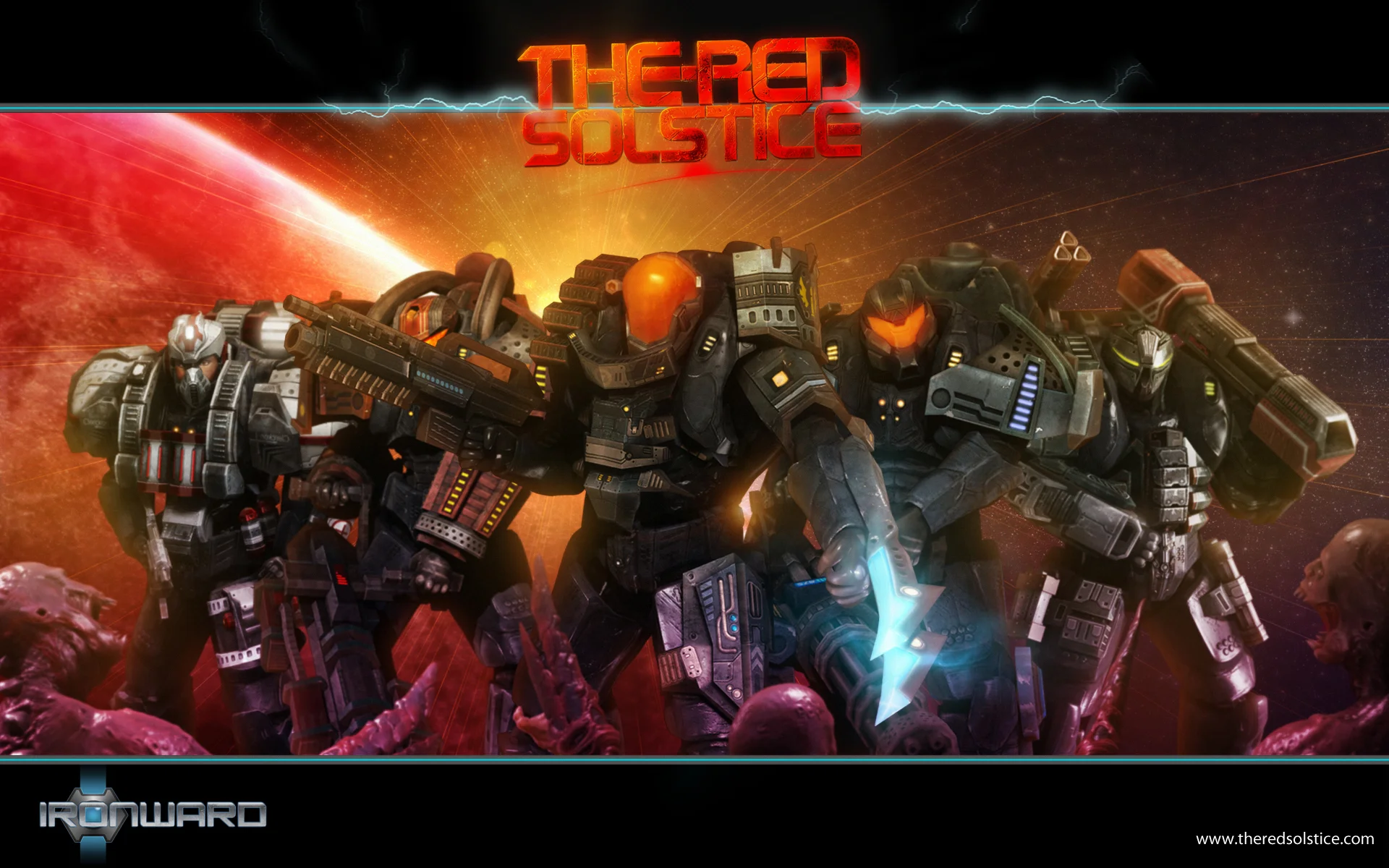
The Red Solstice is a tactical 8 player co-op survival game set in the distant future on Mars. I can see how, in the heat of the moment, with all cylinders firing and everyone trying to figure out a tactical position against the alien hordes, it could be pretty cool. I'm sure there are guilds out there who would do great, shouting orders to one another and locking down a position, mowing down shrieking monsters as they run straight at you. But then there's a part of me that thinks it really missed the boat. A big part of me, actually. And it has to do with independence.
I can see how this might be fun in multiplayer.
I can see how, in the heat of the moment, with all cylinders firing and everyone trying to figure out a tactical position against the alien hordes, it could be pretty cool. Hell, I'm sure there are guilds out there who would do great, shouting orders to one another and locking down a position, mowing down shrieking monsters as they run straight at you.
Then, there's a part of me that thinks it really missed the boat. A big part of me, actually. And it has to do with independence.
The Red Solstice doesn't seem to have very much in the way of independence. The game takes place in dark, monster-filled corridors where you guide four soldiers through an overrun base on Mars. It's a real-time tactical game where you can pick various equipment, stats, and skills, but there isn't much more than that. You and your team wander through cramped corridors on a relatively linear path filled with monsters. Occasionally, you hold a position against an onslaught of creatures, with your marines holding off wave after wave until you can collapse the lair for good. Then you move on, towards the next objective and another hole.
And...that's all there is to it. While the game does have differentiation between classes as you go forward, the entire thing's kind of...samey. Hold position, move, hold position, move, mow down the STROL (their name for the insane mutants), move further, mow down more STROL, complete objectives. I don't feel like there's any real independence or method to stationing my bulky dudes at a choke point and then letting them fire until I need them to move to another choke point. That isn't a game to me. Or particularly fun.
The controls are kind of wonky, too. More than once, I moved my soldiers into position, only to have them then stay there when I needed to move again. The tutorial is incredibly noncommittal on the subject of what to do about things, instead choosing to tell you how to move, and then leaving the rest up to you. Worse still, the controls choose to work at times, and then choose not to work at other times. More than once, I was left in the lurch because the game just decided the explosives hotkeys were no longer necessary.
The game also conflates difficulty with "more monsters," throwing more and more enemies in your way. I'd have liked an enemy variety, and maybe that happens in the part of the game I didn't give up on, but the same two or three enemy types were boring. I'd also have liked different behaviors than "Run at the PCs from all directions."
In fact, most of the aesthetics were pretty boring. Your marines look like chiseled spam in helmets and I honestly wasn't able to tell the various types of enemies apart (nor did I care to), and the exteriors all blurred together. Not that there was much to see, given that it was all kind of "generic space" and the usual low horror lighting, but there was really no distinction.
In the end, I'm sure that, had I powered through the boring, repetitive, bland, passive gameplay, I would have found a game that might have been a rewarding experience. But when the part of the game I can play is supposed to be a backdrop to the part I can't, it isn't worth the price of admission.
Final score: 2/5
Full disclosure: The reviewer received a copy of the game to review.
Galactic Inheritors Review
I don't like having to pontificate on things like this. I get that it's my job, but it's kind of annoying when I can see the game for what it is, see where it could possibly be, and then be forced to lament that it wound up like this.
Galactic Inheritors is a game that seems like its ambitions exceeded its grasp. It might just be the way the game presents itself, or it may be that it seems like a very intelligent 4X game with some definite perks to it. That those perks are weighted down with a variety of bugs, strange design choices, and just in general failure to seem like an interesting game is more of a tragedy than a delight.

I don't like having to pontificate on things like this. I get that it's my job, but it's kind of annoying when I can see the game for what it is, see where it could possibly be, and then be forced to lament that it wound up like this.
Galactic Inheritors is a game that seems like its ambitions exceeded its grasp. It might just be the way the game presents itself, or it may be that it seems like a very intelligent 4X game with some definite perks to it. That those perks are weighted down with a variety of bugs, strange design choices, and just in general failure to seem like an interesting game is more of a tragedy than a delight.
Galactic Inheritors is more or less a standard low-budget empire builder with a space setting. You have a number of different races at your disposal, including Humans, cat people, frog people, and the like. You choose a race, galaxy size, distribution, and difficulty for your game, and then you're unleashed into the galaxy to conquer, plunder, and colonize to your heart's content. The game starts you off on a large galaxy map, and for the first few turns, the issues with the game are far from obvious.
For the most part, there are some interesting and innovative touches. You can't immediately start building warships, as you don't have the tech at the start of the game. Instead, you have to buy the warships from various corporations, and then pay a certain amount of upkeep each turn to keep them running. There's also an entire "media" feature to play around with, where you manage your image both internally and towards other empires. Skilfully manipulating your PR gives you bonuses with diplomacy, causes other empires to leave you alone out of fear, or grants other perks.
I also like the way the advantages and disadvantages are worked into the setting of the game. Each race has a several-paragraph write-up on the character selection screen, and the bonuses and penalties they have are worked into their setting information. Most 4X games I've seen tend to boil these down to the most basic of traits rather than give the complex history, and it's good to see the complex history get its place somewhere other than the flavor text.
But the game commits a rather large sin. It's boring. It doesn't feel like anything's moving at all. To compare, even in the slowest-paced 4X games, ending a turn feels like something is happening for you. Even if it's just research, even if it's waiting around for your ships, there's a sense of pacing. For all Galactic Inheritors does, you might as well be playing in a vacuum. This is immediately cut with sudden bursts of tension as the various other races in the galaxy make themselves known, usually by suddenly colonizing everywhere near you.
Despite this, the game slows down again moments after making contact. You just sit there, watching your opponents explore the universe and colonize stuff. There's nothing particularly satisfying, and eventually I got bored and turned it off. It felt like I was just waiting for things to happen, like I had absolutely no stake in the game. For a game to have no stakes is pretty much a death knell as far as I'm concerned.
I've spent hours building colonies on gigantic sentient planets in Alpha Centauri. I've spent days micromanaging a burgeoning empire in Civilization. Hell, I'm even a decent hand at Master of Orion, as far as that goes. But I guess I'll have to leave someone else to inherit this galaxy.
Final score: 2/5
Full disclosure: The reviewer received a copy of this game via Steam
More Like War Crimes: Chariot Wars for PC
This game has broken me
I've tried every possible angle of attack, from sarcastically framing it as the perfect game for the "offended set" to long pontifications on exactly why this game was made and managed to be released through Steam when it's clearly a quarter of a game. But in the end, I keep coming back to the person whose words have impacted my life far more than anyone's should have, especially his: Roger Ebert.
This game has broken me.
I've tried every possible angle of attack, from sarcastically framing it as the perfect game for the "offended set" to long pontifications on exactly why this game was made and managed to be released through Steam when it's clearly a quarter of a game. But in the end, I keep coming back to the person whose words have impacted my life far more than anyone's should have, especially his: Roger Ebert.
All right! Boring menus, ads, and astronomical load times await!
Ebert always started out his critical viewings by asking himself who the movie was for. If you're a genre film freak but hate the French New Wave, for example, you're going to consider The Dead Matter to be superior to Breathless*. If you're the kind of person who only sees movies if they're limited release, in subtitles, in black and white, and about the disintegration of a marriage, you are not the target audience for The Avengers, and your review is going to carry less weight with the people who might be interested in seeing the movie.
It's the same with games. While games are technically for everyone, intake is kind of specialized from person to person, and quality is kind of relative to what people enjoy. So when someone critiques a game, it's important to figure out who the audience of the game is, to kind of put yourself in their place and critique it so they know it's the best game for them. Or not, as the case may be.
Which brings us (finally) to Chariot Wars. As far as I can tell, this game is for people who hate themselves. I cannot fathom this game being for an actual audience other than the easily hoodwinked and gullible on Steam. The only way I can see this being bought by anyone is if they somehow accidentally clicked on it or got it for free from one of their enemies with no way to fob it off on some other poor bastard.
Ahh, the opening cinematics. State of the art for 1996
The graphics are bland. Not in the sense that they're drab or anything, but in the sense that they have made something interesting incredibly uninteresting. Due to the racing logic being based almost entirely on luck, you will see a lot of samey scenery with really no variation whatsoever. From the back of the pack. It's pretty clear they're using fairly basic backgrounds with a skybox, and I'm glad they found something that worked, but when the sky does not move and the backgrounds are kind of boring and somehow the backgrounds look like walls against the sky, it creates something I wouldn't want to take a relaxed drive around, let alone see in a racing game. Even in games where the vehicle sections mostly suck, at least they try to present interesting scenery to drive around in. This is not the case with Chariot Wars. In fact, it's surprising how limited everything is, since the load times from one screen to another are absolutely astronomical.
Yes, that is me racing against myself. You'd think they wouldn't do that.
The character animations are similarly limited and boring. In fact, it looks like the characters are fresh out of a 3D modeling program and then barely animated-- they stand in the center of their chariots and flap their wrists in a lackluster manner. Combined with the slow movement of the chariots themselves and the bog-standard racing, it's ugly to look at, and not in the interesting way Pathologic is ugly to look at. It's plain, incredibly boring, and I'm actually a little insulted this was called a game.
Sure do love the variety here.
Which brings me to the controls. Again, things are pretty standard. W makes you accelerate, S brakes, and A and D turn you left and right, respectively. As you roll around the track at a movement speed that would infuriate and offend most snails with its slowness, you can occasionally pick up boost coins that allow a small amount of speed. Of course, all of this is immediately lost when you hit another racer, as you don't just bounce off but go careening off into the side of the track and spin around backwards like collision detection forgot physics existed. While the game does warn against this, at the same time, you'd have thought that they'd at least made some attempt to fix this rather than claiming it as a feature.
And then there's the way the game will spontaneously switch into "tablet mode" at even the slightest provocation, switching the window size and making the controls stickier. Since the luck-based racing already makes everything difficult, suddenly switching the controls on the player for seemingly no reason is especially frustrating. Oh, and then there's the luck based racing. While you can accelerate and take corners and do all the things required of you in racing games, none of it really matters, as you will quickly be left in the dust and have to make your way around the track in the hopes that perhaps, just perhaps, you will finally catch up with someone.
In the end, the presence of games like Chariot Wars makes me wonder why people are insisting gaming's moved on as a medium. It makes me seriously doubt the need for artistic criticism as long as crap like this is being put out. This game has made me doubt the entire art form of games criticism. Do not give this any attention. This isn't worth it. Find something better do do with your time.
Score: 0 out of 5
Full disclosure: The reviewer received a free copy of this game for review
*For the record, just about any film is objectively superior to Breathless.
Windward Review
So disclosure time: I loved Sid Meier's Pirates.
I bring this up because Windward is similar in a lot of respects to Pirates. Both are games where you and your crew sail around a large chain of islands and mainlands representing your chosen faction, attacking other ships, trading goods, fighting in wars, and gaining standing and reputation.
So disclosure time: I loved Sid Meier's Pirates.
I bring this up because Windward is similar in a lot of respects to Pirates. Both are games where you and your crew sail around a large chain of islands and mainlands representing your chosen faction, attacking other ships, trading goods, fighting in wars, and gaining standing and reputation.
Where Windward differs, is in that it's a procedurally-generated game, and unlike Pirates, you never leave the ship. You sail from port to port, taking missions and leveling up your ship and equipment as you go. Occasionally, you can also get hot tips about commodities from different ports and various other rumors.
The experience of Windward is actually very meditative in a lot of places. There are a lot of moments where you don't have to go anywhere, just spend your time swanning around the immense map to a soundtrack of soothing flutes and occasionally getting into pirate battles. It actually reminds me a little of what a single-player game of Merchants and Marauders would be like. Which brings me to the multiplayer.
The multiplayer in Windward seems to be what the single player bulks everyone up for. The general structure is the same (go around doing missions, getting in fights with other factions, etc) but the game opens up a lot more when you're pitted against human opponents. It also gets a lot more into the base building/base defense part of the game, where you can build guard towers along the edges of settlements to better protect them. And the decision to strike colors and go pirate.
Yes, in Windward, you can strike your colors and go rogue, hunting down your former faction mates and plundering towns to your heart's content. You have a time limit before you're able to, of course, but it creates interesting new political moves, as you can plunder opposing factions' settlements to destroy their influence and then raise colors and claim them for your own faction. There's an interesting bit of strategy to controlling the regions that I really appreciated for the most part, as it made a game about moving a ship from place to place a lot bigger and more interesting.
Granted, the multiplayer also includes the same jackasses in every multiplayer game, including those who spend their time posturing about how they can "change this whole region pirate", but it's a lot of fun to drift along for a while, constructing guard towers and occasionally butting heads with rival factions.
While it may not be the best game of its type, I fully recommend you give Windward a try. At the very least, it allows for a lot of very deep, but easy to learn, gameplay. At the most, you'll find yourself drawn in to a surprisingly relaxing game of pillaging. While it may not be as deep as others on the market (see also: Pirates), it's well worth looking at.
Final Score: 4/5
Full Disclosure: I received a Steam key to do this review.
0rbitalis Review
0rbitalis is the most obtuse game I've ever played, and I love it.
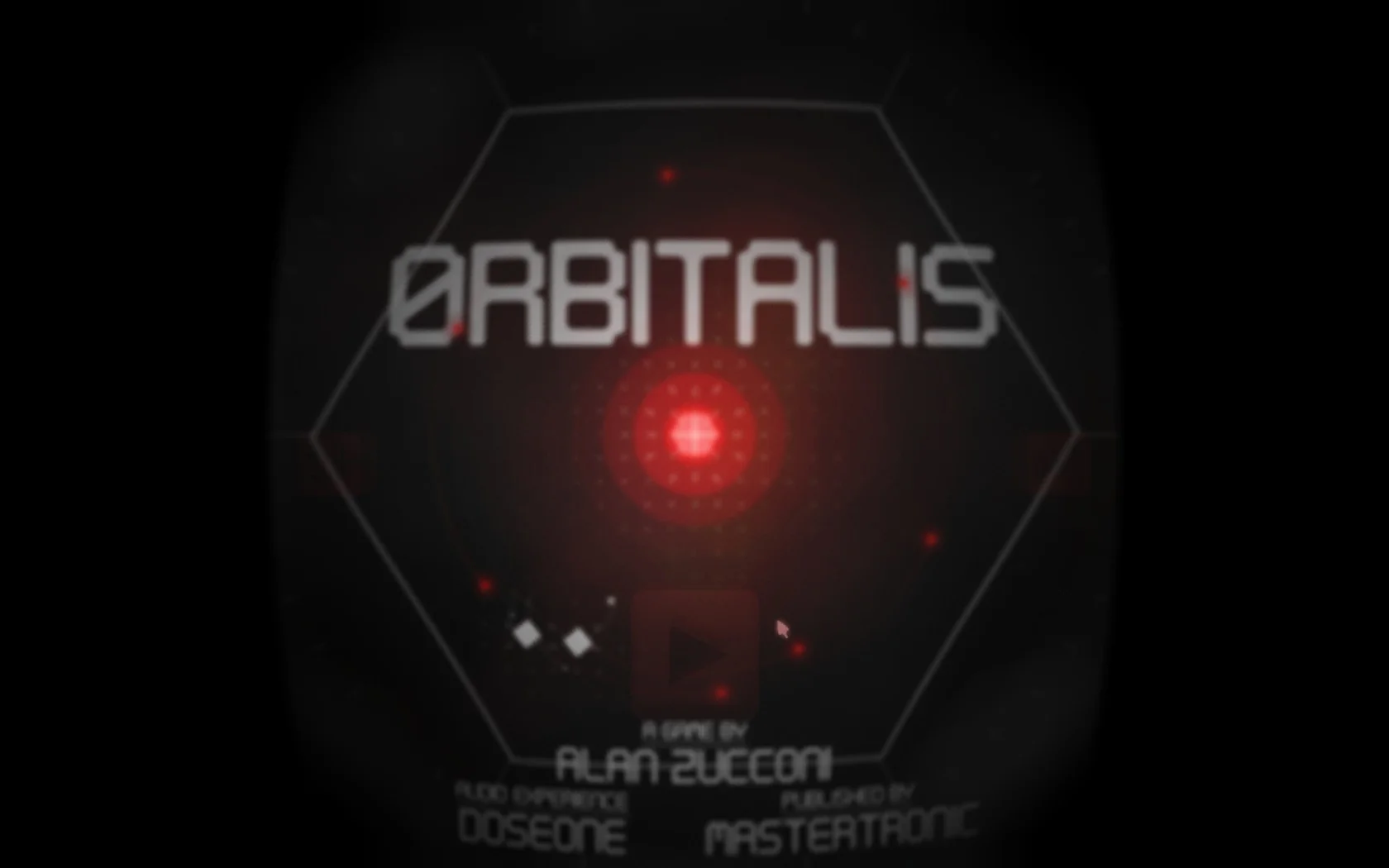
Perhaps I should explain: 0rbitalis is an abstract gravity-puzzle game. The object is to keep your tiny red dot orbiting on screen as long as possible, arcing it around planets and stars (represented by larger and smaller abstract shapes) as it swirls and whirls around the screen. While you only have to do so for a very short set amount of time, there are online leaderboards that encourage players to keep their orbits going for as long as possible, with some frankly unbelievable times in places.

0rbitalis is the most obtuse game I've ever played, and I love it.
Perhaps I should explain: 0rbitalis is an abstract gravity-puzzle game. The object is to keep your tiny red dot orbiting on screen as long as possible, arcing it around planets and stars (represented by larger and smaller abstract shapes) as it swirls and whirls around the screen. While you only have to do so for a very short set amount of time, there are online leaderboards that encourage players to keep their orbits going for as long as possible, with some frankly unbelievable times in places.
But what really makes the game shine is that there are no tutorials, no hand-holding, just you and the simplistic interface you have to manipulate. Everything is learned by intuition. The later levels require you to send your orbit through a geometric shape multiple times, but since it doesn't state that, then you can only figure it out through repeated trial and error. It lets you explore on your own, with just you, the dots, the planets, and the stars.
It's got an interesting sense of accomplishment to it, too. There's just something really satisfying about figuring out the correct arc for your projectile, then following through and watching it curve and loop around the screen. There's something equally relaxing about watching that small red dot arc around until finally it's orbit decays and it drops offscreen or crashes into something on the screen. It's even more satisfying when you cause the dot to loop around for what seems like forever, it's lazy orbit winding down into nothing as you wonder how much longer it can hold out.
A doomed orbit
And then there's the sound design. The sound is mostly ambient tracks, with the most dramatic sounds in the range being the "ignition" sound when you start the orbit (and I love the way the music grows in intensity as your little projectile orbits around) and the sound when you either crash or complete the level. It's especially satisfying when played through headphones, which only enhance the small sounds used in the piece. Also, the sound designer, Doseone, is actually a really good musical artist, so getting to listen to more of his work is awesome.
I think 0rbitalis is a rarity in the modern indie gaming scene-- a game that actually functions as art and an enjoyable game experience. It's interesting to look at, and even if you aren't particularly adept at the mechanics, you can get drawn into it. There's a lot to discover, and that to me is what makes art art. Not that it conveys a message or can be interpreted in some greater way, but that it evokes a personal experience. Everyone is going to come at 0rbitalis from a different angle, and all of them are going to find their own way through the game. Art connects with people on a personal level. It's what makes art what it is.
So give 0rbitalis a shot. It's simple, elegant, and surprisingly deep. And you may find something new and interesting in the world it presents.
Score: 5 out of 5
Thanks to the publisher for providing a code for review.
Crypt of the NecroDancer Review
There are rare times in art when everything works exactly the way it's supposed to. Where everything clicks so perfectly into place that it's almost elegant the way everything is so finely-tuned. And that's what playing Crypt of the NecroDancer from Brace Yourself Games feels like. Elegant. Refined. Like a well-oiled machine. In its unpolished state it was fun and interesting but heavily flawed, but now that it has reached its final polish, it is a beautiful thing to behold.
The story isn't anything much to go by. It begins with a young woman named Cadence following her missing father's notes, where she unearths the crypt of a malevolent lich known as the Necro-dancer. Cadence must journey through the crypt, collecting an arsenal of weapons, armor, and items as she delves into level after level in search of the secrets the crypt holds. It lays out the path for a standard dungeon crawler, but there's a little extra wrinkle that builds in nicely.
When Cadence first encounters the Necro-dancer in the game's opening animation, he pulls her heart from her body and infuses it with magic, forcing her to follow a specific beat. As Cadence journeys, all of her movements and actions must be on an exact beat as well, otherwise she simply won't move.
And that's the premise. A dungeon crawler where absolutely everything has to move to a specific beat. Everything syncs up with this premise. The enemies and even the people in the upgrades screen move to a specific beat. When you find a shop in the dungeons, the shopkeeper actually sings along with the background music. Do well enough, and the ground beneath your character lights up like a disco floor and strobes to the beat. The background music isn't just another part of the ambiance, it's integral to the game. I once made the mistake of loading the game up while listening to music in the background, and I failed utterly, because you need to be listening to the cues. It's not all periodic button presses.
Another wonderful feature of NecroDancer is that, unlike most roguelikes and dungeon crawlers, it doesn't just pit you against increasingly stronger enemies by butting your head against them over and over again. Each zone has a unique set of enemies (hey Weaponographist, you taking notes?) that move in specific ways. While it takes some getting used to, with a bit of planning and some pattern recognition, it's possible (and this is rare outside maybe Binding of Isaac and a few others) for someone to get through the entire dungeon without getting hit once. Incredibly difficult, and takes more luck than skill, but it's possible.
That's something I enjoy that I've been seeing more of in Rogue-likes these days: strategy. There's actually a lot of this in Crypt of the NecroDancer, because the range of movement given allows for a larger playing field. For instance, instead of travelling down a hallway normally and having to take damage from enemies, why not let them get a little closer to you by digging into the side of the hallway, then surprising them? Or, if you know a boss is going to chew you up up close, set a bomb and dance away from them, allowing the bomb to go off in a specific area. Combined with destructible terrain, this causes bosses to sometimes bust through the walls of the dungeon to attack, turning the stage into a desperate race for resources, all to a pounding techno beat.
Additional characters such as Bard (doesn't have to move to the beat, making the game move at ludicrous speed) and Eli (no weapon, upgraded shovel, and infinite bombs) significantly change the game's topography, causing players to find new solutions and tailor things towards their play style. The game can further be changed by trading rare items for unlocks in the dungeons, unlocking upgrades.
Normally, this would be where I put some of the things they didn't like. While I did have issues with the way the dragon bosses moved and attacked, making them incredibly difficult with anything but the small supply of ranged weapons, I can't really think of much I'd change in the game or improve. It's a classic all on its own.
Play this game. It's a game that deserves to stand the test of time. If nothing else because it's executed so flawlessly.
Score: 5/5
Full Disclosure: The reviewer received a steam code to review the game