

Roadwarden Review
Chances are, you already know whether or not you want to play Roadwarden just based on the screenshots alone. It belongs to a very unique family of games with its pixelated sepia visuals and deep text-based gameplay. With games like these, it’s important to meet them on their own terms— yes, they can be frustrating and complex, but the audience they’re aiming for appreciates that complexity, frustration, and density. It’s a game where the mechanics and the story are so intertwined that one requires learning the other, and rewards careful study of both. But that being said, does Roadwarden thrive on its own merits and work as the kind of game it strives to be?
Well, sort of.

Roadwarden
Platform: PC
Developer: Moral Anxiety Studios
Publisher: Assemble Entertainment
Release Date: Sept. 8, 2022
MSRP: Pending Release
Chances are, you already know whether or not you want to play Roadwarden just based on the screenshots alone. It belongs to a very unique family of games with its pixelated sepia visuals and deep text-based gameplay. With games like these, it’s important to meet them on their own terms— yes, they can be frustrating and complex, but the audience they’re aiming for appreciates that complexity, frustration, and density. It’s a game where the mechanics and the story are so intertwined that one requires learning the other, and rewards careful study of both. But that being said, does Roadwarden thrive on its own merits and work as the kind of game it strives to be?
Well, sort of.
Roadwarden casts you as the titular Warden, a kind of free-roaming agent of the Ten Cities sent to the Peninsula to patrol and keep lines of trade open with your homeland. You pick from three classes: a Fighter, a Mage, or a Scholar, something between a diplomat and an alchemist. Over the course of the game’s opening moments, you choose a class, a reason you decided to become a Roadwarden, and a religion. Then, you’re let loose into the map with the barest of direction, sent to interact with and clear up the wilderness as you wish. The more you visit towns and solve the inhabitants’ problems or reconnect the roads, the more people trust you and the more you can uncover secrets and alternate routes around the map. But be warned— you only have forty days to complete your mission and uncover the secrets of the Peninsula before you’re recalled to the Ten Cities for good, and before you know it, that time will be up.

The mechanics of Roadwarden are blissfully simple in practice— It’s all text, so you just click on the onscreen options, follow the prompts, and keep a close watch on your health, armor, hunger, and appearance. While the stats aren’t the meat of the game, they definitely help with things, as you can only perform certain actions as long as you’ve managed your health, hunger, and sometimes even appearance. The joy of playing Roadwarden, however, is the sheer amount of detail within those mechanics. As you click around and explore, the map fills in, giving you a larger picture of the area. Doing certain activities or answering questions changes your general stats, as the game tracks everything from lies you tell to how faithful you are to your specific religions.
It’s a wonderful exercise in minimalism overall. The writing is incredibly strong, with one scene in particular offering up terse, tense inputs for a village where everything is secretive, and the looping, ambient music cutting out or changing to the noises of insects or animals in the distance depending on the scene and how appropriate it is. It’s easy to be lulled by the music, only to be jarred suddenly by its absence or by the sudden sound of animals, and it works excellently with the minimalist interface. It also leaves large portions of the world up to the imagination, with such bizarre details as the prevalence of howler monkeys, gigantic birds, dinosaur riders, and even stranger things up to the reader.

The text also contributes to the density. Roadwarden is not a fast-paced game, nor is it a game that you can beeline through even if you know how to solve certain puzzles. In your quest to explore the Peninsula, you have to exhaust every dialogue option, figure out every relationship, and possibly even make deals with some unsavory characters to advance your own agenda. This also makes the time limit that much more important— you will not be able to do everything or solve every problem, so the ones you can solve count all that much more and it’s important to figure out what impact you’ll have. You’ll find yourself weighing decisions, roleplaying based on your strengths and weaknesses, and trying to figure out how best to use your abilities to fix up the fractured lands of the Peninsula.

But like many games of its type, progress can be frustratingly obtuse at times. The player has to know the right dialogue options to unlock abilities at each settlement, from trade to a place to sleep to other services, and will sometimes find themselves going through the same dialogue tree over and over again trying to find just the right sentence. There’s also a number of “guess the word” puzzles throughout. While some of these can be defeated by looking through your journal, there’s not really an easy way to organize that journal. If there was a way to sort beyond category, that would definitely be more helpful. Also, for a game that kind of showcases its replayability and ability to find multiple solutions to each problem, Roadwarden’s slow pace and dense thickets of words tend to slow it down and make replaying each scenario something of a slog.
The sum total of the experience is that Roadwarden is an excellent work for those seeking an old-school adventure full of textual density and a unique world, but is very much a specific work for a specific audience. While its gorgeous pixel art, sepia tones, and unusual world are willing to give up their delights with patience, it requires significant effort and exertion to get to that point. Worth it for some, certainly, but overall an experience meant for the most devoted.
The Good:
- Dense world
- Interesting spin on a text-adventure format
- Old-school nostalgia and charm
- Unusual fantasy world
- A delight to those who enjoy this kind of old-school experience
The Bad
- Very slow-paced to the point of becoming a slog at certain points
- Not very welcoming to newcomers
- The pace and density make the multiple playthroughs the game encourages somewhat difficult
Final Score:


I Was A Teenage Exocolonist Review
If you like life sims, if you like games you can sink hours into satisfyingly, if you like visual novels or weird stories or branching plots, I Was A Teenage Exocolonist is the game for you. Jump on board the Stratos when it finally launches, a new life awaits you in the offworld colonies.
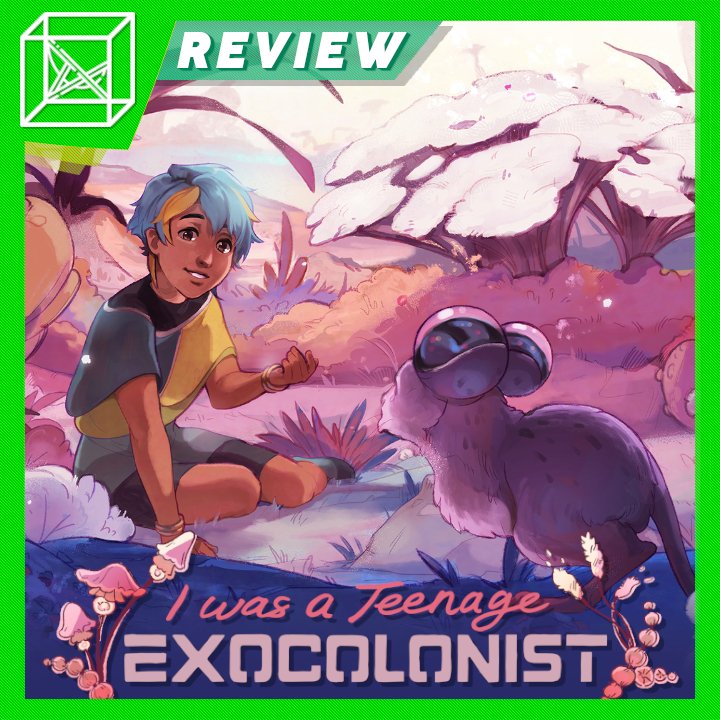
I Was A Teenage Exocolonist
Platform: PC, Playstation, Nintendo Switch
Developer: Northway Games
Publisher: Finji
Dear. God.

Dys, feeling very much like I did when I finished my first playthrough of Exocolonist
So for some background, normally I try to be a bit more formal in my approach to reviews. That ends this second. Upon receiving I Was A Teenage Exocolonist on Saturday, I have lost roughly two days to the game. I have played three of its twenty-seven possible paths, including the one where, well…it’s probably for the best that you discover that one on your own. It’s weird, and takes a couple of playthroughs, but it is beyond worth it. Between its addictive game loop, methods of drawing in real bonds, some bizarre story choices, and some absolutely gorgeous art and music, I Was A Teenage Exocolonist is the kind of game you can get lost in, right up there with both coming of age games like Growing Up and Chinese Parents (and to a lesser extent, Monster Loves You!), weird narrative experiments like The Yawhg and the Monster Prom series, and vast time-sinks with loads to explore like Cultist Simulator. It’s ambitious, it’s audacious, and it’s incredibly heartfelt, and I can only hope it discovers its audience.
You begin on the colony ship Stratospheric, nicknamed “Stratos,” heading to the planet Virtumna to found the first-ever colony on an alien world through a recently discovered wormhole. As you approach, however, you have strange dreams, dreams of possible futures. And one specific dream of a burning house, a colony lit ablaze, and a creature with very sharp teeth closing in for the kill…
You have ten years. Ten years through your tween-age to teenage existence to unravel the mysteries of Virtumna, to discover the truth behind your dreams, and to save both your own life and that of the colony’s. Ten years to train, explore, build your friendships and relationships. Ten years to live on an alien world. Here’s hoping you can make them count.

I Was A Teenage Exocolonist plays out in a semi-open world. During each month of the cycle, you’re allowed to do one activity: explore the colony and the surrounding areas, talk to people, build friendships (helpfully noted by a heart system on one of the character menus), and do various activities to raise your stats. During activities, the game switches to a deckbuilding format, where you draw a hand of cards and have to put them into the highest possible build for points, either by creating runs of colors, numbers, or sometimes both. You gain new cards from participating in story events and interacting more with the other members of the colony, building your relationships and stats as you go. New stats open up new interactions and story activities as well as new abilities, everything from drawing extra cards, to stat boosts during the card battle sections, to even being able to ignore certain world-map events to save time. It also makes everything feel of a piece, from your desperate attempts to build enough perception and forage for enough food so the colony doesn’t starve, to your combat training going up so that you can save more colonists during the tense “Glow” season at the end of each year when the wildlife attacks en masse.

All of this is presented in a visual-novel style with a variety of gorgeous artwork and music. Glow looks suitably ominous, but there’s a strange beauty to the colony-wide fungus. Pollen season is awash in pink, there’s a lush but downbeat look to Wet season, and Dust season has a shimmer effect that works perfectly with the descriptions of punishing heat. But more than that, important story moments are illustrated in a soft watercolor style that still manages to keep the tone while looking incredibly pretty. It’s relaxing, a game where you’re meant to take your time and explore even as the clock keeps ticking ever upward over those 120 turns you have to do things.

It’s also really transparent with what everything does. Areas are color-coded based on what they do, mousing over a choice tells you what stats you need and who you need to be more involved with, and map markers show you the way to world events. When you know what you want to do on a playthrough, it’s very easy to beeline. But beyond just beelining towards certain things, the game has a gentle enough difficulty curve and is easy enough to understand with its interlocking systems that you don’t necessarily have to beeline. You’re free to explore on every playthrough, figuring out what build and events work for you, and ensuring that you can save as many people as possible.
And save them you will want to. This is a game where, if you’re not prepared for it, any number of people can die horribly, everything from your childhood best friend getting blown up to a creature eating you alive. It’s deeply effective emotionally, letting you know that these people have their fates in your hands, but also that bad things can happen, that the colony you become so familiar with and pour so much love and work into might get trashed, might get fed to fascist bounty hunters from Earth, or might just end up destroyed. But it also creates a sense of accomplishment when you do manage to save someone, when you manage to get things just right, and when the colony manages to coexist, both with their wildlife and their invaders. It’s a game that fine-tunes its emotional highs and lows, so that everything is unexpected but not inevitable. It also helps as you can remember things from previous lives and use them to correct things in the present.

It’s also just straight addictive. The ease of each month and of building your relationships, the satisfying way the numbers go up, the simple-to-learn, difficult-to-master card system (which IMO doesn’t need a hard setting, as it’s just difficult enough), and the way whole months can pass, as well as knowing there’s a specific end, combine to a game you can lose days to, setting up your colonist’s actions, managing your relationships, even exploring day after day until you find something interesting, all of it feels like a choice that matters, and all of it feels rather satisfying.

That isn’t to say the game isn’t without its flaws. After the first time, it can get a little frustrating to nudge at the various tasks, trying to save that one person and help a childhood friend, or figuring out how to keep family and friends from their fates. It could also use some quality of life upgrades, like a map during expeditions so you actually know where you’re going, some sort of quest log for the times when you have to grab specific items or do specific things at certain times, an idea of what perks do what after the first time, and perhaps a little less of a heavy load on the old GPU, as when the snow and pollen starts swirling, my graphics card temp suddenly jumped to 56C and everything slowed down immensely.
But those are nitpicks. If you like life sims, if you like games you can sink hours into satisfyingly, if you like visual novels or weird stories or branching plots, this is the game for you. Jump on board the Stratos when it finally launches, a new life awaits you in the offworld colonies.
The Good
- Addictive core gameplay loop
- Story it’s easy to get invested in
- Gorgeous artwork
- Tons of replay value
- Very easy to figure out the systems, difficult to master
The Bad
- Minor performance issues
- Can be difficult to figure out which things to do in what order to change events
- Could benefit from a map during exploration segments
Final Score:


Sweet Transit - An Early Access Review
Sweet Transit, a new rail simulator/citybuilder currently in early access, is a deceptively frustrating game. From the start, it presents itself as something of a pleasant, relaxing, folksy builder game, with a bluesy americana soundtrack by Ely Robbins, a Western-style aesthetic with its laborers and “beginning of the rail era” atmosphere, and soon you’re set loose on a gorgeous map to build your first centers of industry, and, from there, slowly conquer the New World by connecting it up with trains. However, somewhere around building your first train you find yourself somewhat in error, and this was the point that I began to have flashbacks to when I used to try programming in Python.

Platform: PC
Developer: Ernestas Norvaišas
Publisher: Team17
Release Date: Early Access as of July 28, 2022
Sweet Transit, a new rail simulator/citybuilder currently in early access, is a deceptively frustrating game.
From the start, it presents itself as something of a pleasant, relaxing, folksy builder game. There’s a bluesy americana soundtrack by Ely Robbins, a Western-style aesthetic with its laborers and “beginning of the rail era” atmosphere, and the idea of building trains to connect cities and unlock further buildings and advancements is kind of a cool one. You’re set loose on a gorgeous map to build your first centers of industry, and from there, to slowly conquer the New World by connecting it up with trains.
It’s at the point somewhere around building your first train that you find yourself somewhat in error, and this was the point that I began to have flashbacks to when I used to try programming in Python. Sweet Transit is, you see, a systems-based game, in the sense that you have to work out logistics, gates, and kind of puzzle out where the bugs are in your transit system. Some of this is covered by the tutorials. Some of it remains obtuse, always just tantalizingly out of reach. It’s a game with a rather steep learning curve, and one that remains sweetly deceptive even as you bash your head against yet another logistics problem for the fourth time. It’s satisfying, brain-melting, and somehow intriguing in one bizarre package.
Sweet Transit begins with you procedurally generating a map. From there, you place your first warehouse, first village center, and your first industries before finally connecting it all up with railways. As you fulfill more objectives, you slowly open up more options— successfully building a coal plant means you get access to your first train, because you now have a source of fuel, bringing enough people to your village means you open up a market— and connecting the world through a network of rails and signal gates. As nothing moves without a rail network, it places the emphasis on building trains, routes, learning how to set up if/then statements to get your trains to move along those routes, and building signals to control the flow of rail traffic.
So right off the bat, the game is gorgeous. The areas are lush, the colors are vibrant, and even the deserts look like they’re alive. The trains are usually brightly colored in a way that makes the player feel nostalgic for old-style locomotive engines. Between the graphical style and instrumentals, it evokes feelings of the older Sid Meier series Railroad Tycoon, which ran on a similar premise of connecting supply centers with trains in a huge logistical network. With the bluesy Americana of the soundtrack, it makes everything feel of a piece. It’s an excellent presentation.
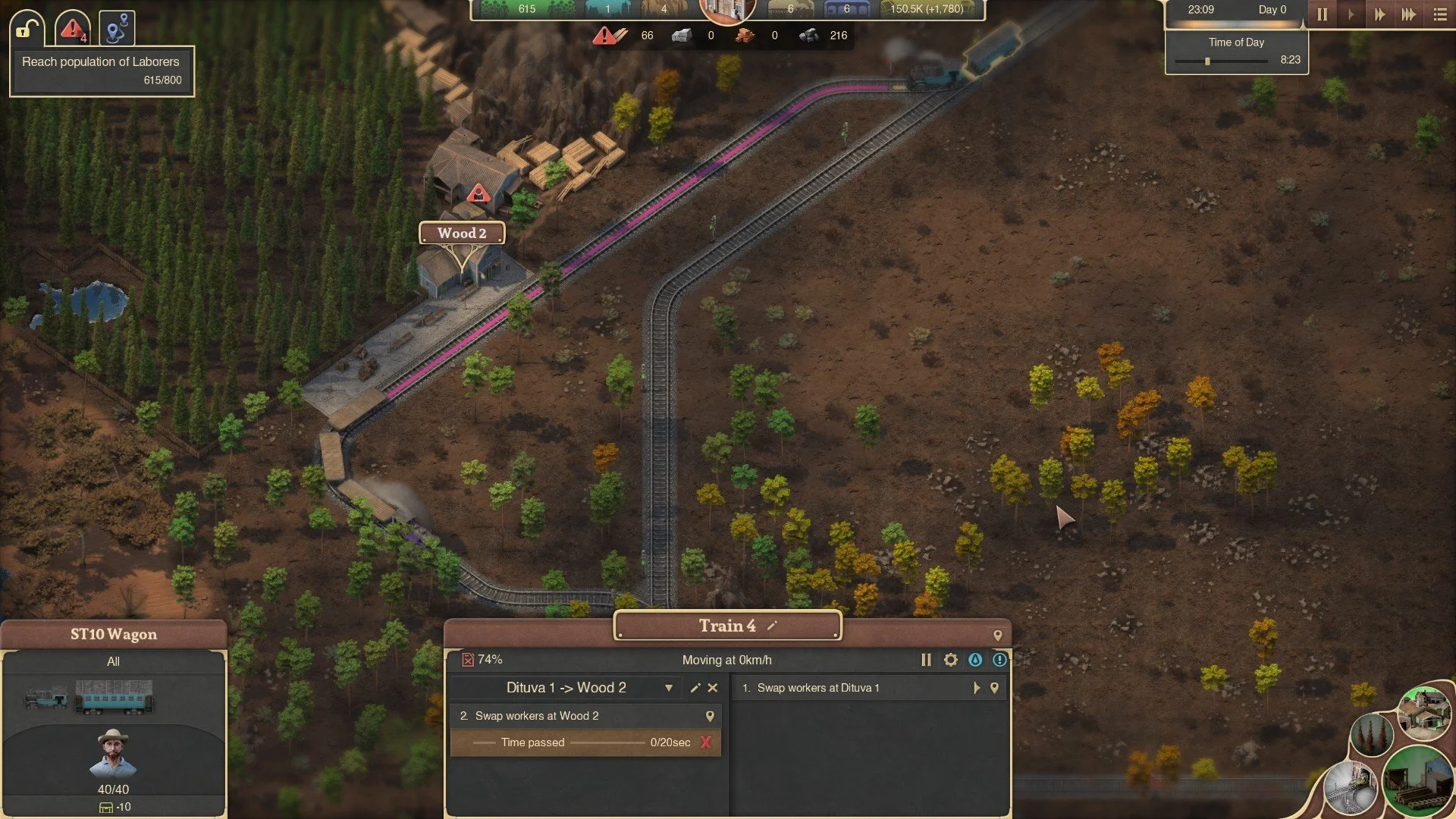
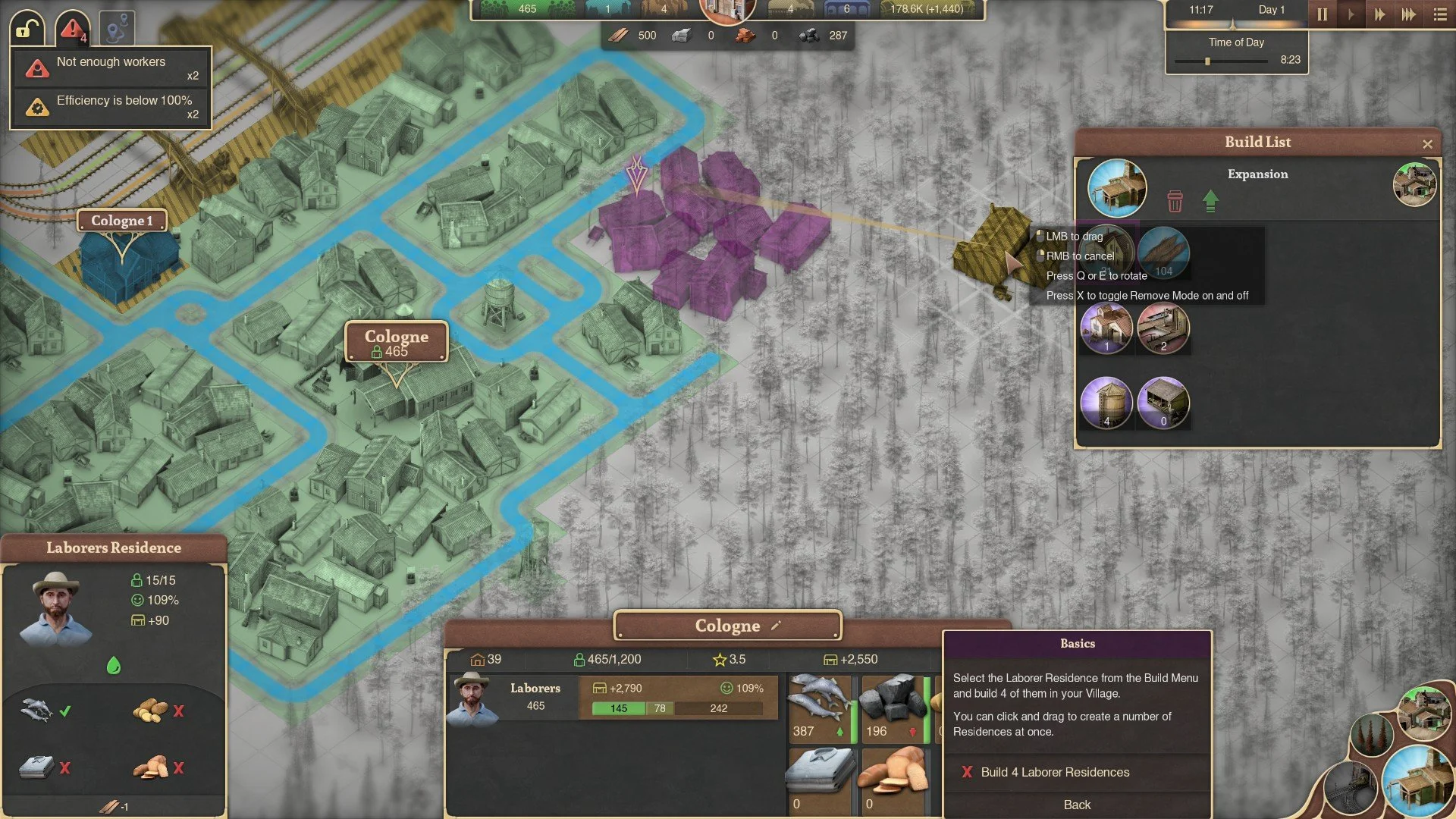
It’s also satisfying to watch things work, to slowly build up your villages and watch them bustle around as you slowly build the town, then the first industry (usually a fishing dock) and then move on to mines and your first train line. Buildings are grouped by use, you can simply click on any part of the environment, and it’ll bring up a menu about the thing you clicked, with the list of building options and extensions right there. It’s very easy in those first few moments to get a jump-start on building. Then you fall off the difficulty cliff, and the game decides to show you what it’s really like.
Building railroads is…complex. It’s also very easy to get stuck with something that doesn’t work, requiring you to plot things out in advance. While the game does come with an extensive tutorial that shows you how to build and chain together signal blocks, set up the basic if/then statements for your train routes, and connect your first villages, it is also very obtuse. This is not a game for those who are just getting into strategy of this type, it’s essentially a ‘90s sim builder game given modern graphics and a mildly easier to understand interface. Even with the tutorials, it’s got a steeper learning curve, requiring you to really know what you’re doing before you lay those first tracks. But the good news is, after the first few tries, suddenly it starts to hum along, and you’re juggling routes, finding more efficient ways to lay rail, and it all starts to come together.
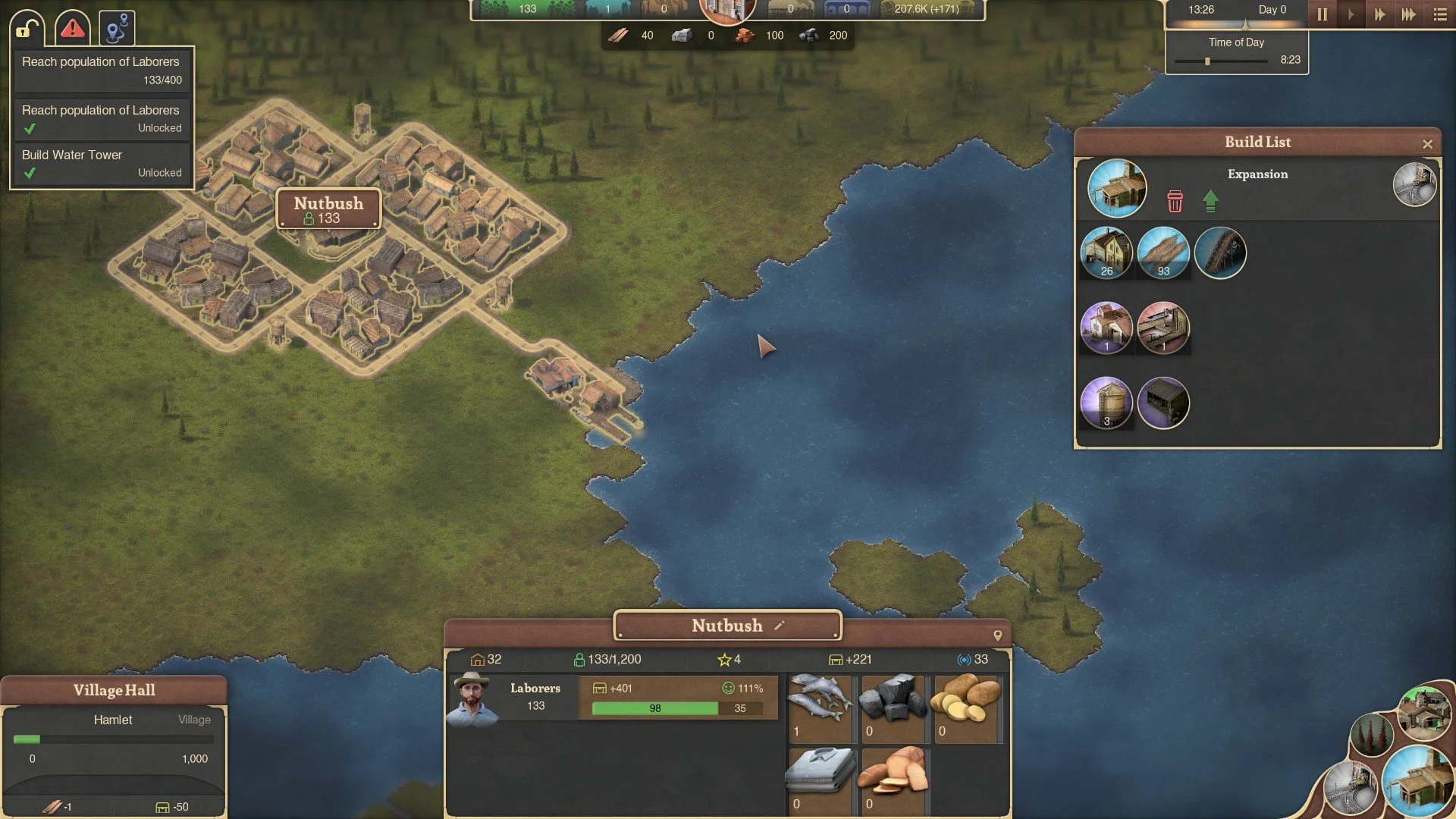
But to get to that point, there’s a lot of trial and error. While the tutorials do give some guidance, and there are help messages, they seem a little obtuse at times. It took me three tries to get my first functioning railroad, with at least one complete restart. When I finally did get things running, it took me a while to experiment with signals until the trains I had would actually move on the tracks, and in one case, a train I sent to load up supplies would just…pass the station completely rather than loading, for reasons still unclear even with the (somewhat overzealous) message system pointing out any errors in logistics. This is after going through the tutorials. Similarly, a bug in the logistics can stall everything, frustrating the player and requiring them to check exactly what happened.
Furthermore, if you botch a building placement, there’s no real way to move it or correct that mistake once it’s down without deleting everything attached to it and moving it to the correct place. This can get annoying, especially with train routes, since then the trains now have specific instructions they cannot carry out and things will have to be re-added to the route. Further frustrating the placement issues are some bizarre pathing errors when laying train tracks, where trying to construct a simple curve will result in esoteric, looping patterns unless you use the “precise movement” option to build tracks incrementally. It’s kind of an unforgiving system, even as it does so many things right.
All of this could actually be fixed with a more integrated tutorial. The tutorial section is very well done and informative, though as it’s not actually connected to starting up a game, it becomes an exercise where one can get very good at learning the tutorials, but a little fuzzier on applying that knowledge. If there was some way to take you through the early steps of the game, it would do a lot for newer players, allowing them to get a grip on systems in a more practical and applied way. It’s a game with some great ideas and some interesting systems that actually has a kind of coding aspect to it, setting up if/then statements and building with more complexity from there.
But for right now, if you’re a hardcore simulation fan, then this will be a definite delight, a pleasing and cozy-looking game with a lot of interlocking systems that require prior planning and full knowledge of how things work to get everything moving just right. It’s the perfect game for those who know what they’re doing.
It could, however, use a little more polish if you’re still new to the genre.

The Good:
- Easy and intuitive interface
- Lush, pleasant visual style
- Deep and complex logistical mechanics
- Excellent map variety
- A relaxing game with just enough challenge for hardcore building sim fans
The Bad:
- Huge difficulty curve for newcomers
- Frustrating pathing for a game entirely about building transit paths
- Making a wrong move can sometimes erase tons of work.
- Tutorials separate from the main game cause difficulty applying the knowledge to in-game scenarios
In its current early access state, it’s a delight for hardcore sim fans and a nightmare to those just getting into things.

Thy Creature Review
From the start, Thy Creature has a lot going for it. A gothic atmosphere, lovely music, a plot full of mysteries, and a rather unique art style and control scheme. It feels like a scaled-up RPG Maker game - one of those ones with a lot of places to explore, people to meet, and a story to gradually uncover as you do. It has all the makings of an interesting game with a lot of heart behind it, but frustratingly so.

Platform: PC
Developer: MazM
Publisher: Growing Seeds Corporation
Release Date: Early Access as of February 19, 2022
I want to talk about the difference between “obtuse” and “cryptic.”
It’s a difference few people consider in their storytelling. Most people think one is basically the pretentious version of the other, but that’s where they’re wrong, and not just because “pretentious” is the silliest possible insult for someone attempting something ambitious. No, “cryptic” is a mystery that definitely has something to it. Questions get answered, things are weird, but you know where you stand, more or less. It can be frustrating, but it can also be thrilling and odd and compelling. Carnivale is cryptic. Dark Souls is cryptic. Hell, Myst is cryptic. Every puzzle has a solution, questions have answers, and you only learn enough for a sense of accomplishment and to drive you forward into further knowledge. Cryptic is interesting. Cryptic goes somewhere.
Thy Creature is obtuse.

Obtuse can be a good thing sometimes, when you want to invoke the surreal or have things be weird or add difficulty. Sometimes “opaque” can be even better, just look at most adventure games from the 1990s— a dreamlike feeling, you have no idea what’s going on, but clearly you’re along for the ride. But other times, obtuse is just exhausting, like with Thy Creature. Questions are answered, but it never feels like those answers are satisfying. Progress is made, but it still feels like you’re standing still. It’s clear the game wants you to think something is going on, but it never feels like you make any progression in figuring out what that is. Which is a shame, because there’s the potential to be a really good adventure game here, if it didn’t fall into all the worst pitfalls.
Thy Creature stars The Creature, a patchwork abomination of body parts who is run out of a village and severely wounded by humans. The creature takes refuge in an unusual and ancient tower, one that haunts his memories. Once inside, he finds himself attacked by monsters and accosted by the tower’s trapped inhabitants, who have their own difficulties with memories, all of them looking for the tower’s owner, Victor Frankenstein. To climb the tower and unlock his own memories and experiences, the Creature will have to fight the mysterious monsters known as Nepes, rescue the memories of the tower’s other inhabitants, and eventually reach the top, all while confronting a variety of mysteries and puzzles along his path.

From the start, Thy Creature has a lot going for it. A gothic atmosphere, lovely music, a plot full of mysteries, and a rather unique art style and control scheme. It feels like a scaled-up RPG Maker game, one of those ones with a lot of places to explore, people to meet, and a story to gradually uncover as you do. The journal promises secrets to uncover about your new friends in the tower and a variety of interesting collectibles to track down, and it has all the makings of an interesting game with a lot of heart behind it.
The game even starts incredibly well, with a fully animated music video welcoming you to the world and showing the Creature’s journey to the mysterious tower, having burned his former home and trudged across the desolate landscape until he finally reaches his destination, the song full of emotion, the strings lush. The tower’s music is creepily atmospheric, and the opening hallways full of defaced and demonic paintings leading into “the fiesta,” a creepy birthday party with a noticeable shift in color scheme, is really effective. Noah’s suitably mysterious, and his guarded behavior combined with you finding his memories makes for an awesome introduction to what should be a compelling mystery adventure game.

Which it would be, if it weren’t so frustrating. Quickly, the core gameplay loop is established: Get insulted by Noah, seemingly your only companion in the place, do some switch puzzles to open up some areas, fight some monsters, grab more memories, then open the exit to the sub-area at which point you get insulted by Noah again, he tells you how to get to the next sub-area, rinse, repeat. This wouldn’t be so bad— each area has its own unique form of “nepe,” the monsters that siphon and hoard memories, putting them in little crystals— but when you realize that for the third time you’ll have to backtrack in and out of rooms, only for your reward to be minimal progress, it gets exhausting.
It also doesn’t help that while each area has its own unique look, the rooms within that area tend to get repetitive and patience with the puzzles tends to run a little thin. Especially when the puzzles get more complicated, meaning you have to move backwards and forwards, opening up pathways, grumbling as I have to essentially perform the same task over and over again, but more difficult this time. It feels padded, like they needed to make up the length of the game by artificially extending things, putting more obstacles and barriers between you and the story.
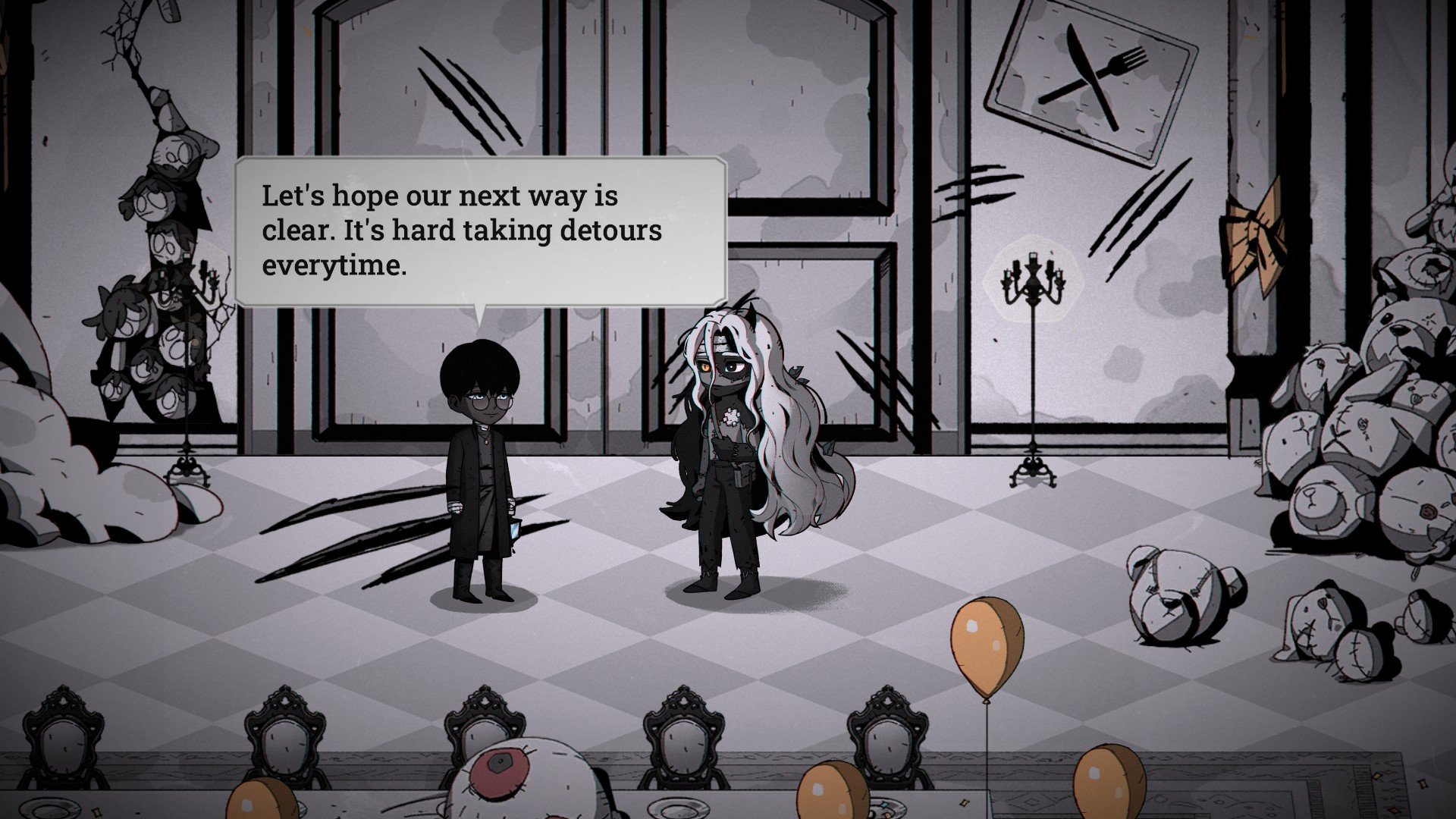
Which brings us to the battles. Battles in Thy Creature take the form of bullet hell maze sequences. You run around the maze path, dodging bullet patterns until a group of dark crystals appears, then pick up the crystals to damage the creatures. It’s novel, and there’s a sense of urgency at times, with bullets flying from every direction but limited movement keeping things tense. Combined with some interesting creature designs, this makes a lot of the earlier battles in a chapter seem really interesting.
But this, too, falls short. Bullet hell derives its name from the way it fills the screen with projectiles, forcing players to find their way through a seemingly impenetrable wall of light and color. It lives and dies on figuring out how to thread the needle with your hitboxes, to move through the onslaught and come out the other side. Thy Creature by comparison has an awkward hitbox, the limited movement also means you can get easily boxed in and slammed by that awkward hitbox placement, and while there’s some clever darting from cover to cover represented by environmental puzzles in the later battles, it gets frustrating when something representing a stuffed doll but evil shrieks and charges you at warp speed, rapid-firing clusters of bullets over and over again. The repetitive enemy design also doesn’t help, with there being maybe one enemy type for a whole area until the boss.

What’s most frustrating, though, is that it doesn’t always do this. When the boss battles come out, when the story actually progresses, when characters have tender moments together or the Creature tries to learn more about being human— when it’s the parts of the game you can tell the developers worked really hard on, it shines. The clouds part and suddenly you’re playing a game you’re invested in again. There’s a really cool boss battle against a monstrous mutated stuffed bunny that feels tense and epic, but then you remember it’s in Thy Creature or get hit weird because you forgot which switch dissolved which piece of cover, or because your hitbox didn’t cover things this time, and suddenly you’re brought shrieking down to Earth.
The game is still in Early Access, so it’s entirely possible that it’s just lacking in a little polish. Maybe if the pacing were a little faster, if the hitboxes on The Creature were a little clearer, if the regular enemy music wasn’t the same grinding drone, if there wasn’t as much wandering around trying to figure out the solution to a switch puzzle, this could be a stone cold classic. It’s frustrating, because I can see the game they wanted to make. I want to play that game. Hell, I still want to figure out more of what’s going on in this game and see if the story takes a turn. It felt like it was going to.
But it’s not cryptic. it’s not intriguing. It’s a game with a ton of frustratingly good elements that then repeats them over and over until you get tired of them.
And that’s just exhausting

The good:
- Interesting atmosphere
- Unique art style blending anime-esque visuals with gothic horror
- Unusual plot centered around unlocking memories and secrets in a mansion
- Gorgeous soundtrack
- Some interesting depth in discovering journal entries, collectibles, and memories
The bad:
- Frustrating, repetitive puzzles and combat
- Depth gives way to shallowness as the game moves along
- Glacial pacing makes all the rough patches that more obvious

Giants Uprising Review
I wish this game was better.
There’s a power fantasy everyone’s had at some point in their lives of just destroying things. Stomping over buildings, squishing people you don’t like, roaring at the top of your lungs, and just straight-up destroying whole cities. It’s an excellent fantasy, a perfect way to release tension and get your feelings out on some tiny pixelated villagers. That’s what this game promises— a large, cathartic brawl through a medieval fantasy world as a huge, lumbering giant. You stomping your way through a cast of horrid villains and destroying siege machinery. While the promise of such a game is in there, Giants Uprising fails to deliver on a meaningful level. Not just with its laundry list of bugs, but with some fundamental issues that might not be solved. And that is possibly the most disappointing part.

Giants Uprising
Platform: PC
Publisher/Developer: VARSAV Game Studios SA
MSRP: 19.99
Release Date: Released to Early Access
Giants Uprising is a game in early access, and this review in no way reflects what will hopefully be the finished product.

The Giants, accepting a deal similar to the one I did by playing this game
I wish this game was better.
There’s a power fantasy everyone’s had at some point in their lives of just destroying things. Stomping over buildings, squishing people you don’t like, roaring at the top of your lungs, and just straight-up destroying whole cities. It’s an excellent fantasy, a perfect way to release tension and get your feelings out on some tiny pixelated villagers. That’s what this game promises— a large, cathartic brawl through a medieval fantasy world as a huge, lumbering giant. You stomping your way through a cast of horrid villains and destroying siege machinery. While the promise of such a game is in there, Giants Uprising fails to deliver on a meaningful level. Not just with its laundry list of bugs, but with some fundamental issues that might not be solved. And that is possibly the most disappointing part.

Giants Uprising casts you as, well, a giant. Years in the past, giants and humans managed to coexist with each other, but the humans soon betrayed the giants, enslaving and tormenting them and taking their power and lands for themselves. At the start of Giants Uprising, you play one of these giants, enslaved and forced to fight to the death in gladiatorial combat. You and your human friend Kielbasa manage to fight your way free from the fight pits, starting a rampage all over the countryside. Your job is simple: rampage across the countryside, slam through buildings, wreck the enemy structures, and smash their armies to death. All very simple, all very violent, and all very fun, supposedly. As you rampage, you can also eat local wildlife and destroy buildings to regain health, pick up debris and throw it at others, and generally wreck most of the countryside.
Sounds fun, right? Well, it should be, for all intents and purposes. When you throw something and it connects, it’s beautiful how the scenery explodes and falls apart. You can stomp your way through whole armies as you cut a swath of destruction through the countryside. When it works, it’s really cool, and you can get some excellent effects out of it.
When it works.
Unfortunately, a lot of the game is sluggish and floaty. You spend your time trudging from place to place, even when you’re sprinting. Your stomp feels like you’re slamming your leg down through custard. That seems like a weird way to describe it, but it honestly looks and feels more like you’re swimming than anything else. Things feel disconnected, like you throw a punch and then the onscreen character decides whether or not they’re going to do it accurately. It’s honestly a frustrating way to deal with combat, which, when combined with the floaty controls and what seems like RNG-based hits, just makes everything a slog. Being a giant should feel like you’re a force for destruction, not a weird, floaty mess that can’t control its limbs all that well.
If this were an isolated problem, fine, but this combines with systems that just don’t really work all that well. You’re supposed to stomp on people and buildings to regain health, but in the heat of combat, the health gains you get are negligible. Picking up debris to throw it at your enemies sounds cool in theory, but in practice requires just too many movements and too much concentration to actually get right. You can quickly get shot down or overwhelmed by the constant swarm of enemies and projectiles while fighting the controls to get any kind of offense. Sure, a giant is big and slow, but a giant is also dangerous, and nothing about Giants Uprising feels particularly dangerous.

You might not have all day, but you’ll see this day a lot
Well, except for the checkpointing. In my time with Giants Uprising, I found myself having to play the tutorial over and over and over again. This wasn’t through any fault of my own skill (or lack thereof), but because the game’s malicious habit of crashing to desktop, combined with the godawful checkpointing that would sometimes put me back half a whole stage or force me to redo sections of the tutorial, just made it difficult to make any progress. When added atop the regular problems the game has, it just becomes too much. A slog on top of a slog.
Which also goes hand-in-hand with the game’s sense of scale. Nothing actually feels all that big, to be honest. You can stomp on buildings, but they come up pretty high on the character. You can stomp on and even pick up humans, but they just seem like, well, somewhat shorter versions of you. What should be an epic struggle feels like a punchup just outside a small town. A huge arena battle just feels claustrophobic. Sure, your sidekick during story mode is perched on your shoulder, but if the world just feels small, all the things meant to feel big and awesome just feel like set dressing.
All of this wouldn’t be so annoying if the game weren’t actually trying to produce something cool. The look of the game is fantastic, with its rough-hewn aesthetic, unique art style, and an interesting backstory that manages to completely subvert itself to Hell and back. When it actually tries to do something, the game could be said to be an accomplishment— the aesthetic is fantastic, the idea of finding creative ways to use the environment and your huge size against armies of foes, and the story that strikes the right balance between snarky and serious are all excellent and beyond reproach— but when actually playing the game is such an exercise in slow-paced frustration, you begin to wonder why you even bothered.

Fear this bridge

As they continue to patch the game, Giants Uprising has seen some improvements. Hopefully, by the time it comes completely out of Early Access, it’ll be more playable. But with the current state of things backing up a game that just…doesn’t really leap off the screen, this one’s far from a recommendation.
The Good:
- Interesting setting and rough-hewn “stonepunk” aesthetics
- Tone that strikes a balance between snarky and serious
- A lot of good ideas in combat decisions
The Bad:
- Frequent crashes to desktop
- Awful checkpointing means you play the same section over and over and over and over
- Sluggish controls
- No real sense of hit detection

Gamedec Review
In short? This could be a really good game, a solid entry in the genre pioneered by Disco Elysium that’s just starting to take off (see also Murder Mystery Machine and to a more failed extent, The Sunken City) but dear god is Gamedec in a rough state.

Publisher: Anshar Publishing
Developer: Anshar Studios
Platform: PC, Nintendo Switch
Release Date: Sept. 16, 2021
Price: $29.99 USD
Gamedec is frustrating. It’s always difficult to write a review like this, a game I clearly had some fun with, a game I really want to like, but that I also have to criticize. It’s a cyberpunk noir RPG-adventure game with actual investigation and deduction mechanics. The world is so deep you could spend hours lost in the various codexes and character bios alone. The graphics are a little basic in places, but the world has a genuine aesthetic that it’s a lot of fun to look at and wander through. But every time I find myself charmed by its world, I get stuck in the level and forced to load a save. A decision tree might say one thing but possibly mean another.
In short? This could be a really good game, a solid entry in the genre pioneered by Disco Elysium that’s just starting to take off (see also Murder Mystery Machine and to a more failed extent, The Sunken City) but dear God is it in a rough state.

Sometimes, a car is an effective solution
Gamedec drops you into the trenchcoat of the titular gamedec, a kind of private investigator who handles cases in virtual reality MMOs. As you hunt down cheaters, scammers, cultists, and the odd child labor ring, you make enough to get by and hopefully try to make a little light in the dark world of futuristic Warsaw. But as you investigate, slowly another, more sinister thread emerges— one involving a mysterious tree, twin cultists, and possibly even your own memories and thoughts themselves. It will take all your cunning and instinct to get out of this one, especially in a world where everyone’s wearing a false identity.
So first, the good. Gamedec’s investigation system is unrivaled and I wish more games would do something like it. As you solve sidequests and gather clues, you slowly fill up a group of deductions. At any time, you can use the clues you have to make a conclusion and move on to the next phase of the case, as long as you’ve collected enough evidence for it. This can be a godsend if you’ve gotten tired of a certain scene or movement in the game. It also allows something most games don’t, which is the ability to draw the wrong conclusion and possibly send the case in a different direction.

This ties directly into the branching narrative. Choices you make don’t just last within your current investigation, but can have far-reaching consequences down the line, depending on how you interact with others and what clues you can figure out. Each case has a variety of outcomes, and depending on your skills, background, approach to each situation, and how you interpret the clues, you can get a wildly branching story with a number of start and endpoints based on that. In theory, it’s liberating— a huge (if linear) world where all your choices matter and each playthrough can be completely different based on how you work the case.
Aiding in this, there are a number of “professions” related to skills you can pick up, everything from electronic intrusion to programming to even cheating in games. Each one’s related to different methods of responding, so you can level up your skills based on how you play, as you’ll be earning points from that. It’s incredibly adaptive, and while the skill tree might not be as vast as some adventure/RPGs, it’s a lot more expressive in places, with clear, concise descriptions telling you what everything is supposed to do.

The most essential starting skill. Never leave home without it
But here would be where things start to fall apart a little. While it’s clear how things might help, the actual in-game benefits range from “marginally useful” to “can solve entire stages of the case in one section and then do very little the rest of the game.” It’s not clear how helpful a profession can be until you use it, at which point you might be rather deep into a case. Similarly, while the skill points you earn are based on the personality of your gamedec, apart from a few adjectives and a group of bars on the side, it’s unclear exactly how the points you need to earn relate to each approach. Overall, this just makes it feel obtuse and confusing more than anything.
Adding to that obtuse feeling, sometimes puzzling through the plot feels like stumbling blindly. While it’s to be expected that you won’t see or do everything during one playthrough (and Gamedec makes this very clear as you play), the lack of direction, existence of wrong choices, and the idea that some things can be permanently locked off just make it feel obstructive rather than open-ended. Sure, it’s refreshing to have a game that allows you to miss content and doesn’t hand-hold at all, but Gamedec’s lack of signposting feels downright malicious at times. Especially when compared to the game’s own demo, which walked you through an early case without completely solving everything for you. It’s especially annoying when combined with the difficulty, where sometimes making the wrong deduction and getting the wrong people angry with you can feel like the game hits a dead end.
Gamedec could also benefit from a better quest log. While I understand the need for the player to puzzle through everything on their own, the lack of a detailed log apart from the information on the right-hand side of the screen makes it difficult to know what direction you need to travel in at all. Even the slightest bit of info could help, as it’s difficult to tell what “investigate the anomaly” means apart from wandering around and looking at the street, hoping the right hotspot suddenly reveals itself.

Getting stuck in VR Farmville is a special kind of Hell
Which brings us to the bugs. Even with the fixes and patching done to the initial prerelease build, the game’s in rough shape. While I can’t speak to every player’s experience, I personally ended up getting stuck in place in some areas, clicking frantically in an effort to move around the screen. There were also moments where NPCs reacted to dialogue from later in the scene, or simply closed conversations quickly using dialogue from earlier parts. One scene stopped completely dead, making it impossible to continue. In a rather odd gesture, controller support is automatically enabled when the game detects a controller, and no option in the menu exists to turn it off. It’s upsetting that a game with this much promise is this rough, but it’s also a sad reality that sometimes ambitious projects just need a little more love
So should you play Gamedec? Unequivocally, yes. But not right now. Wait a little longer, let the game get a little more polish, and you’ll be rewarded with an unusual and fun adventure/RPG with a wide degree of replayability. But until it sheds that layer of frustration and smooths out some of the rough edges, you’re going to want to be a little more patient.
The Good
- Deep, branching mystery with unusual characters and a twisting plot
- Excellent character interactions and some truly messed-up noir scenes
- Intriguing mechanics for both character creation and investigation
- Deduction mechanic rewards players for finding evidence and replaying scenes
- Immersive cyberpunk world
The Bad
- Obtuse narrative design means it’s difficult to find out where to go next
- Loads of bugs can make getting through the game painful
- Large range of deductions can make getting the essence of the story a little difficult
Final Score:

Final note: This game was procured as a review code in exchange for an honest review. The review is based on a release build as of 9/11/2021. It may not reflect the final build of the game
Hell Architect Review
Hell Architect is a standout among survival games. With its relaxed pace, wicked humor, and unusual setting, the game draws you in, and then its forgiving attitude towards death and relatively easy to understand supply chains and production lines make it one of the few welcoming entries to the genre.

Release date: August 18, 2021
Developer: Woodland Games
Publisher: Leonardo Interactive
Platforms: PC
Price: $24.99
I’m bad at survival builders. I want to get that out of the way immediately. I can’t tell if it’s just an attention span problem, or whether it’s the highly technical details that I just can’t get my head around. That isn’t to say I don’t love them. They’re a hotbed of micronarrative and emergent systems, and when you find a creative solution to an issue, you feel really, really, clever. Hell Architect is a standout among survival games. With its relaxed pace, wicked humor, and unusual setting, the game draws you in, and then its forgiving attitude towards death and relatively easy to understand supply chains and production lines make it one of the few welcoming entries to the genre.
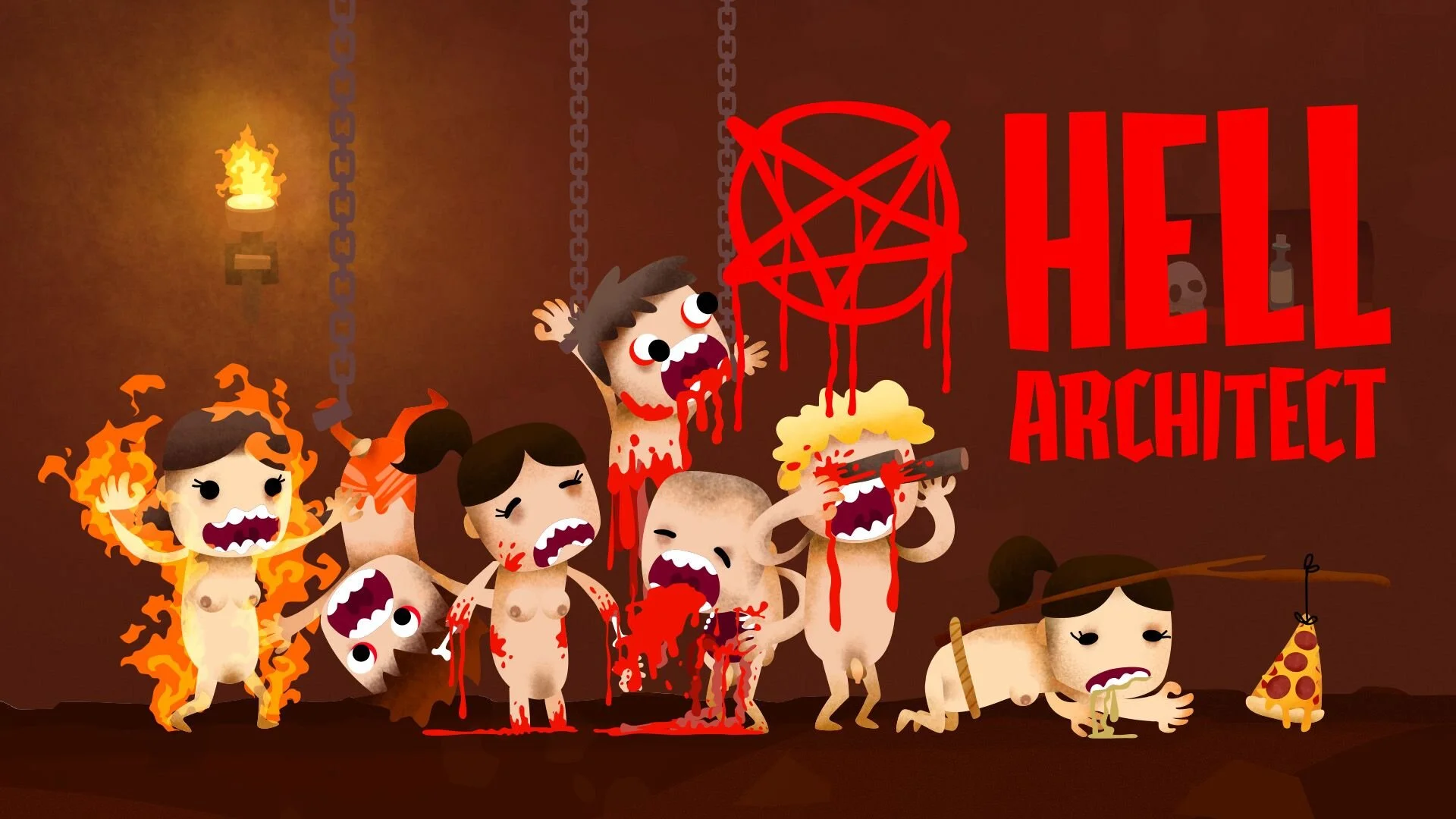
Hell Architect is what’s referred to as a “survival builder” game. As a junior manager in Hell, players are tasked with guiding a growing band of sinners through various objectives and extracting their suffering. This lets players build larger and more efficient structures as a way to increase power and resources. To do this, gamers attend to their sinners’ needs (building them up gives them more hopes and dreams to crush) and eventually bump them off, sending them back to Limbo and giving the player “essence,” essentially soul energy that can be used to make larger structures. Along the way, gamers will dig for artifacts, research better structures, and figure out how to run a thriving Hell where they can torture all sinners to their heart’s content.

Hell Architect lives and dies mainly on its atmosphere and setting, so it seems like as good a place as any to start. A lot of the theming is excellent. You’re given control of your own personal corner of Hell to do with as you wish, gleefully forcing sinners to mine out their own torture chambers and make utterly repulsive food and drink for each other. The gross, edgy, and downright scatological humor of the setting is completely on display, whether it’s every one of your sinners working in the nude with only fig leaves covering their naughty bits, the HR devil who assigns you tutorial tasks while snarking away about how he wants to stop having to hold your hand, or the fact that the usual food and water that survival builders require take the form of “mystery meat” and “sewage water” respectively. There are even legendary sinners and demons you can use to augment your existing flock of unfortunate souls. It’s the sort of game where suffering is a resource, and the kind of game where with a single right-click, you can select one of a number of ways to send your sinners back to Limbo, murdering their physical form once again.

And honestly? That takes a lot of the usual stress out of the average survival builder experience. Sure, there are the usual supply chains and the occasional problem where you have to move your base structures around because your sinners can’t move all the way back up through the chambers you dug, but on some level, it’s okay when they die and go back to Limbo. It’s Hell, after all. You’re about as much an administrator as you are a kid with a magnifying glass, playing with ants. In weaponizing the death mechanic, it actually feels a lot less frustrating to play Hell Architect than it does a lot of other survival builders. If someone annoys you, or won’t go where you need them to, just bump them back into Limbo and either pick up a sinner who will, or bring them back when you feel like it. You even get resources for doing so, incentivizing you to zap them to death in a variety of fun ways (seriously, it brings up a wheel with multiple choices). The systems are easy to understand, the writing is sharp, and while the resources aren’t obviously tallied at times, the clean interface allows for enough management that you’re able to figure out what’s what.
The game really needs this catharsis to bridge the gap between its faults, though. Frequently, your sinners will stand around even when there are tasks that need to be done, or complain their needs aren’t being met even if there’s a path back to the base-camp area they’re just refusing to take. It turns managing needs and pathfinding into a slog, one where all your sinners are either too invested in doing the tasks queued for them, or not invested enough, or simply don’t bother to reach the place they need to be. It can get frustrating, especially when you’re forced in some missions and objectives to dig deep into the furthest reaches and your sinners tend to think it isn’t worth the hike. It’s a little annoying at times, and can bog down the pacing. Survival builders tend to be games of urgency and infrastructure, and while Hell Architect is heavy on the infrastructure (there are entire supply chains for sinner needs), it’s a much slower-paced game than, say, something like Oxygen Not Included. This isn’t always a bad thing, but occasionally it can just take a long time to get anywhere.

The slower pace and occasionally nonsensical AI behavior don’t mar the game too much, though. Hell Architect is the kind of slower, chilled-out, forgiving experience the survival builder genre needs. With the reputation the genre has for being unforgiving and obtuse, Hell Architect manages to be forgiving enough to new players and approach the genre with the atmosphere and sharp humor the concept deserves. While it might be occasionally frustrating and the pace (even with the usual time controls speeding things up a little) might be a little slower than the average game, Hell Architect is a must for anyone who wishes to get a good starting grasp on the survival builder genre.

Final Score:
The Good:
- Remarkably chilled-out and forgiving for a survival builder
- Excellent setting and sense of humor, even if it can get a little on the edgy side
-Wide range of things to do without being too obtuse
The Bad
- Incredibly slow-paced even at its top speeds
- Sinners will sometimes completely ignore what they’re supposed to be doing in favor of something else, sometimes to their detriment
- Gross-out humor wears on you after a while

Cloudpunk Review
By all accounts, I should like Cloudpunk. The vast neon-swathed cityscape evokes the best moments of Blade Runner, complete with the murmur of dystopian advertisements in the background. The flight controls are simple and smooth, allowing you to change height and swing through the city with ease, trailing twin neon contrails as you swerve around Asian-inspired buildings and avoid cars. It’s actually kind of relaxing, even at its most tense, sending you through gorgeous neighborhoods and actually letting you get out to explore them, having conversations that serve to deepen the world and helping various people with their problems. And lastly, it’s the kind of everyday-job noir-flavored experience that I’ve always loved, tasking you with doing a relatively low-level job as the plots around you darken further and further, as seen in such games as VA-11 hall-A and Night Call, among others.

Release date: April 23, 2020
Developer: ION LANDS
Platforms: PlayStation 4, Nintendo Switch, Xbox One, Microsoft Windows
Price: $19.99
By all accounts, I should like Cloudpunk. The vast neon-swathed cityscape evokes the best moments of Blade Runner, complete with the murmur of dystopian advertisements in the background. The flight controls are simple and smooth, allowing you to change height and swing through the city with ease, trailing twin neon contrails as you swerve around Asian-inspired buildings and avoid cars. It’s actually kind of relaxing, even at its most tense, sending you through gorgeous neighborhoods and actually letting you get out to explore them, having conversations that serve to deepen the world and helping various people with their problems. And lastly, it’s the kind of everyday-job noir-flavored experience that I’ve always loved, tasking you with doing a relatively low-level job as the plots around you darken further and further, as seen in such games as VA-11 hall-A and Night Call, among others. That’s all really cool.

So what bothers me? Why this feeling that something’s off?
Cloudpunk puts you in the driver’s seat with Rania, a fresh-faced new arrival in a vast multi-tiered megalopolis who has just joined the Cloudpunk courier service. She’s given her own delivery vehicle, an AI assistant she gives the face and personality of her pet dog, and two simple rules: Follow delivery instructions, and never look in the package. The game follows Rania over the course of one night, criscrossing the vast city and cruising from district to district as she delivers packages, helps out lonely postal robots, dodges annoying street harassers, and has to deal with a drunk dispatcher who knows more than she lets on. But something ominous is going on in the city, whether it’s the mysterious ticking packages, the increasingly terse AI running the Cloudpunk service, or the engineers’ fear that the entire city is falling apart. Rania just wants to survive the night, but she might end up doing so much more.
So first, the game has a unique style that works incredibly well for it. It’s got a perpetually raining neon-dystopia aesthetic with pleasantly chunky voxel graphics that looks retro while also keeping a sort of modern edge and makes the best use of its graphics, with buildings seeming to tower off into the distance and buildings full of lights. It’s also smooth enough that you can fly around the large districts and even get out and walk through areas without having to load, save for flying to or from another district. It’s seamless, and in an age where that’s an issue for most triple-A games, that’s impressive. Particularly impressive is that you can fly right up to and even into buildings, as everything in the city is actually there in front of you. It’s really cool, and gives the flight a weight and meaning as you swerve through buildings and around cars.

The soundtrack is also perfect, it’s clear Vangelis’ Blade Runner score was an influence, and it works perfectly over the towering spires of the city and rainy streets. It’s never intrusive, though, instead adding accents to the existing action, ramping up and down as scenes get more or less intense. Usually, I listen to my own music or podcasts after a while instead of game music, and I immediately switched off my audio so that I could listen to the soundtrack. It was that integral to the atmosphere.
The flight is also really easy, just WSAD for direction, and shift/space for ascend/descend. The controls are smooth and don’t really give you a lot of trouble, and work just as easily moving around the pedestrian scenes as much as the city. It’s a very no-fuss kind of movement, with only the annoyance of a fixed camera and its predilection for messing up your transitions from screen to screen to keep from a whole recommendation. Well, that and waiting for elevators. It’s immersive, but sometimes you just don’t want to have to wait for an elevator. I think it’s both a plus and a minus. It’s relaxing and really satisfying zipping around the city and being immersed in the day-to-day of being a package deliverer in this odd futuristic world, meeting eccentric characters, and trying to solve their problems.
But this is a game based on a narrative, and once it gets into that mode, the cracks start to show. The voice acting tends to vary from person to person and even from line reading and line reading, sometimes making the emotion and inflection in scenes feel a little jarring. I finally turned down the voices, because having the text entirely detached from the voices felt wrong somehow, but hearing the stilted conversations between Rania and Camus, her AI dog, got on my nerves. I should say that there are standouts in the voice cast— a lot of the characters you meet are acted wonderfully— but when Rania is really uneven and you have to spend the most time with her, the immersion the rest of the game works so hard on tends to stutter a bit.

Rania is kind of uneven in general, sometimes. She’s not presented as unsympathetic or ignorant in any particular way, and even has numerous encounters with the usual army of male straw-man idiots, from the guy who tries to ask her out randomly to a creep who demands a debate on how women are inferior, to a music-video director who tries to appropriate her look and culture for a pop star he’s working with, that allow the player to sympathize with her. But then whenever she meets certain characters, most notably a human “companion” for a robot and a dominatrix, suddenly she seems to view what they do as exploitative and dehumanizing, lecturing them on their lifestyle and business choices in a way that feels (since they’re doing something completely consensual and not hurting anyone) condescending and wrong. It’s a little problematic, and the sense you get occasionally from Rania that these people and their lives are beneath her. It’s jarring when compared with the character arc that sees her becoming more and more a part of the city as she goes, getting embroiled in the various factions and lives of its inhabitants piece by piece, and really annoying at times.
It’s a small out of place patch in an otherwise perfect cloudy sky, though. The story is suitably dark and noir in all the right places, the smooth flying around the city is incredibly relaxing, and apart from some timed segments, the ability to explore the city at your own pace and even leave the car at some points to explore on foot are all a lot of fun. It’s a fantastic and ambitious game that’s perfect for moody evenings. Put on some low jazz, load it up, and give it a go. Just maybe fiddle with the voice settings a bit first.

The Good:
- Relaxing and deep experience of driving around a futuristic city
- Loads of plot, atmosphere, and an open-ended experience
- Smooth controls and a wide-open map full of collectibles and sidequests to explore
The Bad
- Uneven voice acting can lead to jarring moments
- SWERFery makes the lead character seem kind of unsympathetic
- Lead character can kind of be a jerk
- Occasionally the environments can look a little similar

World of Horror - A First Look Review
World of Horror, recently released on Steam Early Access, is incredibly addictive.
You wouldn’t expect this at first glance. It’s a brutally difficult roguelike, rendered in one or two-bit graphics that make it look and play like someone emulated their favorite Japanese horror RPG from the ‘80s, with all the retro interface and design that entails. It looks, upon opening it up, like a game made for a very specific audience who will “get” it and fiercely defend it. But once you actually start to play the game and make it through the difficulty barrier of those early deaths (and there will be early deaths), it opens up immensely, turning it into a gruesome and tough but incredibly rewarding experience that only deepens the more you play.

Game: World of Horror
Developed By: panstasz
Published By: Ysbryd Games
Release Date: 2/20/2020
World of Horror, recently released on Steam Early Access, is incredibly addictive.
You wouldn’t expect this at first glance. It’s a brutally difficult roguelike, rendered in one or two-bit graphics that make it look and play like someone emulated their favorite Japanese horror RPG from the ‘80s, with all the retro interface and design that entails. It looks, upon opening it up, like a game made for a very specific audience who will “get” it and fiercely defend it. But once you actually start to play the game and make it through the difficulty barrier of those early deaths (and there will be early deaths), it opens up immensely, turning it into a gruesome and tough but incredibly rewarding experience that only deepens the more you play.

Everyone loves puppets, right?
The plot of World of Horror is a fairly simple one. You are a paranormal investigator tasked with solving five mysteries in the seaside city of Shiokawa. Each one of these mysteries, which play out as short horror-adventure games, ties into a larger mystery surrounding a different randomly-chosen elder god. Solve the mystery, and you get a key to the lighthouse where you can finally disrupt the summoning ritual and banish the Elder God back to whence they came. Fail, and you die in one of a number of horrible ways, from being bashed in the head by a baseball bat-wielding stalker to getting infected by a horrifying plague of holes straight out of a Junji Ito story. Depending on how you play, you can unlock a number of achievements that add more “cards” to the story, a set of optional random encounters that add new elements and items to the game.
World of Horror plays out on its impressively detailed screens through a point-and-click interface, hearkening back to classic horror manga and PC games, each screen painstakingly rendered in 1 or 2-bit graphics using black-and-white shading. You select various icons and actions from your various menus, manage your inventory (four items at a time, plus your Item Storage box), and use a variety of spells and items to keep your characters (one of seven, with eight optional backgrounds to spice up your playthrough). Mousing over any icon or option tells you what it does, and while the game expects you to read through all the material you get and take a careful look at your surroundings and the screens they have on offer, it’s a very intuitive system. It does require a lot of reading carefully and figuring out what option does what, but as long as you pay attention to what’s on the screen, especially at the bottom of it and during the (rather frequent) combat sequences. Combat is handled by putting together a sequence of moves based on a time bar, assembling your defensive and offensive actions into a sequence before letting it rip and hoping for the best.
And there’s a lot of “hoping for the best.” The game is random and kind of unforgiving, and while the interface is intuitive, some things you have to figure out as you go. Mysteries, for instance, have multiple endings you can unlock and each run means considering which ones you play in which order— do you go for the grueling battle against a demon from outside space and time first, and then set up the breather at the end? Do you do the mystery where your impending doom (a percentage which serves as a time limit for the game, it reaches full and you lose) will skyrocket and then hope you can get it to go down as you do more mysteries? Do you dare risk the mystery where you’ve died repeatedly and barely ended up solving so you can get it out of the way, or risk coming to it weakened but with higher abilities? But while careful planning will help with a lot of this, sometimes the random events are just downright nasty, adding high percentages to the impending doom meter or ripping your stamina and sanity apart just moments from the end of the scenario. This is especially nasty in combat, where an enemy with a high rating will absolutely wipe the floor with you and shrug off your hits as if they’re nothing, even with the numerous combat buffs you can add.

You, too, will learn to hate Aka Manto
That, if anything, is World of Horror’s one flaw, is its difficulty and random elements. A playthrough can have you quickly screwed over without any way to fix it as the Old God decides to take away your ability to buy items and heal between mysteries quickly, take on too many curses to feasibly complete things, or just end up in combat encounter after combat encounter until eventually you’ve used up your items and the option to run or use your spells will either kill you or advance the doom meter to the point where you won’t win regardless. It’s frustrating sometimes, the way that enemies seem to curbstomp you quickly and the game gleefully shoves you through a gauntlet of terrifying baddies or a bad bounce leaves you scrambling to figure out what to do next. It also presents a cliff that makes it difficult to progress, even the tutorial is one of the most straightforward but grueling levels in the game (“School Scissors, a desperate race to banish the Japanese legend known as the Slit-Mouthed Woman) , pitting you against several tough combats and a terrifying final battle. It’d also be cool if there were more ways to reduce Doom or alleviate Curses, a kind of injury that seems permanent because, as the flavor text says, “modern medicine isn’t useful here.”

But no one said horror manga or cosmic horror stories were happy affairs, and in this at least, it’s accurate. It’s also incredibly satisfying to beat the mysteries and amass yourself a huge variety of allies and weapons, making careful choices and playing smart until you make it to the top of the lighthouse and finally kick over the summoning circle. It allows for both the happiest possible ending and the most depressing, along with everything in between, and that’s actually pretty cool. It also does a great job with generating narrative. The flavor text is a blast to read as you move from location to location, showing the advancement of the mystery as you go, and it’s cool that even turning on the TV in your apartment adds volumes to the story. I’ve played as scalpel-wielding nursing students, occultist transfer students who always seem to end up dead or insane, a swim team captain armed with an interdimensional katana who wiped the floor with an Alexandrian god of fire, and that’s just scratching the surface. Each story feels unique, and as the game’s in early access, I can’t wait to see what they add. Each achievement also adds things to further playthroughs, from new backgrounds that allow for different styles of play (taking more injuries, a lot more cultists coming after you, etc) to new characters, to even more events and abilities. It’s cool to find something you hadn’t before, and there even seems to be a system for unlocking more Elder Gods to fight and a larger bestiary to send against you, deepening each game as you desperately fight against the elder beasts again.
While World of Horror is still in Early Access, what is available is impressive enough that if it keeps up, the full game is going to be a powerhouse. It’s already fully realized, and has enough variety (there’s an entire second “timeline” that shifts the action to Tokyo on top of the other wide range of content) that it’s just as exciting as any other roguelike or horror game on the market. I can’t wait to see what surprises are added to the game, and I hope it’s just as impressive on the full release.

Final score (for now):
The Good:
- Incredibly detailed and gruesome retro-styled graphics and interface
- Wide variety of unlockables and events
- Narrative and theme hang together incredibly well, making for an awesome retro-horror experience
- Addictive gameplay with a lot of hidden depth
The Bad:
- It’s got a difficulty cliff more than a difficulty curve
- Combat can get frustratingly difficult at times
- RNG hates you, but not always in a fun way

Fast, Furious, Fun: Dead End Job Review
Sometimes you just need something quick to play. Something addictive and engrossing enough that you can get deep into it, but just light enough that you can disengage if need be. Something that can be played a little casually, but has a lot of depth and action. And directly in that sweet spot is Dead End Job. It’s a roguelike shooter with a ton of style, a good sense of humor, and easy enough controls to learn. But between the variety of enemies, the arcade-style combat, and the large number of perks and items strewn across its levels, it’s far from a basic experience. It’s something fantastic for if you want to get lost for a little while busting ghosts, or if you just need something for a quick burst of gaming.
Release Date: 12/13/2019
Publisher: Headup Games
Developer: Ant Workshop, LTD
Platform: PC
Price: $16.99
Sometimes you just need something quick to play. Something addictive and engrossing enough that you can get deep into it, but just light enough that you can disengage if need be. Something that can be played a little casually, but has a lot of depth and action. And directly in that sweet spot is Dead End Job. It’s a roguelike shooter with a ton of style, a good sense of humor, and easy enough controls to learn. But between the variety of enemies, the arcade-style combat, and the large number of perks and items strewn across its levels, it’s far from a basic experience. It’s something fantastic for if you want to get lost for a little while busting ghosts, or if you just need something for a quick burst of gaming.

Dead End Job puts you in the vast overalls of Hector Plasm, a slovenly-looking blue-collar ghostbuster. Hector works for Ghoul-B-Gone, a shady ghost-hunting outfit run out of a small fly-by-night office. When Hector’s partner chokes on a sandwich, he has to save up enough money and complete enough work on a portal to the other side to bring her back from the dead, as outlined in the cheery ‘90s cartoon-style theme song that opens the game. To do this, you go to various locations throughout the city to bust ghosts, shooting them until they’re stunned and then vacuuming them up in your pack. Each ghost you bust is added to your score, represented as an invoice in the corner of the screen. As you try to reach your goal by completing at least one job a “day,” new areas are unlocked at each milestone, allowing you to bust more challenging ghosts and more complicated areas.
There’s a great unified aesthetic to Dead End Job. The dev team set out to make it look as much like a ‘90s Nickelodeon cartoon as possible, and between the loose, gross-out designs and the bold color pallette, it succeeds. Each new level even has its own episode title and credits, popping up as a loading screen as Hector drives his broken-down van to the job site. This is continued in the various stages, all of which have a different theme to them (office buildings, parks, restaurants) with their own variety of ghosts to bust. Even the bosses maintain the theme, with you fighting ghosts possessing sandpits, ghostly babysitters, and huge ice cream cones in the middle of a haunted park. The park’s level design is especially good, with the stage making use of the wide-open spaces and long ranges for some absolutely wild firefights with the destructible scenery adding a nice added dose of mayhem.

And then you add the perks and items. Suddenly what was a simple arcade-style shooter turns into a wild, cartoonish explosion, with things like scenery spontaneously exploding in wads of cash upon clearing a room of ghosts, “coolant holes” that allow your gun/vacuum to fire for longer, or even saving you from losing all your perks upon death. Also aiding you in your quest of ethereal extermination are a variety of throwables, edibles, and extra guns that further clear a room. All of these combine in a variety of interesting ways, allowing you to zip around a level and fill up on ghosts in no time at all.

But there are difficulties, even with such a simple premise. For one thing, movement is incredibly slippery, meaning that you can easily lose control of Hector, even as the game keeps its fast pace. Hector can also tend to get stuck on scenery in places, which in the heat of battle when you have almost bullet hell levels of projectiles coming at you, gets more than a little annoying. While these don’t happen often, it’s enough that when you’re cornered by three enemies, stuck on the corner of a table, and somehow the enemies aren’t similarly impeded. There were also times when my computer forced a quit of the program mid-level only for the game to count it as a loss and start me from zero, and it was really annoying when that happened, even though I get that it discourages rage-quitting. It can also get repetitive in much longer stretches, though this does make it perfect for short to medium bursts instead of sitting down for the long haul. The aesthetic can also be kind of gross, with Hector pelvic-thrusting in the air after every mission, the animation a little too good at showing his movements.
In the end, though, Dead End Job is everything it needs to be— a quick, fast-paced arcade shooter with just enough depth and storyline to keep the player hooked, but nothing that leaves you bogged down or stuck in a grind. It’s fun, with its shabby fly-by-night operation offering a great aesthetic, the unified design of the various stages, and the high score tying into the overall storyline of you trying to raise money so your partner comes back. And that’s not even getting into the co-op, which adds a new dimension to the game and supports local play. It’s addictive, simple, and has a lot of interesting depth and play choices, even if the structure serves short bursts and quick sessions more than longer play. It’s fast, furious, fun, and that’s really all it needs to be.

The Good
- Fast-paced action
- Perfect ‘90s cartoon aesthetic similar to Ren And Stimpy or Klasky-Csupo
- Great level design and some frenetic firefights
The Bad
- Slippery controls, getting stuck on scenery is annoying
- Can get a little repetitive at times

Infliction Review
At first glance, Infliction looks like any other game in the stealth/horror-adventure genre. You wander around dark corridors, dodge attacks from a malicious ghost and other monsters, attempt to complete tasks and progress the story all while trying not to get killed, and occasionally solve environmental puzzles with the help of your in-game Polaroid camera. It has all the hallmarks of a good stealth/horror game: It’s tense, the plot is interesting, the story breadcrumbs are easy enough to find but not all laid out in front of the player. It even has an element of exploration, with setting elements changing between areas and levels of the plot and rewarding careful looking through things. It’s all incredibly impressive, especially having been created by a very small team funded through Kickstarter. But at the same time, it marks a possible new route for the spooky corridors genre, one that future game designers would be wise to explore, one where perhaps the main draw is the setting and not the monsters wandering its halls.

Release Date: Oct. 18, 2018
Publisher/Developer: Caustic Reality
Platform: PC
Price: $19.99
At first glance, Infliction looks like any other game in the stealth/horror-adventure genre. You wander around dark corridors, dodge attacks from a malicious ghost and other monsters, attempt to complete tasks and progress the story all while trying not to get killed, and occasionally solve environmental puzzles with the help of your in-game Polaroid camera. It has all the hallmarks of a good stealth/horror game: It’s tense, the plot is interesting, the story breadcrumbs are easy enough to find but not all laid out in front of the player. It even has an element of exploration, with setting elements changing between areas and levels of the plot and rewarding careful looking through things. It’s all incredibly impressive, especially having been created by a very small team funded through Kickstarter. But at the same time, it marks a possible new route for the spooky corridors genre, one that future game designers would be wise to explore, one where perhaps the main draw is the setting and not the monsters wandering its halls.

Infliction casts you as a man with a loving wife and a dear family, returning back to your house to pick up some plane tickets. Unfortunately, the plane tickets are securely locked in your wife’s office and studio, which means you have to find the code to unlock it. But as you explore the house to find the code, strange things begin to occur, subtly at first (horror titles, odd CD names and track titles that seem to foreshadow things for you) and then with alarming frequency, plunging you directly into a nightmare. As you’re stalked through what used to be your home by a vengeful spirit hellbent on dragging you further into the darkness with her, new dimensions and memories open up, forcing you to uncover what happened to your peaceful family or for your soul to be destroyed forever.

Infliction is a game that gets a lot of things right. The monster designs are suitably grotesque, the house is well-designed and the continual trips through there build a kind of familiarity that makes it all the scarier when things start to break down. The sound design is similarly superb, and the amount of detail put into the house and the further (more spoilery) environs after that, making the player want to explore every surrounding, turn over every rock, and look through every VHS and CD case for clues as to what goes on. Even before things kick off, it’s a suitably eerie place, and that sensation deepens in a really satisfying way, each new location bringing up something even more twisted, from haunted paintings to basements with mysterious passages and holes.
It’s a game that wears its influences very heavily on its sleeve, from references to past environmental narratives like Gone Home, a collection of horror videotapes that contain some interesting references , and a hallway that riffs gently on the infamous Silent Hills trailer P.T. In some ways, it’s almost a love letter to both the stealth-horror/jumpscare games and the more atmospheric environmental horror games, infusing a slow-burning dread and exploration with the nastier surprises of avoiding the vengeful ghost and other, equally upsetting monsters. With the rather simple “hide-a-key” system of exploration (click to pick something up, right-click to zoom in and read, other keys to activate different abilities), it also makes exploration feel really easy and satisfying, allowing you to move through the house and explore what happened, unlocking your memories and new areas as you go.

And here’s where it starts to fall apart a little. Infliction suffers from trying to have its cake and eat it too, to be an exploration game balanced by the urgent threat and tension of being stalked through the house and having to avoid a relentless creature. But that urgency doesn’t allow the setting to seep in as well once the monsters end up on your tail, and the threats kind of get in their own way sometimes. It’s a game with tons of atmosphere and style, and some very tense scripted sequences (the morgue butcher scene and the prison chase stand out), and there are some great mechanics, like keeping the vengeful ghost trapped using the camera, or being able to hide in closets. But having to rush through the various things to read and memories to uncover and phone messages and newspaper articles, as well as not being able to enjoy the scenery as you rush to the next location to stay away from the monsters definitely does not help.
It’s paired with an incredibly annoying checkpointing system, requiring you to sometimes play sequences over and over again if you can’t get them right, something that just grinds down the atmosphere and exploration and fun of the game to a single point as you batter your head against a wall hoping to get through with a combination of luck and skill. While it can be exhilarating to finally get by a rough section, it feels annoying to keep having to replay sections, story and cutscenes intact, so you can make another try at escaping whatever horror’s waiting for you just around the corner. While the horror and possibility of failure helps the tension, the problem is that it wrecks the atmosphere after a while. It’s also a little annoying that some of the scenes rely on trial and error, forcing you to either search everything carefully (time pressure) or watch death after death until you figure out the thing you’re doing wrong. Neither is really all that much fun.

In the end, while Infliction is certainly a well-made game, and one of the better games of its type, the survival/stealth horror genre seems to get in its way more than help. For those who can get through its stickier sections, there’s a lot to enjoy, but it might be worth thinking about how the genre and games of this type could be a little moodier and maybe have a few less checkpoints or more monster attacks or something to kind of take the edge off. But it’s still a fantastic game, and among the better entries of its type, full of great atmosphere and some absolutely nerve-wracking scares.

The Good
- Disturbing visuals and a perfect moody horror atmosphere
- Simple, satisfying control scheme that makes it easy to explore the setting
- Great level design and some tense, genuinely scary sequences
- Large areas to explore and find secrets and memories
The Bad
- Checkpointing means you have some incredibly difficult sequences you will replay over and over again
- Roaming monster attacks sometimes get in the way of exploring the house and wreck the mood
Thanks to Caustic Reality for providing a code for review.

Disgaea 5 Complete Review
Disgaea is a series that’s been around for a while, an absolute tactical-strategy juggernaut that’s made its bones on unique gameplay, a vast array of characters, and an absolutely wicked sense of humor. The fifth numbered sequel (Sixth game if you count D2) in the series delivers on all of that, with two snarky morally ambiguous heroes taking on the threat of a massive army poised to take over the Netherworlds and rule the afterlife entire. But while you can certainly expect all the usual hallmarks of Disgaea— Fourth wall breaks, snarky heroes, wacky humor, talking penguins— the game introduces some interesting new systems and classes while still giving you all the power to take the fight to the Netherworlds and conquer the lands of the dead in the name of revenge.

Release Date: October 22, 2018
Publisher/Developer: NIS (Nippon Ichi Software) America
Platform: PS4, PC (Reviewed)
Price: $39.99
Disgaea is a series that’s been around for a while, an absolute tactical-strategy juggernaut that’s made its bones on unique gameplay, a vast array of characters, and an absolutely wicked sense of humor. The fifth numbered sequel (Sixth game if you count D2) in the series delivers on all of that, with two snarky morally ambiguous heroes taking on the threat of a massive army poised to take over the Netherworlds and rule the afterlife entire. But while you can certainly expect all the usual hallmarks of Disgaea— Fourth wall breaks, snarky heroes, wacky humor, talking penguins— the game introduces some interesting new systems and classes while still giving you all the power to take the fight to the Netherworlds and conquer the lands of the dead in the name of revenge.

The netherworlds are being conquered by Void Dark, a sinister force that seeks to control the lands of the dead entire. As the various regions try desperately to stop this and are summarily crushed one by one, a young man named Killia suddenly appears in the midst of a battle, stopping to eat lunch. Killia immediately wipes out the forces opposing the embattled Princess Seraphina (who is fighting Void Dark partly to stop her arranged marriage), explains his motivations for opposing the conquest of the netherworlds, and they set out to unite the Underworld’s disparate regions and free things from the grip of Void Dark. But the netherworlds are a vast and eccentric place full of weird denizens and the souls of the dead, and this is going to be far from an easy fight.
By now, Nippon Ichi knows well enough to not tinker with what works in Disgaea. The series is both deceptively simple and deceptively complex, allowing you to easily build up an army and unlock their various personality traits and special skills, the tactical system is a finely-honed beast where ending a turn even when you’re not doing so well is immensely satisfying, and the way attacks can chain together or the battlefield can alter in an instant to turn in your favor, or even the way you can turn your troops into weapons for your characters to hit people with are all excellent mechanics. DIsgaea 5 shows the series at its best, with all the mechanics of previous games tighter than ever and the charming graphics updated nicely for modern systems. It’s a fantastic entry to the series, and if you’re a fan, you know some of what you’re getting already

But while not fixing what isn’t broke is all well and good, Disgaea 5 adds more content and mechanics, further creating a satisfying experience. The new “revenge” mechanic, which fits into the overall theme of Killia and Seraphina enacting their revenge on Void Dark for a variety of crimes and indignities, functions as a kind of limit break that goes up when units are damaged, party members drop, or the heroes damage enemies, leading to a berserker mode where they rack up critical hits and can possibly unleash devastating special moves, on top of all the existing special conditions and arrays of movement. It opens up some amazing tactical options, and kind of softens the blow of having units drop in battle by allowing for massive boosts to turn the tide back in your favor. Adding to this are a ton of new classes to unlock alongside old favorites, further shaking up the traditional gameplay and making sure everything doesn’t feel too samey.
The difficulty curve is also helped by gradually introducing tutorials, something that allows the player to get their head around the more complex systems. There’s still a rather fast difficulty curve, and the game still has the usual issues of grind and the usual micromanaging, but all of these are part of the tactical RPG genre. Anyone who’s experienced tactical RPGs more than a little will know what they’re getting into, and there’s enough here that beginners can at least get their feet wet.

In the end, there’s a lot to recommend. Disgaea 5 and tactical RPG fans will find a lot to like. What low points there are will pretty much be the same things that turn people off tactical RPGs, in which case, well, this game wasn’t for you in the first place. It’s a game that knows what it is, does what it likes, and delivers an excellent experience for fans. There’s even some interesting bonus content where you can unlock higher-level versions of heroes from other games, adding superpowered main characters to your roster for further destruction. If you’re looking for a solid tac-RPG, look no futher.

The Good
- Trademark N1 sense of humor
- Improves upon the classic Disgaea formula
- Deep systems and subsystems that can radically alter the gameplay and turn the odds in your favor
- Lots for tactical RPG fans to enjoy
The Bad
- Occasionally can get bogged down in equipment and unit management
- Occasional difficulty spikes
Thanks to NIS America fro providing a code for review

First Strike Final Hour Review: How About A Nice Game of Chess?
When I first saw First Strike: Final Hour in the Steam store, I was intrigued. I've been a fan of the nearest relatives to it, Introversion's Defcon and Team Jolly Roger's Interplanetary, for a while now, and the idea of cleansing the Earth in pixelated fire has never not sounded like a fun time. It's the ultimate expression of kicking over a block castle when you're done with it, only the block castle is the entire planet. There's a cathartic thrill to just knocking something over, and especially when that thing is the entirety of the planet Earth. In theory, anyway. In reality, the game is a little more...complex.

Developer: Blindflug Studios AG
Publisher: Blindflug Studios AG
Release Date: May 31, 2017
Platforms: Windows, Mac
Price: $11.99
When I first saw First Strike: Final Hour in the Steam store, I was intrigued. I've been a fan of the nearest relatives to it, Introversion's Defcon and Team Jolly Roger's Interplanetary, for a while now, and the idea of cleansing the Earth in pixelated fire has never not sounded like a fun time. It's the ultimate expression of kicking over a block castle when you're done with it, only the block castle is the entire planet. There's a cathartic thrill to just knocking something over, and especially when that thing is the entirety of the planet Earth. In theory, anyway. In reality, the game is a little more...complex.

First Strike: Final Hour casts you as the leader of a world power. You're given a small selection of superweapons, missile bases scattered around your nation, and a brief tutorial about how best to cause casualties somewhere in the megadeath range. From there, it's up to you to form truces with the other nations, or wipe them out as you see fit. The "First Strike" part of the title refers to a massive launch where all your missiles are fired into one huge area of effect at once, a star-field of parabolic death raining down upon enemy nations like a swarm of angry, blunt-nosed hornets. But that isn't the only way to reduce your enemies to piles of ash. You can also form alliances, research new technologies to upgrade your tech, and finally build superweapons to crush your peskier opponents. The game goes until you and your allies emerge atop glow-in-the-dark rubble triumphant and unbowed, or until you wipe out everyone else, whichever comes first.

And for the most part, it's good. Watching the missiles turn their target into glowing, burning fields of orange is satisfying. The interface is, while not gorgeous, tremendously easy on the eyes and simple to use. If Defcon was Global Thermonuclear War as imagined by Wargames, First Strike is its modern-day counterpart, a 3-D globe swirling with missile strikes, tense momentary pacts, and irradiated sections of the board done up in glowing orange cross-hatch. The simple interface involves setting everything up with a few clicks here and there, and it's satisfying to click that mouse and watch anywhere from one to one million missiles sail across the globe until they impact with their targets.
The game's tone is augmented by tempo and pacing. There's a constant ticking noise in the background of the soundtrack that swirls into a crescendo of noise whenever someone chooses to launch their missiles en masse at a target, possibly even you. Adding to the tension, there is no pause. Even on the options menu, everything slows to a crawl, but doesn't actually stop, meaning that you could be turning down that anxiety-inducing music only to have a trillion missiles make it up your hind end. It's nerve-wracking, but it also helps keep you on your toes.

But the game is rather obtuse and the nerve-wracking timing works against it in conjunction with this. It's not clear exactly when your opponents are eliminated or how, just that you need to either be the last one standing or make alliances with the remaining powers to win. It's also not clear how to ally yourself with the other powers, though you can create non-aggression pacts easily enough. Things quickly dissolve into a repetitive slugfest where you defend frantically against missile attacks while occasionally launching your own that do...something? and attempting to take over territories before they either become nuclear-capable or fall into your enemy's hands.
This turns what could be a frantic game of nuclear annihilation into you building a ton of cruise missiles while hoping your superweapon and all related things do, well, just about anything they say they will. While I haven't ever won a game of First Strike I've spent numerous times losing games via attrition, as the matches stretch on until I eventually either get tired and let the computer win, or simply turn the game off. The initial thrill quickly fades, leaving a mess that while not confusing, also is maddeningly obtuse about what progress is made if any.
And that's what sinks the game, honestly. It's a fun game that's also its own worst enemy, dragged down by being too simple when it needs a little more complexity, and just too frantic when it maybe needs to take a breath. It's a wonderful game with some interesting systems, but in the end, it just leaves its players a little cold and wondering how long it's going to take, and a game should definitely not do that.

Pros:
- Frantic, fast-paced global thermonuclear war
- Simple interface
- Nerve-wracking soundtrack with ascending tone
Cons:
- Too obtuse
- Games stretch on forever.
- No real clear indicators of progress
The Reviewer received a free copy of this game in exchange for an honest review

Bounty Train Review: Early American Elitism
Bounty Train is a curious game. It's a sandbox trading sim/adventure game/railway enthusiast entertainment piece that, while the positions are static and the routes are fixed, still manages to give the player a great deal of movement. It's a genre bending game with multiple story routes and an excellent way to generate micronarratives as you go. And it's also one of the few games where you can lose during the tutorial levels, thus causing the game to shrug and go "Well, the game's over, but here, keep playing after the game over screen." But unlike other genre-bending sandbox sims, Bounty Train keeps a focus on fixed points instead of free exploration of the map, allowing the player to focus on things like the complex economy, resource management, and the interplay between various factions and characters, opening up in a way few games of its type do, and creating an entirely unique experience.

Release Date: May 16, 2017
Developer: Corbie Games
Publisher: Daedalic Entertainment
Platforms: PC, Mac
Price: $24.99

Bounty Train is a curious game. It's a sandbox trading sim/adventure game/railway enthusiast entertainment piece that, while the positions are static and the routes are fixed, still manages to give the player a great deal of movement. It's a genre bending game with multiple story routes and an excellent way to generate micronarratives as you go. It's also one of the few games where you can lose during the tutorial levels, thus causing the game to shrug and go "Well, the game's over, but here, keep playing after the game over screen." But unlike other genre-bending sandbox sims, Bounty Train keeps a focus on fixed points instead of free exploration of the map, allowing the player to focus on things like the complex economy, resource management, and the interplay between various factions and characters, opening up in a way few games of its type do, and creating an entirely unique experience.
Bounty Train's story begins sometime during the Civil War with you and a busted-up locomotive with a cargo compartment. In order to get the majority shares of your father's railroad company and keep the business in the family, you must gather up your siblings, upgrade your train, and slowly expand your rail lines across the United States in an effort to achieve rail dominance and fulfill your father's dream of a transcontinental railroad. Along the way, you will tangle with bandits, get caught up in the Civil War, trade with natives, and engage with numerous dreamers, schemers, con men, and ne'er do wells along the great iron rails. But, lest that sound too sparse, you can also hire a team of hardened gunmen yourself and go after bounties, aid bandits, or smuggle contraband across the United States if you so wish, allowing a remarkable freedom in your quest to fulfill your father's legacy.

It's actually kind of relaxing at times. Travel is as simple as clicking on the assigned city, figuring how much coal it will take to get there and how much weight you can take with you, then hitting "travel" when you've worked out your route. Along the way, you might run into random events, but most of the time they're very well-defined on the map and you can route around them if you just want to focus on the other aspects. The other cool thing about this is that the events usually follow on storylines from previous events, so you get the sense that you're interacting with a living world. It's a pretty intriguing world, too, with people trying to involve you in get rich quick schemes and various conflicts all over the place, or telling you their life story before joining up with you.
In fact, a lot goes into the dialogue. Even the NPCs feel like full characters with backstories and personalities, from the person you have to run from New York up to Portland, all the way to the young woman with an abhorrent bandit admirer who gets angry when he's told "no" one too many times. The dialogue also allows a tremendous amount of branching in terms of paths, with multiple methods of completing the main quests, and even some of the sidequests depending on how you react to certain characters. Between this and the extensive quest lines and numerous trips back and forth to the various cities, it does a lot to make the player feel invested in the world.

Adding to the concrete details are both the variety of train components-- all based on real historical locomotives-- and the in-depth but surprisingly easy to understand economy that charts prices not just on supply and demand, but on the political climate, as the ensuing revolution causes various things to become contraband and prices to spike and fall based on the needs of the various cities. It helps root the game in a sense of history and place, and that accuracy helps sell the realism of the world, even if things are a little more simplified for the sake of gameplay.

But there are definite problems that need to be addressed. Combat is a kind of scattershot slog, a real-time with pause battlefield where you defend the train from a variety of threats by positioning your people so their field-of-vision cone reaches the enemies and then hoping for the best, occasionally hitting active skills or repairing the train as need be. However, the lack of movement range within the train means that positioning becomes more or less a static thing, as there are only so many optimal positions that exist. The other issue with this is that there's very little range in terms of combat, with a handful of options at most at any given time, the best of which seem to be basic ranged and hand to hand. The other issue is that eventually, when the train becomes overwhelmed in the early stages of the game (before you can upgrade to something a little better) you have to choose between letting your train get overrun by enemies or the train moving forward, making fleeing from the combats an unusually dangerous proposition as opposed to trying to fight.
The difficulty spikes in combat also highlight how grindy the game can get. After the initial tutorial stages, unlocking new routes and upgrading your train can take a lot of swanning up and down the East Coast trading and ferrying people, with quests and assignments not necessarily carrying the load. Highlighting this is the way that, if you aren't careful, there are a few ways to lose in the early stages of the tutorial, from getting stranded in a city with no money to getting killed on the way through a story mission meant to teach you the game, to simple bad luck in an introductory combat. It's frustrating to have to either restart the tutorial again and again or to throw up your hands and play the game in sandbox mode.
But these issues do little to detract from the true meat of the game, that being a fun trading/adventure hybrid. While the grind may get a little difficult to deal with at times, the result is still a fascinating experience, a free-wheeling trading adventure through early America that offers a decent challenge and easier controls than most trading sims, but with a learning curve that takes a bit to get used to. All in all, though, it's an excellent game.

Pros:
- Trading game with relatively easy interface
- Incredible depth and complexity
- Great writing
- Can generate stories easily
Cons:
- Can get grindy at the beginning of the game
- Combat kind of kills the game's pacing and rhythm

Thimbleweed Park Review
With the resurgence of many of those franchises (as well as Tim Schaefer trying to relive the days when he did something other than design failed business plans and games that sound better on paper,) Ron Gilbert and Gary Winnick reunited again to bring us a perfectly encapsulated blast of old-school gaming, a pixelated wedge of surreality that brings back the days when puzzles were kind of obtuse and games were dialogue-heavy, and none of that was in any way a bad thing.

The initial review of this game had two inaccuracies, one about an element of the game needing to be patched, and one about the dialogue being unskippable. These have since been altered for accuracy.
Release Date: March 30, 2017
Developer: Terrible Toybox
Platforms: PC, Mac, Linux, Xbox One, IOS, Android
Price: $19.99

In 1987, Lucasfilm Games released a game that would change the adventure-gaming world forever: Maniac Mansion. Maniac Mansion was a graphical adventure game, not rare for it's time period, but instead of a text parser, used a graphical interface where players made sentences by combining a verb menu with various objects onscreen. It was also rare for its day in another way: You had to actively try to lose the game or die, a direct antithesis to most games of the era, where if you moved the wrong way down the right street, you would wind up needing a game restore. The parser they used, SCUMM (short for "Script Creator Utility for Maniac Mansion) allowed the team of Ron Gilbert and Gary Winnick to create even more classic adventures over the years, including beloved games like Day of the Tentacle and the Monkey Island series.
With the resurgence of many of those franchises, as well as Tim Schaefer trying to relive the days when he did something other than design failed business plans and games that sound better on paper, Ron Gilbert and Gary Winnick reunited again to bring us a perfectly encapsulated blast of old-school gaming, a pixelated wedge of surreality that brings back the days when puzzles were kind of obtuse and games were dialogue-heavy, and none of that was in any way a bad thing.
In Thimbleweed Park, you switch between a number of characters in an effort to solve a murder in the small town of Thimbleweed Park. Using a command list of nine verbs and items from your inventory, you solve puzzles and talk to the eccentric inhabitants of the town-- a town run on tubes where the mayor, sheriff, and M.E. might all be the same person with different verbal tics, lorded over by the godlike "Chuck," who may or may not actually be dead. This is not a spoiler, it's pretty clear early on with a city seal that says "his mind lives on" with a picture of a brain under a city. Each character has their own unique ability as well, encouraging the player to switch between various inhabitants of the town in your efforts to solve the murder.
The game essentially lives and dies by it's roots, and this is both a good and a bad thing. First, the good: The writing, old-style nine verb interface, and graphics are great. It's simple in the way the best '80s and '90s adventure games were, has a graphical interface for inventory items so that you know what you're doing, and is recently updated so you have a quick movement system. It runs well on modern resolutions, has the off-kilter atmosphere of something like Twin Peaks or Monkey Island, and it's a lot of fun to wander around the town at night. In other words, it does exactly as it's supposed to. It's an excellent experience, and kind of delightful.
But with it comes the very reason adventure games sorta died in the first place: obtuse puzzles, repetitive dialogue segments, and a movement system that seemed rather slow at first blush. It's difficult to say how much of this is actually the point, especially on higher difficulties, where you have to make printer ink by burning logs in a fireplace, and that's one of the least obtuse puzzles. There are moments where there's no real direction, no place to go, just an impenetrable wall that requires one thing to knock a chink in it. There are moments where the dialogue starts to drag, like the numerous trips to the town hall to talk to the wacky officials who all might be one guy, scenes that got so grating I had to turn the voices off, and endless conversations that aren't immediately skippable through. Adding to this, while the inventory and verb menu are a great throwback, the verb menu being necessary to combine items is most definitely not.
In the end, this game will live and die on one question: How much do you miss the older style of adventure games? If the answer is "a lot," then Thimbleweed Park is the best of the bunch. If the answer is "no, and I wish they stayed dead," then this game is going to drive you nuts very quickly, because it is the ideal of that. All in all, though, it's a fun experience for what it is, and if that's your sort of thing, then this is well worth it.

Pros:
- - Perfectly captures the feel of a '90s adventure classic
- - Great, off-kilter atmosphere
- - Excellent writing and art direction
Cons:
- - Captures all the flaws of a '90s adventure classic
- - Some tedious cutscenes when backtracking
- - Puzzle logic that comes from a '90s adventure classic
A review copy of this game was provided by Terrible Toybox
Monster Monpiece: Maybe They're Learning - A Review
Monster Monpiece, the latest game from Compile Heart, is something of a departure for them. There's no obvious grind, no weirdly implemented combo system, and it feels significantly different from most of their other games. All in all, it's new territory, and at first, it felt like they'd learned something from the process. Maybe, I thought to myself, maybe I've just suffered burnout from too many samey anime-style JRPGs. Maybe this time I'm wrong.

Monster Monpiece, the latest game from Compile Heart, is something of a departure for them. There's no obvious grind, no weirdly implemented combo system, and it feels significantly different from most of their other games. All in all, it's new territory, and at first, it felt like they'd learned something from the process. Maybe, I thought to myself, maybe I've just suffered burnout from too many samey anime-style JRPGs. Maybe this time I'm wrong.
And then the story started, conveyed through text boxes, voice overs, and static images whose mouths move. And then the onscreen manual popped up. And I remembered what kind of game I was playing here. But thankfully, there's an intuitive enough system, and the stripped-down (pun intended) approach that Compile Heart takes with their games works wonders here. The result is a fascinating card battler trapped within a game that doesn't quite do it justice.
To Monster Monpiece's credit, there's a lot of good here. The basic gameplay is a simple card-battler system where you play your cute-looking monstergirls against your opponent's cute-looking monstergirls on opposite sides of the field. Your objective is for your cute-looking monstergirls to make it all the way down the board and attack the opponent's castle. Once there, they attack the castle, shave off its HP, and are teleported off the field to go do it again. The battle system has four types of creatures: Melee, Ranged, Healers, and Support, with each having a role to play. The roles are clearly outlined, there's no confusing card text, and there's a very gentle learning curve to it all.
Even some of Compile Heart's usual tendencies are toned down. There's no real grinding, the usual hub level/world map is nonlinear and allows for a lot more movement, and even gives event spaces here and there where no battles occur. It's a much more satisfying experience than jumping a hundred times with each character to level up their stats in obtuse ways, too, putting it ahead of their more conventional JRPGs.
But there are still a host of problems. In spite of the relatively easy tactical battle system, it can be a grind to get your monstergirls down the field. Every battle turns into a war of attrition, with your advance halted every time your opponent decides to drop another monster to keep things just out of reach. Granted, you can do the same thing, so turnabout is fair play, but having to flood the field with monsters to win a battle of attrition is about as annoying as it is in those innumerable flash games where you summon units to march across a field. Exacerbating things is the busy design of the cards, which can make it difficult at first to figure out which cards do what and where.
It's also not really all that great a port. A lot of the guides for touch-input are still on the screen, as is the "First Crush Rub" system, where you rub the monstergirls' clothes off to get them better artwork and level them up. Which...is just creepy and a little tawdry, honestly. It also doesn't really have a place in a bright, cheery, cute card battler about three friends and their monster assistant trying to become the best battlers. It just seems out of place and overall wrong.

If you think I'm posting actual screenshots of this gameplay, you are freaking high.
In the end, the trappings of the game aren't up to snuff. The creepy rub system, heavily padded story, and some of the grindier aspects of the system just drag a game that mostly has itself together down to the level of something that just isn't as good. as it should be. It's a game with a lot of potential, but not much substance in that. If you're going to give this one a go, at least find a way to try it first, or wait for a sale so that you're not spending full price on it. At the very least.
3/5
The Reviewer received an early access copy of this game for the purposes of review.
"Perhaps It Is Crueler To Let You Live" - Hands-On With Conan Exiles
It's been almost a week since FunCom released their fantasy sandbox survival sim, Conan Exiles. And the prognosis is...better than initial launch. The game looks great, and the loop of scavenging and survival is well worth it, sure. It's also the only game with (and this is obligatory since it's been the only news coming out about this game other than the lag info,) an endowment slider so you can choose the size of your character's breasts, or, if you are so inclined, pendulous lower extremities. But while the game has a lot of interesting systems and some absolutely gorgeous graphics, the extreme lack of balance, lag and rubberbanding issues, and just downright uncooperative AI mean that this game will have a lot of polish to deliver before its final release.
The following article may contain mature images inappropriate for those under the age of seventeen

It's been almost a week since FunCom released their fantasy sandbox survival sim, Conan Exiles. And the prognosis is...better than initial launch. The game looks great, and the loop of scavenging and survival is well worth it, sure. It's also the only game with (and this is obligatory since it's been the only news coming out about this game other than the lag info,) an endowment slider so you can choose the size of your character's breasts, or, if you are so inclined, pendulous lower extremities. But while the game has a lot of interesting systems and some absolutely gorgeous graphics, the extreme lack of balance, lag and rubberbanding issues, and just downright uncooperative AI mean that this game will have a lot of polish to deliver before its final release.

Conan Exiles casts you into the ancient and brutal world of Hyborea as an Exile, one who has committed terrible crimes (procedurally generated for each new character) and been thrown out into the forgotten wastelands, fastened to a cross to die. The player is then saved by Conan, who leaves them naked and unarmed on foot in the middle of vast ruins hewn from jet-black stone, to gather sticks, rocks, and plant matter until they have enough resources to get themselves clothing and tools. They then must build and upgrade their equipment, gain experience, and eventually rise to assert their dominance over the savage world, provided a crocodile doesn't bite them in half, forcing them to find their body all over again.
Yes, friends, it turns out that not being Conan or one of his allies in a Conan story isn't all that much fun. A lot of the early game is spent running from literally everything, because everything will kill you. Arguably the least dangerous two enemies are the giant bat you meet in a scripted event, and the "imps," nude guys who look like a hunchbacked Toxic Avenger and can't take you out unless in a pack. Even the under-equipped AI-controlled "exiles" who run around on the PVE and single-player instances of the game can take you out. The game is punishing, make no mistake.
But this highlights one of the major issues with the game. While brutality is all well and good, and is in fact a major feature of the Conan world, the sheer size of the difficulty cliff makes it annoying to play. Enemies will chase you across the map, and even after breaking line of sight. Also, none of them seem the slightest bit interested in anything but you, which means you can be standing on a rock trying to catch your breath and get around things, and suddenly be surrounded by enemies who are only interested in killing you. Moments after leaving the starting desert in any direction, you are swarmed by some fresh horror, which immediately kills you and drops you in the starting desert again.

This necessitates either finding your dead body to loot it in a very dangerous area, or starting all over again from scratch. It's frustrating, but much appreciated over the system where you would lose all your items, weapons, clothing, and any structures as well as everything else, which has since been patched out. However, with the hyper-aggressive enemy AI, this is still a dangerous proposition, and one difficult to enact. You will end up making a lot of stone pickaxes and stone axes to get through the early part of the game, and sometimes it isn't worth it.
Aiding and abetting the enemy AI is a system that doesn't register hits when you attack and some serious lag and rubberbanding issues, leading to such moments as an ibex who will stand still while you hit it, never once registering that it's hurt, only to teleport a mile away and start running like crazy. Enemies will drop you in four hits, regardless of armor or how much damage you deal to them with the same weapon they're using. Sometimes, I even saw people walk across water or through rivers. The lag gets even worse on the online servers, which, I should caution to remind everyone, are the entire point of the game. That you get your open ended Hyborian adventures in a world with real players and real player-created content. Which is nigh-impossible to play.

And all of this really ticks me off, because the game is great. It feels really satisfying when you win a combat and then butcher your kill for parts. It has bizarre moments, like harvesting human adversaries for food and hides, meaning you can be wearing human-crocodile hybrid pants. It's satisfying to gather and make things. It's even cool figuring out the past of the Wastes from the sinister glowing tablets hidden throughout the world, or trying to go to the distant spires you can see from locations. It's a fun game, cloaked in the worst nightmare of hardcore survival game nonsense. It's an awesome concept hampered by extreme performance issues.
Wait until this one comes out of early access. FunCom is working tirelessly to fix what's broken, and when it finally comes out of early access, the result should hopefully be an intriguing adventure in the brutal world of ancient Hyboria. Until that time, I suggest watching the patch notes intently until the game it is now becomes the game it could be.
Conan: Exiles is currently in early access. The reviewer received a complimentary copy for this hands-on look
Trillion: All Sizzle, No Steak - A Review
There can be such a thing as too much of a good thing with games. Trillion: God of Destruction is a good example of that.
The game is packed with systems, subsystems, and various synergies, all of which Compile Heart does fairly well when they can. It's also packed with grinding, obtuse onscreen tutorials, and wonky controls. It's like someone took all the best parts of Compile Heart games and mashed them all together, and then also somehow the worst parts got in there, too. It's a phenomenal mess, and unpacking just how much of one will probably take the rest of this review.
There can be too much of a good thing with some games. Trillion: God of Destruction is a good example of that.
The game is packed with systems, subsystems, and various synergies, all of which Compile Heart does fairly well when they can. It's also packed with grinding, obtuse onscreen tutorials, and wonky controls. It's like someone took all the best parts of Compile Heart games and mashed them together, but then also somehow the worst parts got in there, too. It's a phenomenal mess, and unpacking just how much of one will probably take the rest of this review.

Trillion: God of Destruction casts you as a god who must manage seven goddesses, each based on one of the seven deadly sins. To keep your corner of Hell from being wrecked by the titular god of destruction with a trillion hit points, you must raise your chosen goddess, fight the eldritch abomination on your doorstep, and send him back to the void. But a trillion hit points and numerous defenses are going to take a lot of time, effort, and training to get there, and you will have to manage interpersonal relationships and discover various secrets to gain the true ending and unlock everything.
In anyone else's hands, this would be a really cool concept. In Compile Heart's hands, it's a fairly cool concept on paper. The world needs another intricate combination dating sim/raising sim/real-time JRPG. But, in practice, the issue is that Compile Heart's usual impulses work against them. The tutorials are maddeningly vague as to how you control your character, explaining the targeting system in a way that greatly benefits your enemies. In a game this intricate, it helps to know what you're doing, but the on-screen tutorials and in-game manual just obfuscate this. Especially when those tutorials are just re-stating the options menu in different writing.
Adding to the frustration, the controls are often obtuse and difficult to figure out, making a fight that should already be difficult, border on impossible. Sometimes, obtuse controls can be a godsend, but even Dark Souls, the most unfair and unforgiving game not made by Ice Pick Lodge, gave you an intuitive tutorial. Even as a proponent of "play to find out," it helps if one can manage to play the game, rather than spending one's time confused, frustrated, and wondering why one is playing the game at all. I lost a fight because I couldn't hit the enemy in front of me. Right in front of me. This shouldn't be happening in 2017. It shouldn't even happen in 2016, when the game was released.
But what burns me up about it is, the game is actually fairly innovative. It's about maintaining relationships and drilling through intricate systems, and has a lot of depth. The characters are interesting, your fighters need to be trained for particular strengths and weaknesses, and sometimes losses mean unlocking interesting new story paths. This should be a classic, but it's not, and that has to do more with execution than anything else.
In the end, that's what it comes down to. A game should be more or less playable, regardless of what current indie thinking would have us believe. Trillion, while showing a great deal of promise, does not feel like a game that should have made it this far. It feels unpolished, obtuse, and ultimately kinda boring. Combined with some off pacing issues, the result is a game that isn't really worth recommending, no matter how good it seems on paper.
2/5
Syndrome: Haven't We Been Here Before? A Review
All my life, I've wanted nothing more than a proper successor to System Shock 2. Bioshock was always way too easy, even on the hardest setting. Dead Space relied on jump scares and didn't create the necessary level of existential dread. Hell, even Amnesia was just Myst on a very bad drug trip. There hasn't been a game that blends claustrophobia, outright horror, desperate combat, and the feeling that something is terribly, terribly wrong in the same way as Looking Glass Games' classic first person horror/RPG/Adventure. When I saw Syndrome, though, I had hope. The claustrophobic corridors, non-working lights, and twisted imagery made me think of my old standby for any list of horror games. I had a lot of hope.
All my life, I've wanted nothing more than a proper successor to System Shock 2. Bioshock was always way too easy, even on the hardest setting. Dead Space relied on jump scares and didn't create the necessary level of existential dread. Even Amnesia was just Myst on a very bad drug trip. There hasn't been a game that blends claustrophobia, outright horror, desperate combat, and the feeling that something is terribly, terribly wrong in the same way as Looking Glass Games' classic first person horror/RPG/Adventure. When I saw Syndrome, though, I had hope. The claustrophobic corridors, non-working lights, and twisted imagery made me think of my old standby for any list of horror games. I had a lot of hope.
And unfortunately, most of those hopes were dashed. Syndrome isn't a bad game, it just succumbs to it's flaws more than rises to the occasion.

These...wounds...they...will...not get fun?
Syndrome is one of what is becoming a huge genre of stealth/survival horror games taking place in poorly lit corridors full of unnerving imagery. In this case, the poorly lit corridors are on board a malfunctioning spaceship, with the player taking the role of a crewmember on said spaceship trying to fix the malfunctions and somehow survive the numerous warring factions and creepy creatures that are running rampant all throughout.
I give it credit for this, at least-- where most games go with a generic haunted house or woods and try to get some transference off of the grandfathers of spooky corridor games (Slender and Amnesia), Syndrome does take its cues from a forgotten ancestor of the survival horror games by setting itself on a spaceship where something has gone horribly, horribly wrong. It's an effective opening, one that goes from having you fix things, to unrest on the ship, to outright horror that shouldn't have been telegraphed in the manner it was by all the game's press.
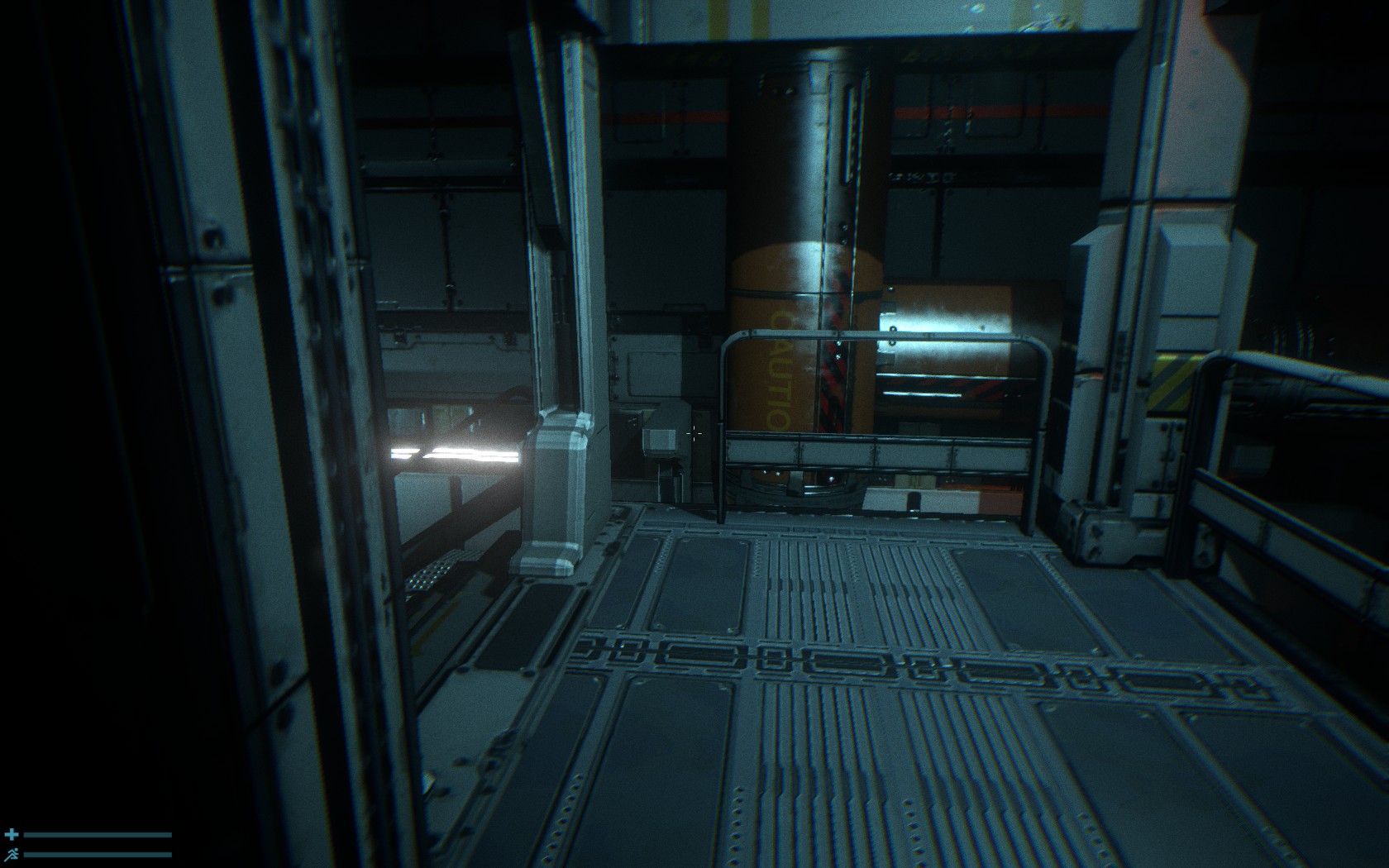
But there's an issue at the heart of Syndrome, and it's that none of it is new. From the flickering hallways, to the sudden appearance of mutilated bodies, to the dead crewmembers hanging from sparking pipes, it's all kind of old hat. Even someone as susceptible to jump scares as I am derives no pleasure from something that only seems to go through by-the-numbers spook 'em ups. It's got some interesting ideas, but they were interesting ideas twenty years ago, and then got ground down through repetition. The atmosphere just isn't there any more. It's already clear from the outset who's manipulating you, which things are going to go wrong, and where everything is. The problem, however, expands even beyond that.

The game also makes you backtrack a lot. Backtracking, long known as the scourge of every adventure gamer and gamer in general, is an egregious sin in horror games. Imagine a haunted house where they just made you wander down the same hallway four or five times in a row with different scares each time. Not a lot of fun, is it? Now imagine you had to look around for things while wandering along that same hallway. Any more fun? No. No, it's not. Syndrome is like that. You have to backtrack to find tools, backtrack to figure out what to do next, backtrack to the next scare, etc, etc. Reusing backgrounds is actually kind of admirable next to "we didn't render enough space for you to explore, so go back to this earlier level." It wrecks the atmosphere, and frustrates the player more than disturbs them
Finally, there are serious issues with controller support. As in, the game forces it whenever you have a controller attached. As in, you can't switch it off without unplugging the controller. Which, for someone with a setup like mine, is completely unacceptable, since I have to basically yank all my USB peripherals out so the game doesn't think my camera is a controller and force support. That, in a modern game, is unacceptable.
While Syndrome does some things that are vaguely admirable, most of it is not. This is a game best left avoided, even before one gets to click "play." I wish it were something better, but it appears we've reached the nadir of the survival horror genre and will probably never learn.
Final score: 2/5
Full disclosure: The reviewer received a steam key for the purposes of reviewing this game
Clustertruck Review
Imagine someone took the simplicity and design philosophy of SUPERHOT and applied it to a platformer, and you'd get Clustertruck, the latest by Landfall Games. A platformer that finds you playing "the floor is lava" on the back of featureless trucks, where one bad bounce leads to a hilarious demise and making your way through the level is about as much luck as it is skill, Clustertruck is one of those few games like the aforementioned SUPERHOT or Nidhogg where adding anything more to it would be stupid. It only has to be what it is. And it's fun like that.
Imagine someone took the simplicity and design philosophy of SUPERHOT and applied it to a platformer, and you'd get Clustertruck, the latest by Landfall Games. A platformer that finds you playing "the floor is lava" on the back of featureless trucks, where one bad bounce leads to a hilarious demise and making your way through the level is about as much luck as it is skill, Clustertruck is one of those few games like the aforementioned SUPERHOT or Nidhogg where adding anything more to it would be stupid. It only has to be what it is. And it's fun like that.
Clustertruck is simple. Run across the trucks, don't hit anything else, don't touch the ground. You can also get a number of "style points" for achieving a certain amount of hangtime in the air, leaping across trucks as they fly over the terrain, dodging obstacles, and other things like that. Annoyingly, they do not give you points for back or frontflipping, which is awesome to pull off and should definitely be added in a later update. Especially since the mouselook goes three hundred sixty degrees. You will frequently see the "YOU LOST" screen, whether it's missing a jump, getting hit by a rock, or even winding up beneath the wheels of those faithful trucks.
Get used to seeing this.
Adding to the fun, the trucks seem to collide and drive forward randomly, forming the titular clusters and unforming with equal speed as they jostle about, sometimes crashing into each other to cause explosions. What this leads to is not the normal, firm layouts of platform games, but in fact a complete anarchic scramble across dissonantly pleasant terrain.
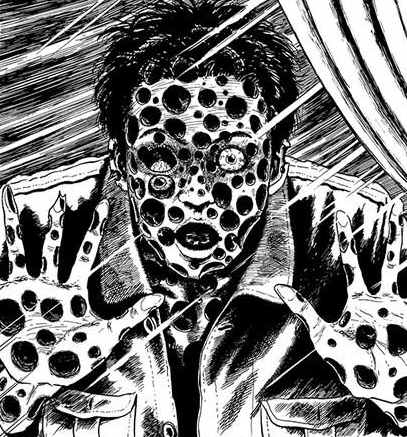
It all adds up to something incredibly simple, but also both incredibly frustrating and rewarding. When you figure out how not to ram nose-first into the ground on a level, there's a wave of relief not unlike defeating a difficult portion of Dark Souls or Superhot. When you finally finish a level, it's so worth it that often times, I don't even replay the level for better times. Once you begin unlocking abilities, it gets slightly easier, but never enough to ever relax you to a state of complacency. You will keep falling off of trucks until you finally get fed up and rage-quit, and then go back to falling off trucks all the more. It's a classic game, and one simple enough that it's well worth playing.
5/5
Full Disclosure: The reviewer received a copy of this product for review.