

Death Squared Review
Death Squared has a pretty straight-forward concept. You control between two and four colored cubes and have to guide each of them to their goal marker without letting any of them die. Cubes can trigger buttons that match their color, which can open paths and make changes to the level layout, and/or trigger additional hazards that may affect the path of to the other cube’s goals.

Release Date: March 13, 2017 (PC, Xbox One, PS4), July 13, 2017 (Switch)
Developer: SMG Studio
Platforms: PC, Xbox One, PS4, Switch (Reviewed)
Price: $14.99
Death Squared has a pretty straight-forward concept. You control between two and four colored cubes and have to guide each of them to their goal marker without letting any of them die. Cubes can trigger buttons that match their color, which can open paths and make changes to the level layout, and/or trigger additional hazards that may affect the path of to the other cube’s goals.
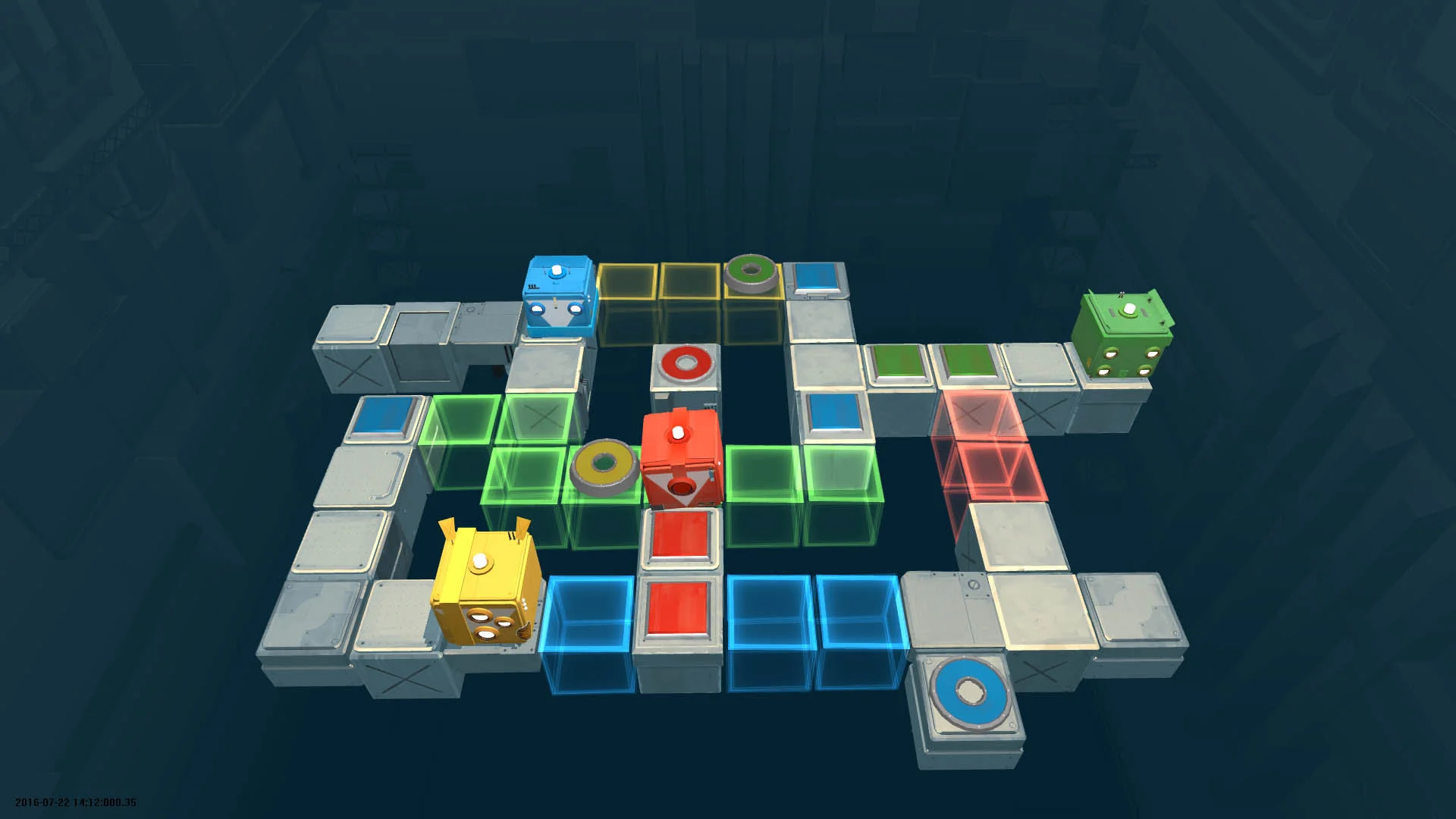
There is no real story to Death Squared, only some minor dialogue between levels. Speaking of the levels, they start out fairly easy and basic. Some of the later levels can be very, very difficult. While there is no real story to the game, there is a lab technician that provides some random dialogue as you play. Not only does he speak, he also gets more and more frustrated with you the more you die. Every now and then he will even do something to amuse himself, such as reversing your controls or spawning dozens of cubes, just to keep you on your toes. The game also keeps a running tally of how many times you've failed, rubbing it in each time you die. It can get quite irritating, but it is fun nonetheless.
When it comes to controls, you can play the game by yourself by controlling each cube by using one analogue stick for each cube. If you are playing with more than 2 cubes, you use the shoulder buttons to switch between cubes. I found it much more fun to give the second joycon to another player and work “cooperatively” to figure out the levels. The coop play in Death Squared reminded me a lot of Snipperclips. Both games require communication and patience, as well as plenty of yelling back and forth.
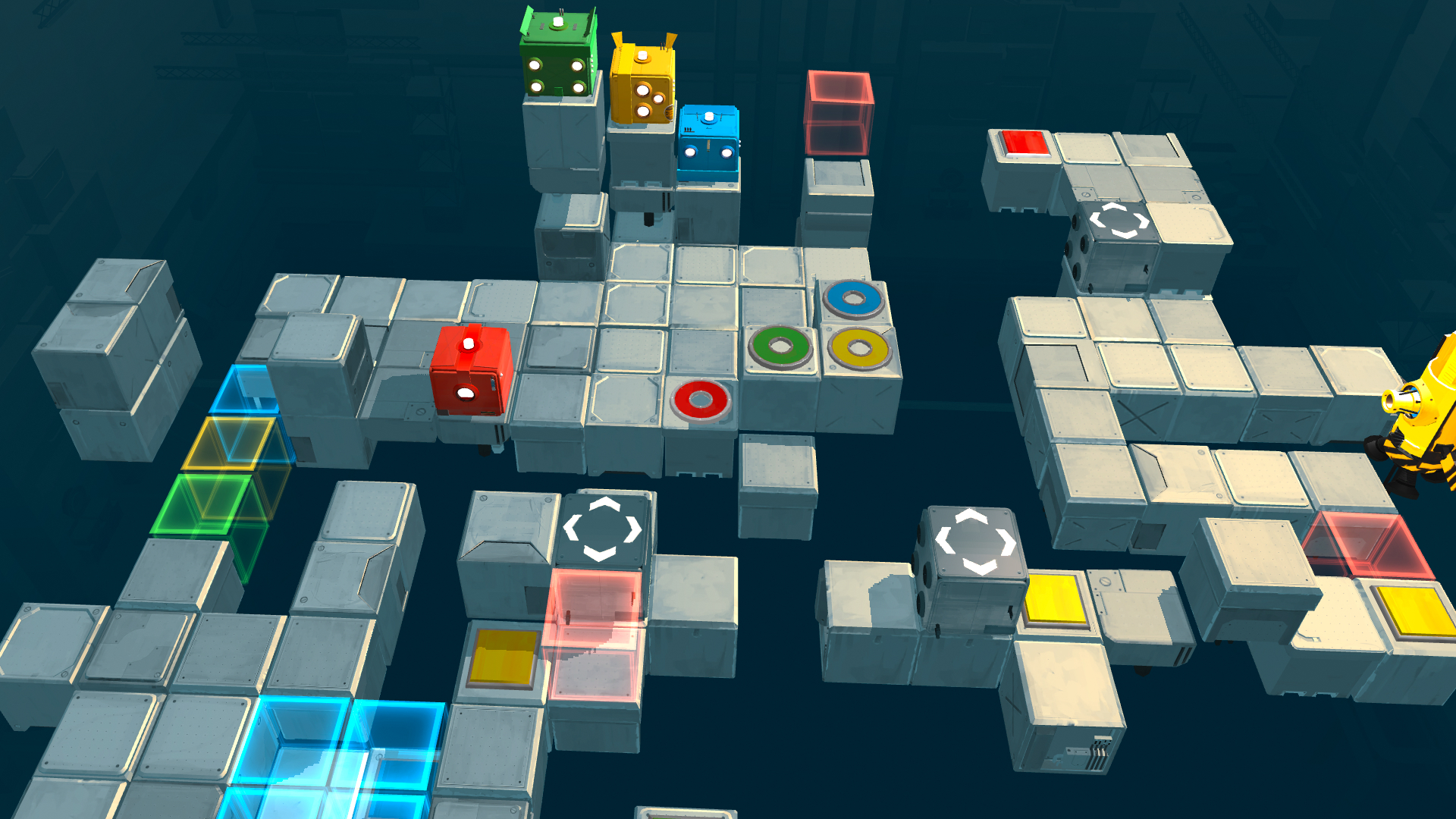
Every hazard is color coded, and cubes are immune to traps of their own color. For example, a red cube can block a red laser, allowing a blue cube to pass by. The levels can be thought out and played at your own pace, which is nice. You can move as slowly as you like to try and anticipate the hazards, as well as analyze and figure out a strategy to each level before you even make a move.
The graphics and design are very well done. Levels are crisp and easy to read. There are optional cosmetic decorations for every cube, and you can collect more patterns by finding them in secret areas throughout story mode.
There’s 80 two cube levels, 40 four cube levels and then you can also unlock the vault, which is a collection of super tough puzzles that show no mercy. The number of levels in Death Squared provide lots of replayability, especially when playing with a group of people. It can be fun to see what group, or team, can finish a level the quickest, as well as see what various types of strategies everyone comes up with. The Switch’s JoyCons make it even easier to pass the game around and have some fun. Speaking of JoyCons, the game runs equally as smooth in both docked and handheld modes. I noticed little to no difference between the two.
Death Squared can be fun by yourself, but it’s even better with some friends. Anyone that enjoyed multiplayer, cooperative puzzlers, such as Snipperclips, will enjoy Death Squared.

Pros
Great cooperative gameplay
Crisp, detailed level design
Lots of levels, providing lots of replayability
Cons
Can get too difficult for some
Thank you to SMG Studios for providing us with a review copy.
Puyo Puyo Tetris Review
Puyo Puyo Tetris is a four-player puzzler mashup that launches April 25 for $39.99 on the Nintendo Switch. It combines the classic falling-block action of Tetris with the bean-matching gameplay of Puyo Puyo, which is similar to Kirby’s Avalanche. These games are mixed in a variety of ways, depending on the game mode you choose, but publisher Sega has found a way to do just about every possible combination.
Release Date: April 25th, 2017
Developer: Sega Studios
Platforms: Nintendo Switch
Price: $39.99
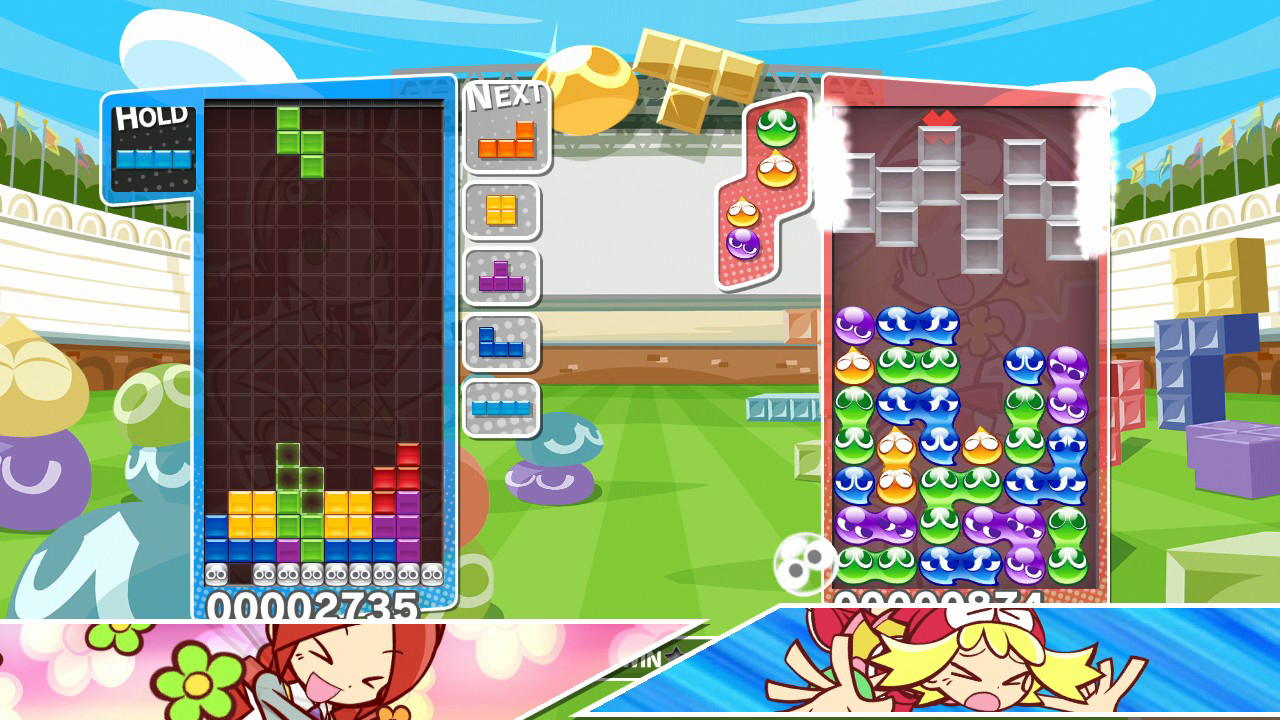
Puyo Puyo Tetris is a four-player puzzler mashup that launches April 25 for $29.99 on the Nintendo Switch. It combines the classic falling-block action of Tetris with the bean-matching gameplay of Puyo Puyo, which is similar to Kirby’s Avalanche. These games are mixed in a variety of ways, depending on the game mode you choose, but publisher Sega has found a way to do just about every possible combination. As expected, you can play Puyo Puyo or Tetris on their own. You can also play them at the same time, on the same playfield, or randomly on their own playfield as the game switches between the two. You can even play Tetris against someone playing Puyo Puyo.
When you start up the game, you are given three options that allow you to instantly start a game of Puyo Puyo, Tetris or Mix Mode. A game like this on the Switch should be simple to pick up and go and Puyo Puyo Tetris is very good at this aspect. The fact that I can boot up the game and be in a game in less than a minute is perfect for the handheld mode.
Even with all of these game mode options, there is a full story mode in which you follow the characters of the Puyo Puyo franchise. They meet new friends who don't seem to know your game and only play something called Tetris. In story mode, you will play missions which vary from competing against opponents to clearing out certain objectives as quickly as possible. The objectives are pretty straight forward and the difficulty of these levels are at just the right level to give you a little challenge, but not too arduous. The story mode is also a good tool to help learn different aspects of both games. Each level also has a 3-star objective system, which you earn a star for completing each of 3 different objectives in a level. These vary from defeating your opponent within a certain amount of time to earning a certain amount of points. Some of these objectives can be tough, but I found myself replaying some levels to attempt to get that 3rd star. It took me about 6 hours to complete story mode, but I didn’t 3-star every level.
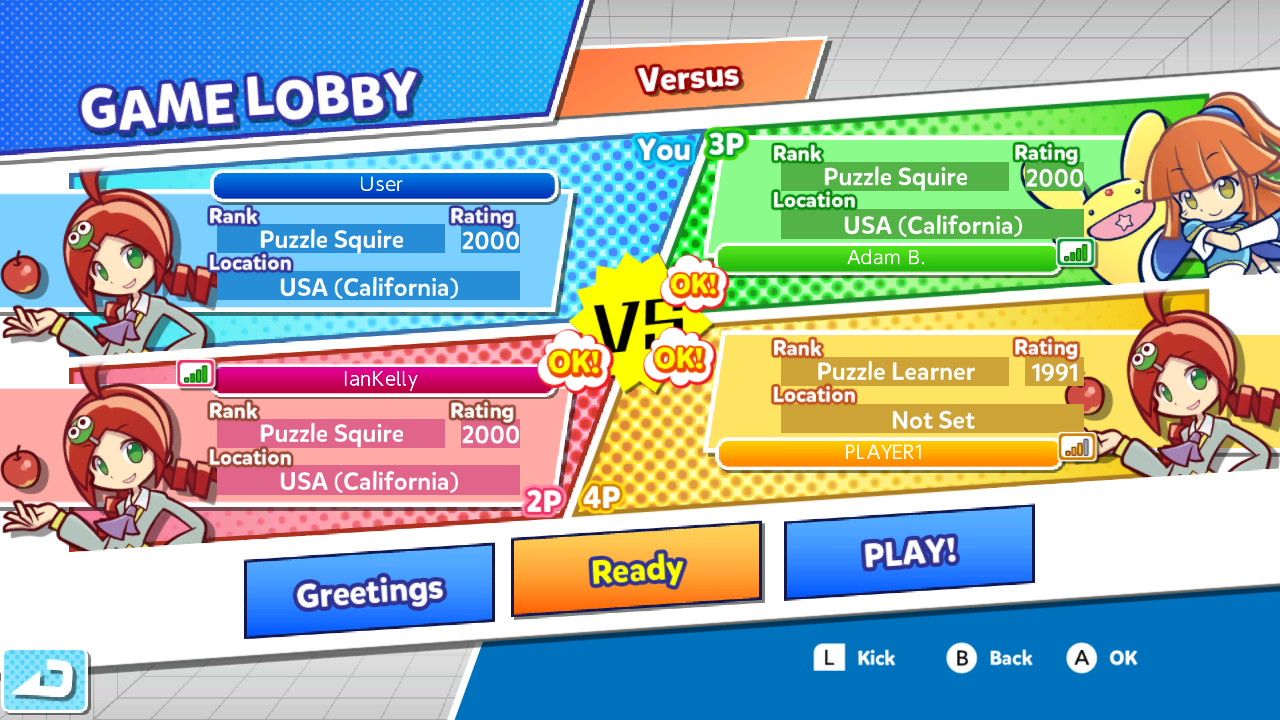
I had the most fun in the competitive modes. One mode I really enjoy is Big Bang Mode, which is basically an Endless Fever game with up to 4 players. Players continuously solve easy puzzles for points and build up an attack bar. After a certain amount of time has passed, players battle it out and those with an edge can deal some heavy damage to the opponent's hit points. Once a player is out of hit points, they are eliminated from the game. The last player standing wins.

Multiplayer games can be played locally on TV or tabletop mode, locally with multiple Switches and online. At the time of review, online matches were not available, but I am really looking forward to getting into some online matches after the launch of Puyo Puyo Tetris on April 25. From what I could find in the Online menus, you can play against random players or easily set up a match with a friend. You can also make your own lobbies and add specific rules to challenge the internet at large.
Puyo Puyo Tetris makes its arrival on the Nintendo Switch in grand fashion. Anyone that enjoys a good puzzler from time to time should pick this one up. The solid amount of modes, both solo and online, keep the replayability high. Puyo Puyo Tetris is one of the best games currently available on the Switch. Don't miss out when it releases very soon

Pros
- Colorful art style
- Easy to pick up and play
- Great variety of game modes
- Very entertaining multiplayer modes
Cons
- Some single player competitive modes are too easy
Thank you to Sega for giving us a copy for review.
Poncho Review (PS4)
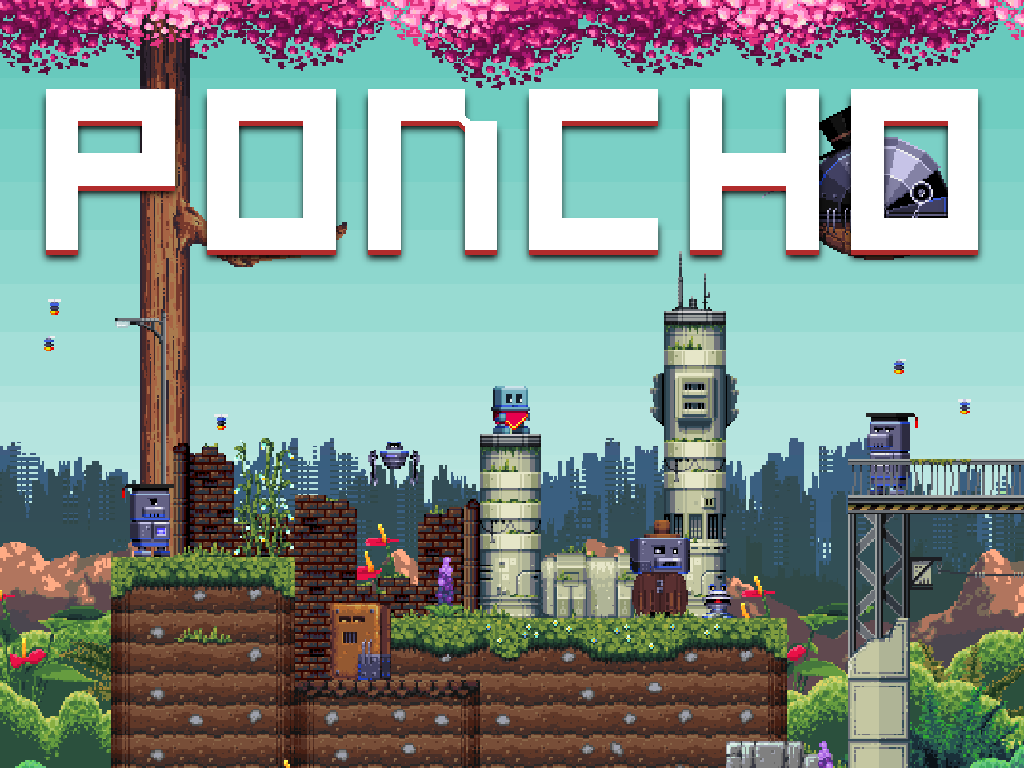
Poncho is a two-dimensional, semi open-world, scrolling platformer with puzzle-solving elements that takes place in a world where all humans have been eliminated, leaving only animals and a bunch of robot servants. You, the player, control one of these servant robots named Poncho. Your goal is to discover who your maker is and why humanity was wiped off the face of the world.

Poncho is a two-dimensional, semi open-world, scrolling platformer with puzzle-solving elements that takes place in a world where all humans have been eliminated, leaving only animals and a bunch of robot servants. You, the player, control one of these servant robots named Poncho. Your goal is to discover who your maker is and why humanity was wiped off the face of the world.
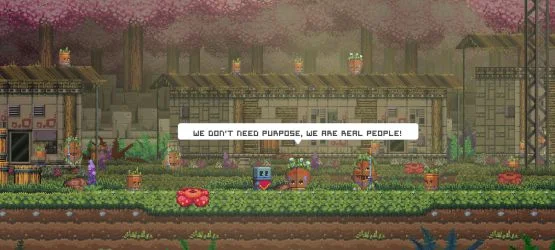
Poncho contains wonderful pixel-art graphics with vibrant colors, which works great for this style of platformer While it is a two-dimensional platformer, the levels actually contain 3 different layers (think Little Big Planet). Navigating between these layers is as simple as pressing R1 and L1 to move forward and backward, respectively. I found myself switching between layers quite often, and this aspect of the game makes the game even more fun. The one issue I had with the layers was that there were a few times that I needed to make a jump but wasn’t sure which layer I needed to be in to make that jump. This resulted in a few trial-and-error attempts.

As I mentioned before, Poncho is a semi open-world game. You are pretty much free to go through the levels in any order you want, but in order to get to certain parts you will need to unlock color-coded gates. These gates can be unlocked with color-coded keys, which you obtain by finding them throughout the world or buying them from robot merchants using gems that you find in the open. I found myself back-tracking quite a bit to find or buy keys to advance, but not too much.
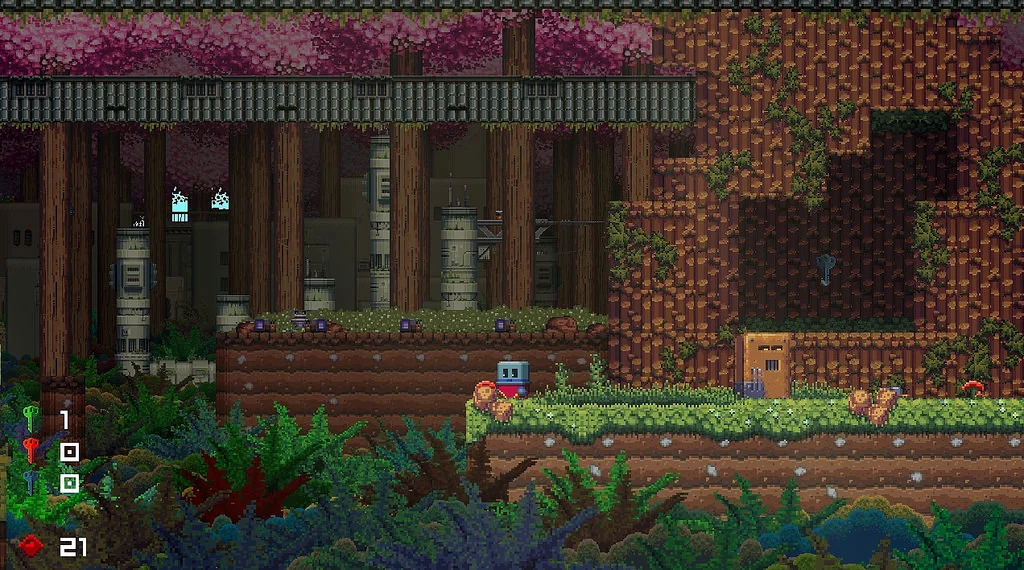
The gameplay and controls in Poncho are very good. Guiding Poncho through the levels is fairly easy. Both the platforming and puzzle aspects of the game are implemented very well. One of the few problems I had with Poncho is that there are very few checkpoints in the levels, so when you happen to fall (make a jump on wrong layer), you likely will have to start from the beginning of the level, which can become quite frustrating when you reach a difficult area.
Overall, Poncho is a fun game with vibrant graphics, solid gameplay and a unique story. I ran into a few glitches, but nothing serious. The game can become frustrating at times, but nothing that ruins the fun of the game. If you are looking for a new platformer/puzzler to try out, give Poncho a shot. I don’t think you will regret it at all.
Score 3 out of 5
Thanks to the publisher for supplying a copy for review