

Titan Quest Review
Titan Quest is a loot-gathering dungeon crawler that was first released on PC in 2006 and was one of the main contenders up against Diablo 2. Titan Quest, and it’s expansion ‘Immortal Throne’, were both critically amazing games and ranked up there with the best of the games within the genre. Fast forward to today, Titan Quest has been released on current gen consoles, but can it hold up to its success from 2006?

Release Date: March 20, 2018
Platform(s): PS4, Xbox One, PC
Developer: Black Forest Games
Price: $29.99
Titan Quest is a loot-gathering dungeon crawler that was first released on PC in 2006 and was one of the main contenders up against Diablo 2. Titan Quest, and it’s expansion ‘Immortal Throne’, were both critically amazing games and ranked up there with the best of the games within the genre. Fast forward to today, Titan Quest has been released on current gen consoles, but can it hold up to its success from 2006?

The story in Titan Quest is pretty good. The Titans once ruled the primordial darkness before the Olympian Gods appeared and thus begun the great war. The Titans were all exiled and imprisoned whilst the Olympians ushered in a golden age all across the mortal realm. Sometime later, three smaller Titans called Telkines had managed to break the communications conduit the Olympians held between the immortal and mortal realm and thus, summoned hordes of creatures to terrorise the humans and prepared the release of the mighty Titans.
You take control of a character, which you can only customize by sex and color of their tunic, who is learning of these events. You begin by running into enemies terrorizing a horse in a field, but before you know it you will be battling with hordes of enemies across all of the land. Through your journey, you will travel to Egypt, China, Greece and Olympus. You will encounter many different creatures of the underworld as well as mighty Titans and even Olympic Gods.

As with most games released on PC only in this genre, they were originally controlled by keyboard and mouse. Having multiple menus and interfaces may be difficult to map onto a controller, but Black Forest Games did a great job of mapping these controls without causing too much confusion. Navigating to the different menus is pretty smooth and easy to learn. However, the basic movement controls of your character are not as smooth. Pressing the stick slightly in one direction or another moves your character quite drastically, making precision movement very difficult.
Another issue I have with the controls is that you cannot choose who you are attacking, you are simply locked onto the nearest enemy. I found myself in multiple situations where I wanted to attack a distant enemy first with my bow, but was not able to because other enemies were closer.
Another question most people have about a game first released in 2006 that is re-released in 2018 is how well do the graphics look? Titan Quest was remastered with updated graphics and it looks pretty good. While you can’t move the camera around, you can zoom in and out and when zoomed in you can see the great detail put into remastering the visuals. All of the models look very good both zoomed in and out.

Being a loot-gathering game, there are a vast array of weapons and armor which you can pick up off dead bodies, find in chests and buy from the merchants. With that said, most of these are purely stat-increases and don’t really make a huge difference in combat. There is a decent selection but you will find yourself with multiple duplicate items.
Titan Quest can be played single player or online co-op with up to 6 people. Unfortunately, there is no local co-op, which is a real bummer. However, the online play works very well and is a lot of fun.
Overall, Titan Quest is a good remaster of the 2006 original. Fans of the original will likely enjoy the remaster, as long as they can get over the wonky movement controls. Others that enjoy loot-gathering dungeon crawlers may enjoy Titan Quest, but they should understand that it is a remaster of a 12 year old game before jumping in.

Pros
- Nicely remastered textures and environments
- Menu system and UI remapping were done very well
- Entertaining storyline
Cons
- Movement controls are not very fluid
- Cannot choose enemy to lock onto
- No local co-op (online only)
Thank you to Black Forest Games for providing us a copy to review on PS4.

Disc Jam Review
Disc Jam by High Horse Entertainment is best described as a pong/tennis game using a frisbee. Just like in tennis, there are 1v1 Singles and 2v2 Doubles matches. Instead of using a ball and racket, players launch a giant frisbee at each other until one player misses and concedes the goal.

Release Date: February 8, 2018 (Switch)
Platform(s): Playstation 4, Windows PC, Nintendo Switch*
Developer: High Horse Entertainment
Price: $14.99
Disc Jam by High Horse Entertainment is best described as a pong/tennis game using a frisbee. Just like in tennis, there are 1v1 Singles and 2v2 Doubles matches. Instead of using a ball and racket, players launch a giant frisbee at each other until one player misses and concedes the goal. Goals are worth differing amounts of points. The longer the rally goes, the higher the points awarded to the scoring player. There is a scoreboard in the middle of the net that shows how many points the current rally is worth. The first player or team to amass 50 points wins the set, and the first to win two sets takes the game. It is a very simple, but addicting experience.

There are 4 characters to choose from when you first start Disc Jam, with 2 more characters that you can purchase using in-game currency. Every character has the ability to perform lob, power and curve throws, but each character has their own unique strengths. For example, Stanton has a lot of strength which allows him to excel at power throws, while Haruka has a lot of agility which allows her to quickly move from one side of the court to the other. You can definitely tell the difference between characters, but it has never felt like one character completely overpowers another. It more or less comes down to preference and skill.
The graphics and sound in Disc Jam are really good. Each character looks unique and their designs illustrate their playstyle. For example, you can tell Stanton has brute strength just by looking at him. The animations and focus on detail are very good and the colors are vibrant.
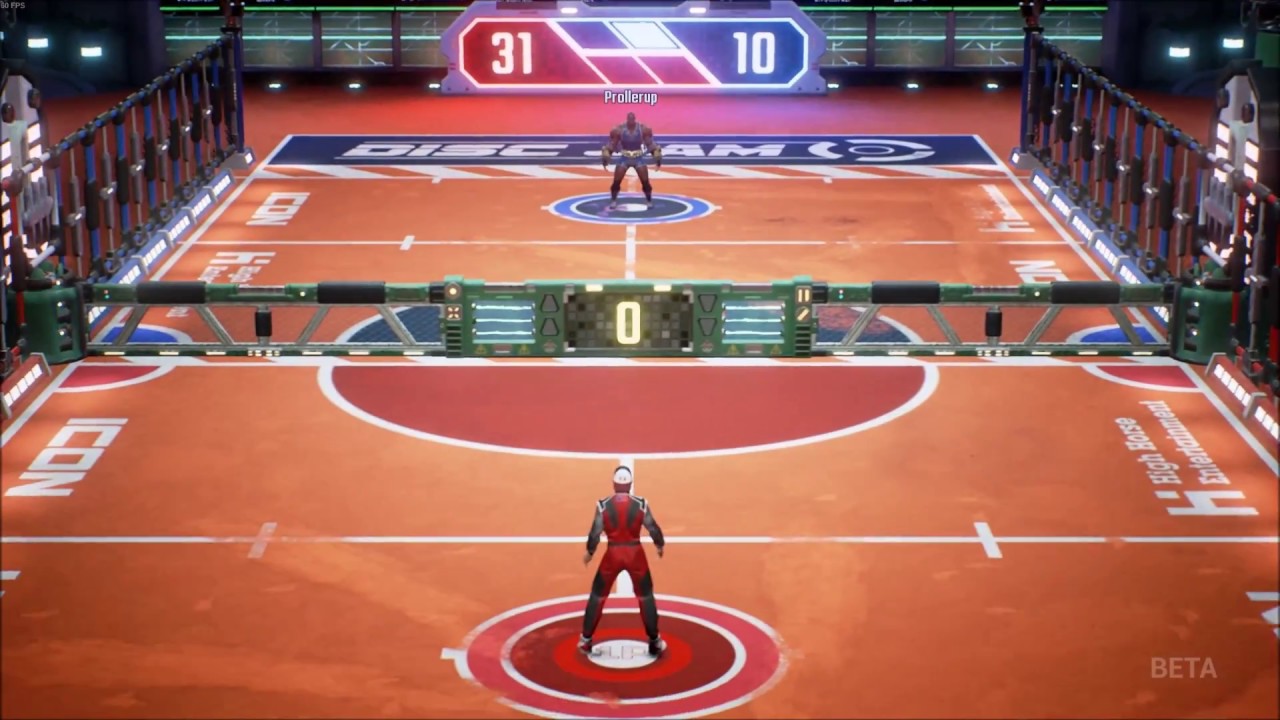
Matches can be played in single player, local multiplayer and online multiplayer modes. Online multiplayer works like a charm. Games connect and load quickly and I experienced little to no lag, which is important in a game like this. New players are placed in ten placement matches with helps the system get a feel for your skill level. After these matches, you are put into a league of players of similar skill level. I found this system to work quite well.
In single player matches, Disc Jam has what’s called the Ghost Arcade. This is very similar to racing ghosts of other players in Mario Kart in that you play against the ghosts of other players which helps keep the skill level of your opponent fairly even. I never really found myself blowing out an opponent or getting absolutely demolished myself.

As I mentioned before, there is an in-game currency that players can use to unlock items for use in online play, such as new skins, discs and characters. Everything is unlocked from the very beginning in single player mode, so you can test out the different items to help decide what you want to spend your hard earned currency on for online play. You only earn the currency when playing online matches, so you could say this currency is a form of leveling up.
Overall, Disc Jam is a very fun and addicting game. The game plays very well in both docked and undocked modes, with very little to no difference. Online play is very smooth and balanced, and single player and local multiplayer is just as fun. If there is one downside to Disc Jam, it would be that I found the battery life on my Switch to fall drastically while playing. If you enjoy this kind of over-the-top action-sports games, Disc Jam is a steal at $14.99 on the Nintendo eShop.

Pros
Unique characters and playstyles keep matches interesting.
Great looking graphics with gameplay that runs smoothly.
Online play runs like a charm.
Fun to play in single player and local multiplayer as well.
Cons
Seems to drain the Switch’s battery life substantially faster than most games.
A special thank you goest out to High Horse Entertainment for providing us with a review copy.

Strikers Edge Review
Strikers Edge, developed by Fun Punch Games, is basically a game of Dodgeball with weapons combined with classic arcade visuals and sound. Two or four players are put in an arena that is divided down the middle and contains barricades, which can be broken. Depending on the characters chosen, players throw swords, axes, arrows and more at their opponents to try to eliminate them.

Release Date: January 30, 2018
Platform(s): PS4*, Steam PC
Developer: Fun Punch Games
Price: $14.99
Strikers Edge, developed by Fun Punch Games, is basically a game of Dodgeball with weapons combined with classic arcade visuals and sound. Two or four players are put in an arena that is divided down the middle and contains barricades, which can be broken. Depending on the characters chosen, players throw swords, axes, arrows and more at their opponents to try to eliminate them. The gameplay is extremely simple, you control your character with the left analog stick and aim with the right. Players can also dodge, block and use a special attack. The action is very fast-paced and can get quite intense.

Each character offers slightly different movesets, but the only way to learn each one is simply by playing as each character. While there is a tutorial that shows the basics of the game, there is no training mode that allows you to practice. With that said, there is a campaign mode that contains a storyline for each character. These storylines are pretty thin, but it helps make the somewhat repetitive single player mode a little more enjoyable.

Multiplayer is where Strikers Edge really shines and playing with others is a much more enjoyable experience than facing the AI over and over. Online multiplayer features cross-play with the PC version, but finding an opponent can take a while. The online matches I played were quite fun, but there was definitely some noticeable lag, which is a bit of a problem in a game that has you aiming precise shots and second guessing your adversary's movements.
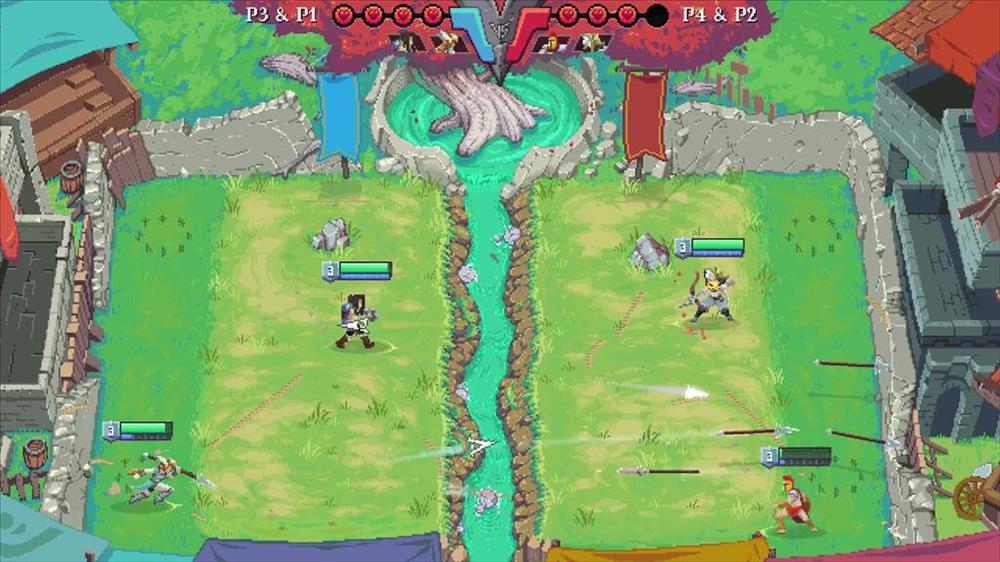
Local multiplayer is definitely the best experience. Playing with 4 players on the couch, throwing, dodging, blocking and yelling at each other can get pretty hectic and fun. I played several matches that had everyone in the room watching and yelling as me and my foe were both down to our last bit of energy and one of us would dodge just before getting hit. Moments like that are what makes Strikers Edge fun. Unfortunately, after a few matches, it does get a little repetitive and old. Strikers Edge is very light on content, with only four arenas in which to fight and very few modes to try. The stages alter things slightly with different obstacles and hazards, but you'll quickly grow tired of them.
Overall, Strikers Edge is a good, fun couch multiplayer game. The pixel art style and sound are almost perfect for this type of game since there is so much going on at all times. The controls are easy and fluid, but the gameplay gets boring after a little while. Having more modes, such as a free-for-all, as well as more variety in arenas would be a great addition. With improvements, I could see this being a big multiplayer game.

Pros
Local multiplayer is lots of fun
Unique characters
Pixel art style fits the game very well
Cons
Gets repetitive after a short time
Lacks content
Campaign lacks depth
A special thanks goes out to Fun Punch Games for providing us with a review copy on the PS4.

Light Tracer Review
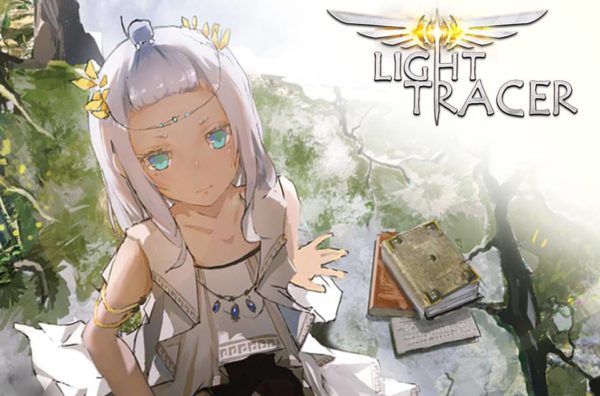
Light Tracer combines platform-style movement and unique puzzles with exceptional controls and graphic style. Using two Move controllers, players lead a princess to the top of a tower to help her save her people. One controller is used to wield a Light Staff to guide the princess and the other interacts with objects and moves the camera around the world. Players will use a combination of jumping skills, precise timing and strategic attacks to complete eight chapters with five levels each.
Release Date: September 26, 2017
Platform(s): PSVR
Developer: Void Dimensions
Price: $14.99
Light Tracer combines platform-style movement and unique puzzles with exceptional controls and graphic style. Using two Move controllers, players lead a princess to the top of a tower to help her save her people. One controller is used to wield a Light Staff to guide the princess and the other interacts with objects and moves the camera around the world. Players will use a combination of jumping skills, precise timing and strategic attacks to complete eight chapters with five levels each.

As with most VR games, the controls in Light Tracer are a little difficult to adapt to at first, but I got used to them fairly quickly. One thing I found that I didn’t like was that I had to center the camera quite often. As mentioned before, one controller is used to move the world around and this is used quite often. Some levels require a bit of rotating the world in order to look at the path ahead of the princess to plan out your strategy or solve puzzles. Doing this causes quite a bit of re-centering the camera.

With that being said, the gameplay in Light Tracer is very fluid and immersive. The levels get more and more difficult as you go, with little messages appearing with info every now and then, such when you unlock a new ability or need to use an ability for the first time. This doesn’t make the game any easier, it just notifies you about what the princess is able to do now. Thankfully, there are checkpoints throughout the levels that you will return to if you die. Not only are these appreciated due to the rising difficulty level, they also give you a chance to take your time and explore different ways to solve puzzles and advance through the stages.
At one point, the constant rise in difficulty reaches the point where you can control gravity in an upside down world, and a world with mechanical puzzles that are even harder to beat. This all goes for the bosses as well. The first boss requires a couple of easy moves, but after that, each boss can take a few tries before conquering. The boss puzzles are fun and usually more challenging than their stages, as they usually combine recently learned mechanics with some new idea or twist that you need to really think of to identify and successfully beat each boss.

When it comes to graphics, the game is beautifully designed. The levels are fantastic and beautiful with quirky characters as enemies, and every single platform is unique. As for character design, each type of terrain has its own type of enemy and they are all cute and quirky. There are different outfits you can purchase for the princess by collecting crystals strewn about the levels. There are three dresses and one panda suit. Yes, a panda suit. The crystals are easy to get at first, but later it becomes a life-or-death choice when there are multiple moving platforms and enemies and 10 crystals to be had over a gaping hole in the center of the platform.
Overall, Light Tracer is a very fun and intuitive VR experience. The controls can take a little bit to get used to, but once you are used to them they come natural. The increasing difficulty is a plus, as it never becomes too easy or too difficult. In fact, have those ‘aha’ moments is one thing that makes you want to keep going. The only downside to Light Tracer is the camera issues, but I was able to put these aside for the most part. If you enjoy platforming puzzle games and own a PSVR, Light Tracer is a no-brainer purchase for $14.99.

Pros
- Fluid and intuitive gameplay and controls.
- Beautiful graphics
- Unique and challenging puzzles
Cons
- Camera angles can cause problems
Thank you to Void Dimensions for providing us with a review copy.

A Hat in Time Review
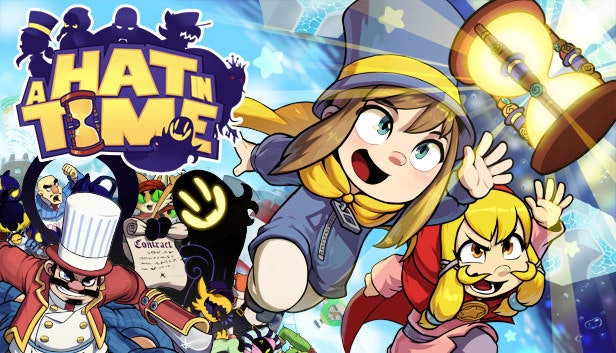
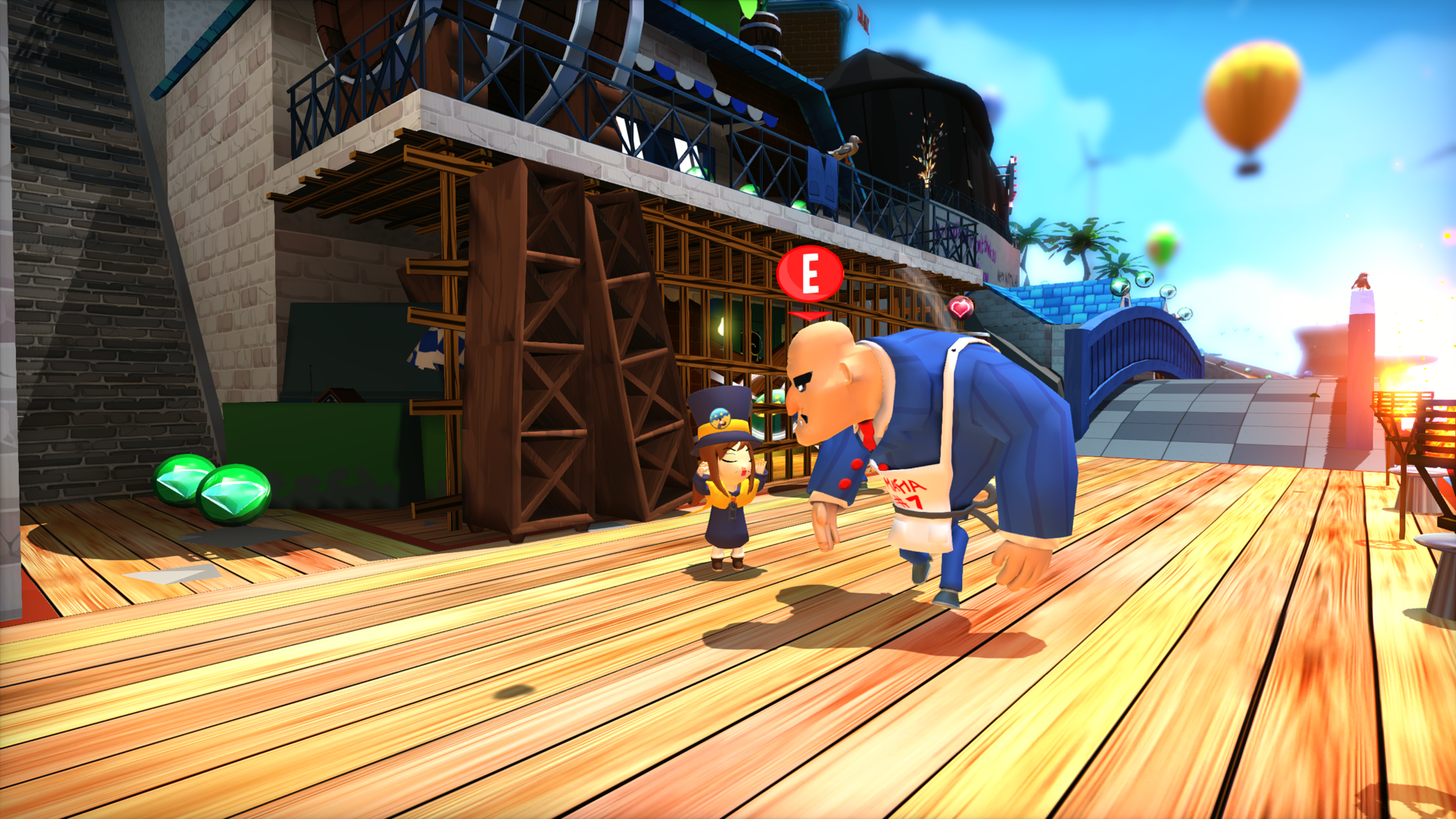
In A Hat In Time players play as Hat Girl, a top hat wearing child captaining her own ship from world to world on her own. As the game starts, you encounter a bald mafia man knocking on the outside of your windshield and demanding you pay a toll for occupying his planet’s airspace. When you refuse, he smashes the window, sending you, along with 40 hourglasses that power your ship, falling towards the planet. To make it back home, she must venture down to the surface and collect all the time she lost.
Release Date: December 5, 2017 (PS4)
Platform(s): PlayStation 4, Xbox One, Microsoft Windows, Mac
Developer: Gears for Breakfast
Price: $29.99
In A Hat In Time players play as Hat Girl, a top hat wearing child captaining her own ship from world to world on her own. As the game starts, you encounter a bald mafia man knocking on the outside of your windshield and demanding you pay a toll for occupying his planet’s airspace. When you refuse, he smashes the window, sending you, along with 40 hourglasses that power your ship, falling towards the planet. To make it back home, she must venture down to the surface and collect all the time she lost. Naturally, the only way to survive the planet's strange locales is to utilize a bottomless collection of flashy headwear.
Stages come in the form of different planets, floating across the universe, waiting to be unlocked with timepieces. Hat Girl’s spaceship is filled with cuddly toys, pillows, and even a Roomba. Jumping on the latter unlocks a trophy, highlighting one of the many excellent touches A Hat in Time hides across its charming world. The hub area is filled with nifty secrets, many of which are discovered naturally once you unlock new hats.
Along with collecting the hourglasses needed to power your ship, you can also collect balls of yarn. These balls of yarn are used to craft different types of hats that can be used in many ways. You’ll only craft a small range of hats throughout A Hat in Time, but the number of ways they can be used are vast. Whether it’s a hat that gives you the ability to sprint or see into the nether realm, platforming and puzzles are engineered to make you think both fast and outside the box. Gaining different abilities using these hats made me want to go back to previous levels to explore for more hidden goodies.
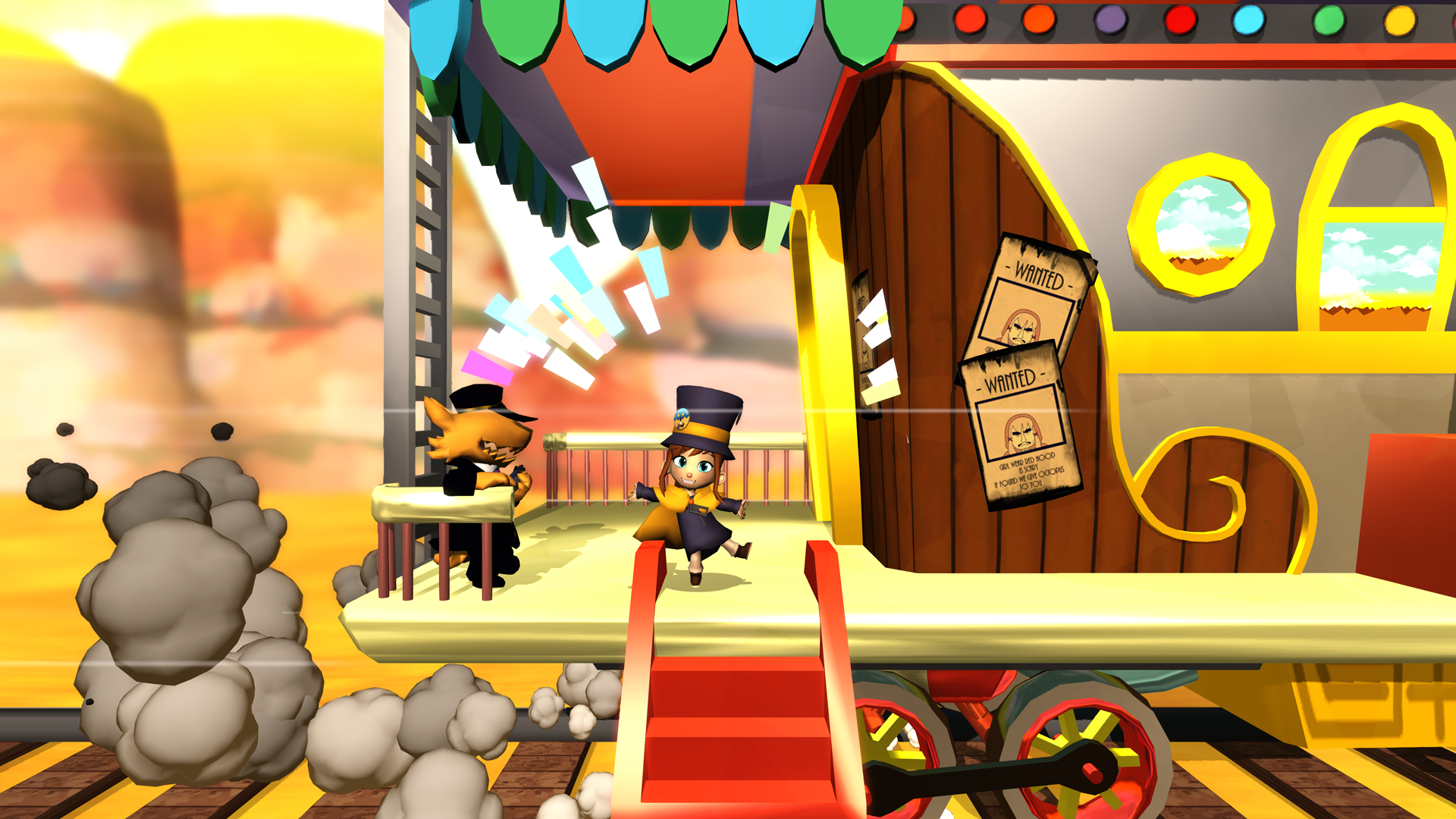
Visually, A Hat in Time looks wonderful and the controls are smooth, for the most part. However, my one main gripe is that the camera can be unpredictable from time to time, making some platforming elements difficult and frustrating. The main levels are fairly easy to get around and enemies are easy to defeat. The boss battles are a lot of fun and each one is different. While they are not difficult, each boss battle takes some thinking to figure out the best way to defeat the boss. Again, each hat you craft can help you defeat these bosses in different ways.
Overall, A Hat in Time gives off a Super Mario 64 vibe and is a very fun platformer collect-a-thon. There is a lot to explore and collect, levels are a decent difficulty and each boss scene is fun and unique. I found myself using the different hats I crafted to explore as much as possible and reach areas that I thought weren’t possible before obtaining certain hats.

Pros
- Lots of collectibles to find with many ways to explore the world.
- Visually fantastic
- Boss battles are fun and unique
Cons
- Camera can be very unpredictable
Thank you to Gears for Breakfast for providing a review code. This review was done on the PS4 version of the game.

Rive: Ultimate Edition Review
Rive: Ultimate Edition is a 2D twin-stick shooter in which you play as Roughshot, a scavenger trapped in a vast, dilapidated ship from which you must escape. You’ll embark on your adventure in a Spidertank, a walking/flying hybrid ship that fittingly looks like a spider.

Release Date: November 17, 2017
Developer: Two Tribes
Platforms: Nintendo Switch
Price: $14.99
Rive: Ultimate Edition is a 2D twin-stick shooter in which you play as Roughshot, a scavenger trapped in a vast, dilapidated ship from which you must escape. You’ll embark on your adventure in a Spidertank, a walking/flying hybrid ship that fittingly looks like a spider. Using your Spidertank, you’ll need to find your way out while taking out all kinds of enemies and collecting scrap metal they leave behind, while dying quite often. Thankfully you come across checkpoints quite often because you’ll need these checkpoints, considering the amount of times you will die. Most enemies you encounter don’t do a whole lot of damage, but the amount of enemies that come at you at any given time can be overwhelming and take total concentration to avoid their attacks.

The main campaign in Rive: Ultimate Edition offers 12 missions, each with worldwide and friend leaderboards. There are also a few other modes and options to keep you coming back for more, such as single credit mode where you do not get any continues. There is also a unique co-op multiplayer mode where each person takes control of one aspect of the ship. One person will control movement and the other will man the gun, alternating after each death. I found this mode to be quite fun with friends and family.
The core gameplay and mechanics of moving, jumping and shooting are very fluid and smooth, and even though the rigid difficulty can be frustrating at times, I always found myself jumping back in for more. Unlike most shooters of this genre, you won’t find random upgrades in the environment and then lose them upon dying. Instead, you use the loot you find by destroying enemies to permanently unlock four different abilities by purchasing them after completing missions. Each upgrade has situations when they work best, such as the shotgun blasts are great for tight corridors with hordes of enemies. Homing missiles are solid for more open areas where enemies are spread out. These abilities should be used wisely as each one can only be used once before you need to find more ammo. In addition to upgrading your abilities, you can also boost your ships armor and range in which it gathers ammo. However, the most unique ability is the ability to hack. Early on you’ll hack computers to open paths for you to continue pushing forward, but eventually gain the option to hack certain enemies. These range from heal bots to literal trains.

Visually, Rive: Ultimate Edition look fantastic and runs at a smooth 60FPS in 1080p when docked and 720p in handheld mode. Even with all of the hectic action happening on the screen at once, I never noticed any slow down. The environments both inside and outside of the ship look sharp and detailed.
Rive: Ultimate Edition is a very fun, albeit difficult, twin-stick platformer/shooter. While the difficulty can be mildly frustrating, I found myself wanting to play more and more, rather than giving up. For $14.99 on the Nintendo eShop, it is a steal!

Pros
Solid, fluid gameplay
Fantastic graphics with no dips in framerate
Tons of fun
Cons
Mildly frustrating difficulty
Could use more upgrades
A special thank you to Two Tribes for providing us a review copy of Rive: Ultimate Edition.

This is the Police Review
In This is the Police, you play as long-time Police Chief Jack Boyd. At the beginning of the game, Jack is given the news that the Mayor is forcing him into an early retirement. He is given 180 days until his job is finished, and he will be forced to hand it down to his successor. You begin playing at the beginning of those 180 days as you attempt to and keep your police force together for those 180 days.

Release Date: August 2, 2016 (PC, macOS, Linux); March 22, 2017 (PS4, Xbox One); October 24, 2017 (Nintendo Switch)
Developer: Weappy Studio
Platforms: PC, Xbox One, PS4, Switch (Reviewed)
Price: $29.99
In This is the Police, you play as long-time Police Chief Jack Boyd. At the beginning of the game, Jack is given the news that the Mayor is forcing him into an early retirement. He is given 180 days until his job is finished, and he will be forced to hand it down to his successor. You begin playing at the beginning of those 180 days as you attempt to and keep your police force together for those 180 days.

The gameplay in This is the Police basically consists of managing your police officers, which are split into two shifts and alternate between days. As calls come in for your officers to respond to, it is your duty to send out what you feel is the correct number of officers, as well as which officers will successfully respond to the call without any injuries or casualties. A majority of the calls you receive will be dealt with without your intervention, but some of them require your input on decisions that will end the situation in one of a few ways. For example, I had a situation where a domestic dispute was happening inside of a home and officers could hear yelling. I could choose between knocking on the door, breaking down the door or surrounding the house and yelling in.
I found most, but not all, of these decisions to be fairly easy to choose the best answer. It seems that every question has a logically correct answer, a “risky, but could work answer” and a “obviously not going to work, but let’s see what happens” answer. I don’t think I had any of these events give me a decision that I didn’t immediately know the answer to. Not only are the best answers obvious, the decisions don’t really make a difference at all when it comes to the story, which really hurts the game. No matter what choices you make, the story follows the same path. It would have been much better if there were different storylines based on the decisions the player makes. The only thing that happens when you make a bad decision is that you can be fined money, which is used to hire more officers. In the end, this does make a little difference in how you play the game, but the “fines” are not that big, so it doesn’t affect your strategy too much.

There is some strategy involved in This is the Police that helps keep the game interesting, such as hiring new officers and promoting current staff. Each officer has a rating and a “stamina” bar of sort. The higher an officer’s rating, the more likely they will respond to a call without injury or casualties. Each incident call has a limit to the number of officers you can send, so choosing the best officer combination for each call adds a bit of strategy to the game as well. You don’t want to have your top officers out together on a call and have a high priority incident call come in, leaving you with only your lower rank officers to handle the call. Each day the officers’ stamina bar will drop and if they get too low the officer will not perform as well as normal and will need a day or two off in order to restore their stamina. Sometimes officers will request random days off, with various reasons. It is your job to approve or deny these days off and, depending on your answer, the officer may get upset and not perform well because of it. These are the only decisions that I found made a big difference in gameplay.
This is the Police has a good concept and the story is actually pretty good, even though your decisions do not change it at all, but the non-branching storyline and repetitiveness are pretty big downfalls. At the $29.99 price point, I would wait and give the game a look when it’s on sale.

Pros
Good, funny storyline
Simple, easy to learn UI
Good concept and strategy elements
Cons
Non-branching storyline
Becomes very repetitive
No real consequences for bad decisions
Thank you to Weappy Studio for a review copy on the Nintendo Switch.

Slime-san Review
Slime-san is a simple, yet very difficult platformer where each single-screen level consists of four very unique stages, which constantly change in mechanics and available tools to use. Players control a green glob of slime and have less than a handful of moves to help guide him/her/it through the levels, a standard jump, a dash move and a phase move.

Release Date: Auguest 3, 2017
Platform(s): PC, Nintendo Switch (Reviewed)
Developer: Fabraz
Price: 11.99

Slime-san is a simple, yet very difficult platformer where each single-screen level consists of four very unique stages, which constantly change in mechanics and available tools to use. Players control a green glob of slime and have less than a handful of moves to help guide him/her/it through the levels, a standard jump, a dash move and a phase move. Each level is contains items that are one of three colors, green, red and white. White is the main surfaces of the level, which are nothing special. Anything red kills you immediately. Green can be used by Slime-san in many ways. A green block can be used as a standard platform, but using phase allows Slime-san to pass through these blocks, which I will get into further detail below. There is also a level timer that ticks away as you try to get through the stages. As the timer runs out, the level will fill up with red slime from the outside in. Touch this red slime and you are done. Players must use the different elements around the levels, along with these moves, in order to pass. The dash move is exactly that; Slime-san dashes in the direction you’re pointing, whether in the air or on the ground to cover distance quickly. It takes a little bit of practice, but It’s great for getting into tight spaces, and when coupled with the wall-jump it allows Slime-san to go pretty much anywhere. Slime-san’s other ability is a phase move, which allows him to pass through anything green. You are able to use both abilities at once as well, which can be helpful for getting through a green block and is surrounded by red block on both sides of it, which can be pretty tough. Phasing also slows down the level, but not the level timer. The level timer is still ticking away at standard speed but everything is moving more slowly.

The gameplay in Slime-san is great. Controls feel very nice and fluid, which is necessary in a platformer that requires this much precision. The game is difficult from the beginning, but the further along you get, the more mechanics you run into and the higher the difficulty gets. For example, shortly into the game you learn a dash move that is used to push or break blocks. It seems like a new mechanic is introduced every couple of levels, which keeps the game interesting. I have even managed to find a secret exit or two along the way, which get you special coins to use in the Arcade.

While the main game contains a lot of content, there’s also a huge amount of extras in what is called Slumptown. The little town of Slumptown provides a couple of areas to visit which contain creatures that sell all sorts of things, such as extra characters, each with their own traits, and clothing items for Slime-san.. There’s also an arcade with a selection of games. Slumptown is fairly expansive, with five main areas plus a few offshoots to explore, and the secret exits from the main levels add more characters to it's population.
The coins I mentioned earlier are only for the arcade, everything else costs apples. Each area in a level has an apple in it somewhere. These apples are not hidden, but can be hard to reach. I’ve found myself wanting to get the apples on each stage and have died multiple times because of this. There are times I could have easily cleared the level without getting the apples, but for some reason I didn’t want to clear a stage without that dang apple.
Speaking of dying, which happens a lot, Slime-san has infinite lives. When you die, you instantly spawn back at the screen’s start, not the beginning of the level. There is literally no noticeable loading when the stage is resetting after dying, and yes you lose the apple if you die after reaching it on that stage.
Slime-san is very trick, challenging and unique platformer that demands quick fingers and perfect timing. Sometimes the difficulty can be a little frustrating, but it’s usually in a good way. Slime-san is also a great game to pick up and play in short bursts. The graphics are definitely nothing special, which may be my only drawback. A game like this does not need great graphics, but I think it would be pretty cool to play this game with better visuals.
A special thank you to Fabraz for providing The Gamer’s Lounge with a review copy. This review is for the Nintendo Switch version of Slime-san.

Pros
Controls and gameplay is very polished and smooth.
Lots and lots of contents, both in main story and extras.
Challenging enough to make you want to play more.
Cons
Graphics are not the best.
Can be a little too difficult at times, which gets frustrating.

Death Squared Review
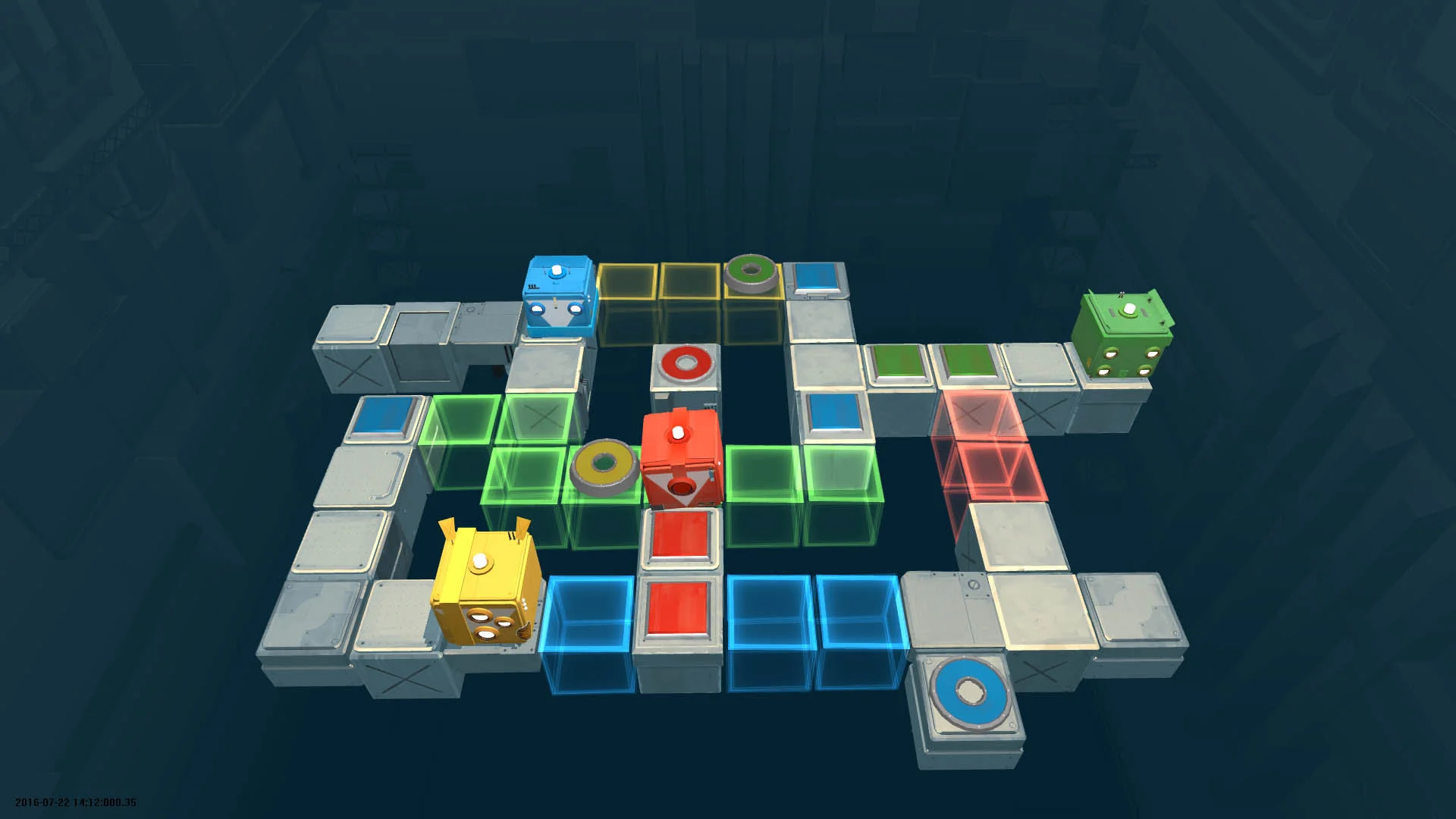
Death Squared has a pretty straight-forward concept. You control between two and four colored cubes and have to guide each of them to their goal marker without letting any of them die. Cubes can trigger buttons that match their color, which can open paths and make changes to the level layout, and/or trigger additional hazards that may affect the path of to the other cube’s goals.

Release Date: March 13, 2017 (PC, Xbox One, PS4), July 13, 2017 (Switch)
Developer: SMG Studio
Platforms: PC, Xbox One, PS4, Switch (Reviewed)
Price: $14.99
Death Squared has a pretty straight-forward concept. You control between two and four colored cubes and have to guide each of them to their goal marker without letting any of them die. Cubes can trigger buttons that match their color, which can open paths and make changes to the level layout, and/or trigger additional hazards that may affect the path of to the other cube’s goals.
There is no real story to Death Squared, only some minor dialogue between levels. Speaking of the levels, they start out fairly easy and basic. Some of the later levels can be very, very difficult. While there is no real story to the game, there is a lab technician that provides some random dialogue as you play. Not only does he speak, he also gets more and more frustrated with you the more you die. Every now and then he will even do something to amuse himself, such as reversing your controls or spawning dozens of cubes, just to keep you on your toes. The game also keeps a running tally of how many times you've failed, rubbing it in each time you die. It can get quite irritating, but it is fun nonetheless.
When it comes to controls, you can play the game by yourself by controlling each cube by using one analogue stick for each cube. If you are playing with more than 2 cubes, you use the shoulder buttons to switch between cubes. I found it much more fun to give the second joycon to another player and work “cooperatively” to figure out the levels. The coop play in Death Squared reminded me a lot of Snipperclips. Both games require communication and patience, as well as plenty of yelling back and forth.
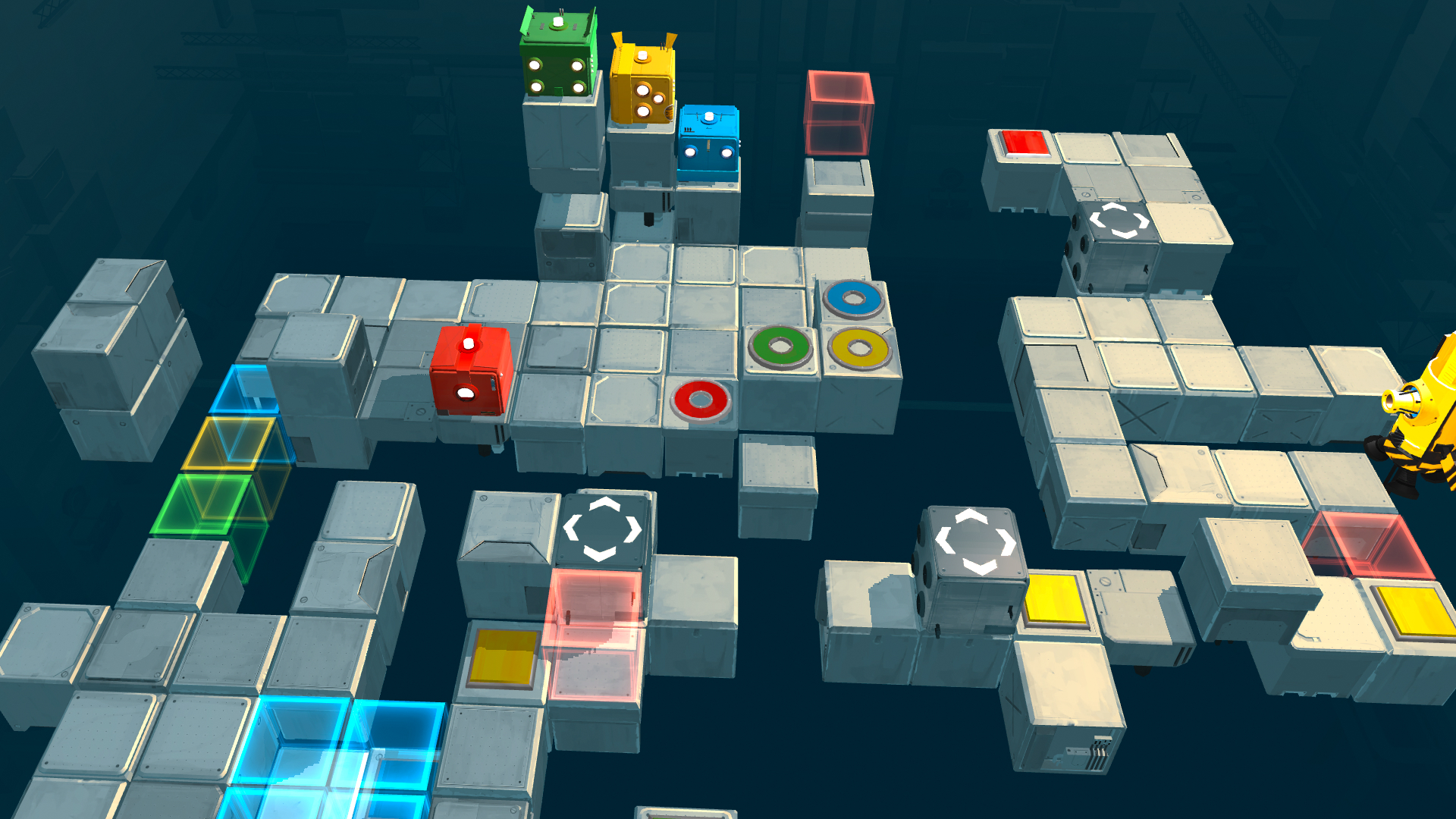
Every hazard is color coded, and cubes are immune to traps of their own color. For example, a red cube can block a red laser, allowing a blue cube to pass by. The levels can be thought out and played at your own pace, which is nice. You can move as slowly as you like to try and anticipate the hazards, as well as analyze and figure out a strategy to each level before you even make a move.
The graphics and design are very well done. Levels are crisp and easy to read. There are optional cosmetic decorations for every cube, and you can collect more patterns by finding them in secret areas throughout story mode.
There’s 80 two cube levels, 40 four cube levels and then you can also unlock the vault, which is a collection of super tough puzzles that show no mercy. The number of levels in Death Squared provide lots of replayability, especially when playing with a group of people. It can be fun to see what group, or team, can finish a level the quickest, as well as see what various types of strategies everyone comes up with. The Switch’s JoyCons make it even easier to pass the game around and have some fun. Speaking of JoyCons, the game runs equally as smooth in both docked and handheld modes. I noticed little to no difference between the two.
Death Squared can be fun by yourself, but it’s even better with some friends. Anyone that enjoyed multiplayer, cooperative puzzlers, such as Snipperclips, will enjoy Death Squared.

Pros
Great cooperative gameplay
Crisp, detailed level design
Lots of levels, providing lots of replayability
Cons
Can get too difficult for some
Thank you to SMG Studios for providing us with a review copy.

Ancient Amuletor Review
Ancient Amuletor combines a first-person shooter with tower defense to bring a very under-explored genre to PlayStation VR. However, in most tower defense games, players build and upgrade their towers and defenses to protect their towers from waves of intruding enemies. In Ancient Amuletor, the only goal for the player is to protect their tower, which in this game are big blue crystals spread out through the map.

Release Date: June 27, 2017
Developer: TiGames
Platforms: PlayStation VR
Price: $19.99
Ancient Amuletor combines a first-person shooter with tower defense to bring a very under-explored genre to PlayStation VR. However, in most tower defense games, players build and upgrade their towers and defenses to protect their towers from waves of intruding enemies. In Ancient Amuletor, the only goal for the player is to protect their tower, which in this game are big blue crystals spread out through the map.
Players begin by choosing from four different heroes, with two additional hero slots marked as “Coming Soon”. Each of the four different heroes play very differently, which requires a bit of strategy from the player. One hero is an archer that you have to nook the arrow and pull back to shoot, which requires precision but gives good range and damage. Another hero dual-wields pistols that you can shoot rapidly while flicking upwards to reload. While this hero can shoot much faster than the archer, the pistols have far less range and damage than the archer’s bow. There is also a mage that summons orbs from a spellbook and then throws them down at enemies with a magic hook, causing a bit of splash damage where they hit. These orbs give medium range and damage. And lastly, there is a puppeteer that throws down a metal golem that mimics the moves you make, giving you the ability to melee enemies.

As I said, Ancient Amuletors also has FPS elements. Players do not run around like in a traditional FPS, they warp to different platforms around the map and attack the waves of enemies that come from various directions. Thankfully, you can swap heroes on the fly, so if one hero isn’t able to perform at a certain time, you can switch to one that may better suit the situation. This is essential for beating levels solo, particularly on harder difficulties. It can become quite a fast paced game of moving to the right platform with the right hero to take down the variety of enemies you’ll be facing.
The controls for each hero work very well and playing as each character is a lot of fun. I found it can take some time getting used to warping from point to point because of the way the game adjusts your forward position on each platform. It takes some getting used to, but once you get it down it isn’t much of an issue.

Ancient Amuletor currently has two areas to choose from, Desert and Empire, with two levels in each are. There are two additional areas that are locked and labeled “Coming Soon”, which could come as DLC or a future update. As is, Ancient Amuletor is a very short game. It took me less than an hour to run through the four currently available levels.
Once you play through the four levels there isn’t much else to do. Thankfully, there is a multiplayer co-op mode to add a little bit of replayability to the game. You can team up with up to three other players and battle it out. Each player can select any hero they want, even if another player has already selected the same hero and players can stand on the same platform as their teammates. I am not sure if I would rather have only one player per platform and no duplicate characters or not. Either way, the multiplayer mode adds some much needed replayability, but not a whole lot.
Speaking of replayability, there’s an unlockable endless mode for each level, as well as a second, more powerful unlockable weapon for each hero, but they are mostly cosmetic while being more powerful. Unfortunately, I wasn’t able to figure out a clear way to unlock these weapons. I’m not sure if it is random or objective-based. It would be nice to have some sort of information regarding this.
Ancient Amuletor is a very fun VR game in a genre that fits VR very well. I would love to see a sequel with much more content. The gameplay mechanics are great and it is some of the most fun I’ve had playing a PSVR game yet, but being so short it feels like a demo. Yes, there is some “Coming Soon” content, but even doubling the levels and adding two more heroes may not be enough additional content. Also, it is not yet known if this will be free or paid DLC.
There are a lot of good pieces in place here, with the gameplay mechanics and the co-op, but they’ve been packaged in a very scant box that doesn’t do them justice. Ancient Amuletor needs to be more than a short PSVR experience that is barely longer than the demo that’s already available for free. Perhaps all of the elusive “Coming Soon” content will fix that, but at launch Ancient Amuletor finds its quiver running out of arrows too soon.

Pros
- Great gameplay mechanics and controls.
- Character and weapon variety.
- Multiplayer is a lot of fun.
Cons
- Very short with little replayability.
- Positioning can be awkward when teleporting from platform to platform.
Thank you to Time of VIrtual Reality and TiGames for providing us with a review copy.
Puyo Puyo Tetris Review
Puyo Puyo Tetris is a four-player puzzler mashup that launches April 25 for $39.99 on the Nintendo Switch. It combines the classic falling-block action of Tetris with the bean-matching gameplay of Puyo Puyo, which is similar to Kirby’s Avalanche. These games are mixed in a variety of ways, depending on the game mode you choose, but publisher Sega has found a way to do just about every possible combination.
Release Date: April 25th, 2017
Developer: Sega Studios
Platforms: Nintendo Switch
Price: $39.99
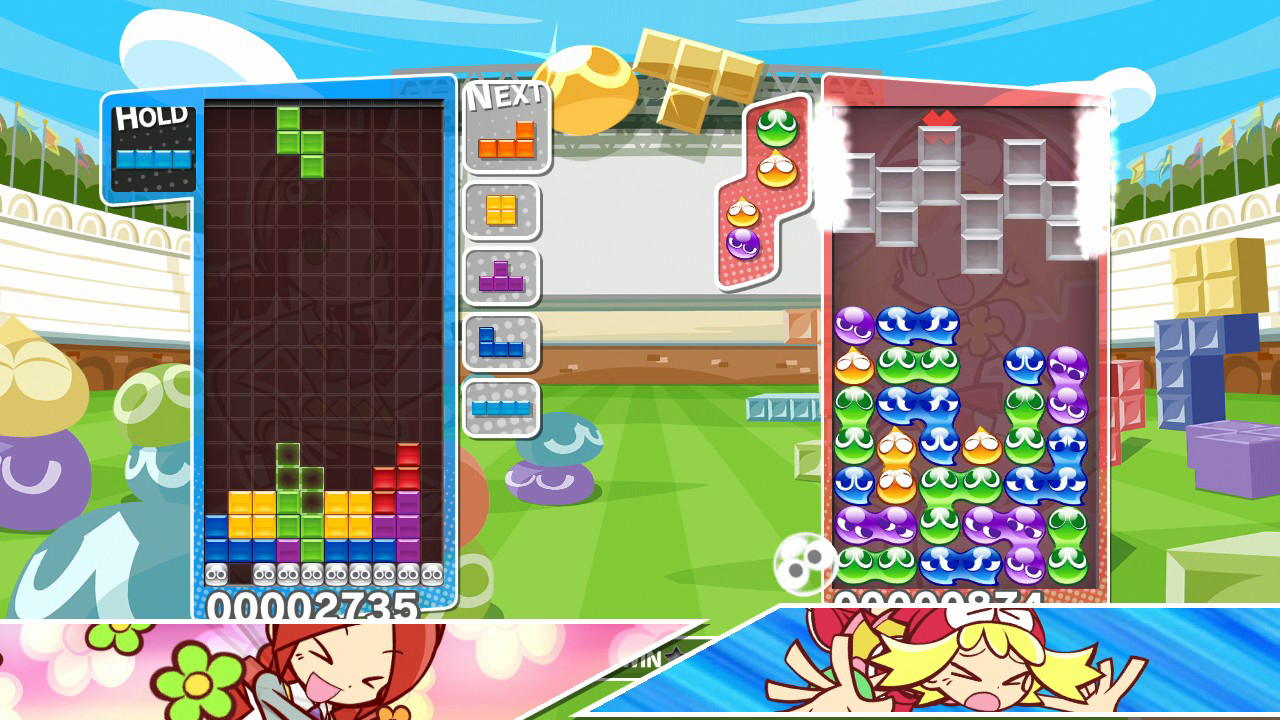
Puyo Puyo Tetris is a four-player puzzler mashup that launches April 25 for $29.99 on the Nintendo Switch. It combines the classic falling-block action of Tetris with the bean-matching gameplay of Puyo Puyo, which is similar to Kirby’s Avalanche. These games are mixed in a variety of ways, depending on the game mode you choose, but publisher Sega has found a way to do just about every possible combination. As expected, you can play Puyo Puyo or Tetris on their own. You can also play them at the same time, on the same playfield, or randomly on their own playfield as the game switches between the two. You can even play Tetris against someone playing Puyo Puyo.
When you start up the game, you are given three options that allow you to instantly start a game of Puyo Puyo, Tetris or Mix Mode. A game like this on the Switch should be simple to pick up and go and Puyo Puyo Tetris is very good at this aspect. The fact that I can boot up the game and be in a game in less than a minute is perfect for the handheld mode.
Even with all of these game mode options, there is a full story mode in which you follow the characters of the Puyo Puyo franchise. They meet new friends who don't seem to know your game and only play something called Tetris. In story mode, you will play missions which vary from competing against opponents to clearing out certain objectives as quickly as possible. The objectives are pretty straight forward and the difficulty of these levels are at just the right level to give you a little challenge, but not too arduous. The story mode is also a good tool to help learn different aspects of both games. Each level also has a 3-star objective system, which you earn a star for completing each of 3 different objectives in a level. These vary from defeating your opponent within a certain amount of time to earning a certain amount of points. Some of these objectives can be tough, but I found myself replaying some levels to attempt to get that 3rd star. It took me about 6 hours to complete story mode, but I didn’t 3-star every level.

I had the most fun in the competitive modes. One mode I really enjoy is Big Bang Mode, which is basically an Endless Fever game with up to 4 players. Players continuously solve easy puzzles for points and build up an attack bar. After a certain amount of time has passed, players battle it out and those with an edge can deal some heavy damage to the opponent's hit points. Once a player is out of hit points, they are eliminated from the game. The last player standing wins.

Multiplayer games can be played locally on TV or tabletop mode, locally with multiple Switches and online. At the time of review, online matches were not available, but I am really looking forward to getting into some online matches after the launch of Puyo Puyo Tetris on April 25. From what I could find in the Online menus, you can play against random players or easily set up a match with a friend. You can also make your own lobbies and add specific rules to challenge the internet at large.
Puyo Puyo Tetris makes its arrival on the Nintendo Switch in grand fashion. Anyone that enjoys a good puzzler from time to time should pick this one up. The solid amount of modes, both solo and online, keep the replayability high. Puyo Puyo Tetris is one of the best games currently available on the Switch. Don't miss out when it releases very soon

Pros
- Colorful art style
- Easy to pick up and play
- Great variety of game modes
- Very entertaining multiplayer modes
Cons
- Some single player competitive modes are too easy
Thank you to Sega for giving us a copy for review.

Digimon Story: Cyber Sleuth Review (PS4)
Having never played a Digimon game, I figured this game would be a Pokemon-type knock-off. Boy was I wrong! Digimon Story: Cyber Sleuth is set in the near future where a next-generation virtual-reality version of the internet named EDEN dominates.

Having never played a Digimon game, I figured this game would be a Pokemon-type knock-off. Boy was I wrong! Digimon Story: Cyber Sleuth is set in the near future where a next-generation virtual-reality version of the internet named EDEN dominates. As with most RPGs, players start by choosing either a male or female character, though this has no impact on the story or character interactions. The main character is an amateur hacker, and in EDEN hackers use programs called Digimon that appear as a large variety of creature-like forms. The player comes across a mysterious entity called an Eater that leaves the protagonist with a half-digital body, letting them move between cyberspace and the real world.

The sleuth part of Cyber Sleuth is mostly story-related and doesn't show up much in the gameplay. Following the incident with the Eater, the player character is rescued by private detective Kyoko Kuremi and quickly recruited to be her assistant while investigating various Digimon-related incidents using the helpful abilities that emerge from being half-digital. Solving various cases is usually just a matter of finding the correct person to talk to, but the cases themselves frequently feature interesting little side-stories. While the overall plot itself doesn't offer all that many surprises, it's helped by a very entertaining cast.
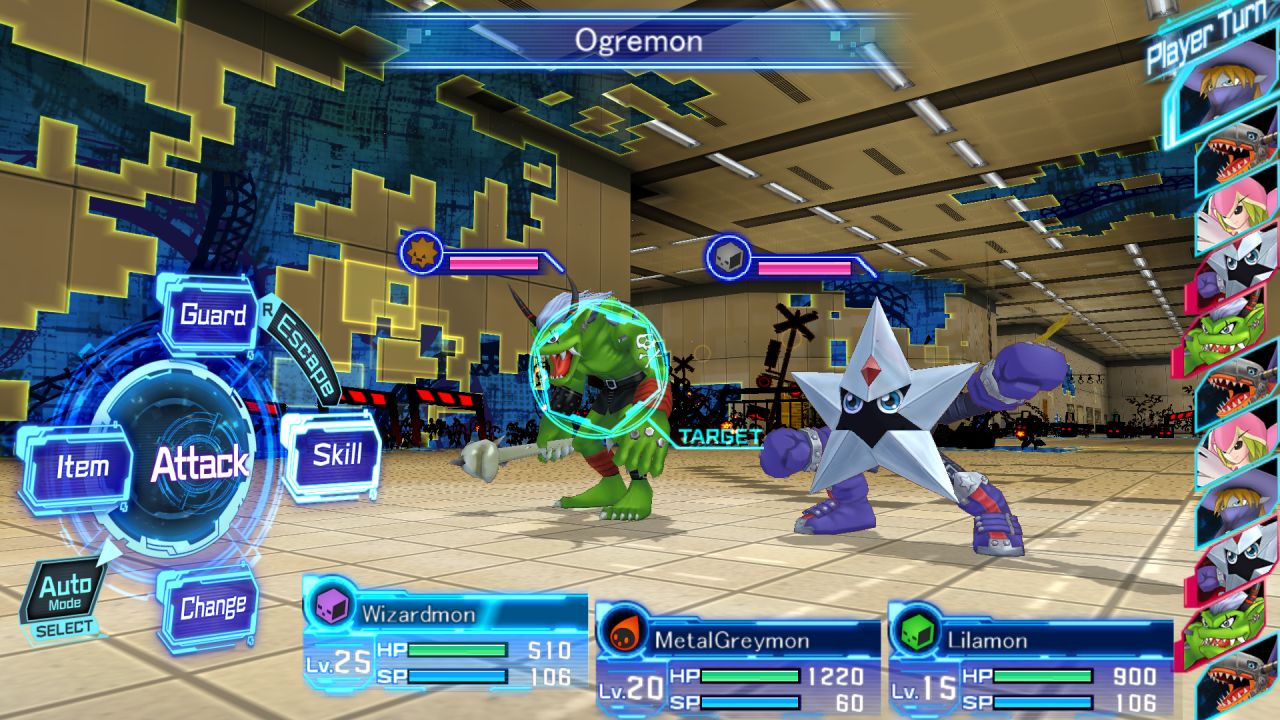
Although Cyber Sleuth is a standard, generic, turn-based battle system, it is stable and entertaining. Players can have up to three Digimon from their party fighting at any one time, occasionally joined by impenetrable mates. A players Digimon may be swapped out at any time, at the cost of an action. The standard options are available on each Digimon's turn: attack, guard, item, or skill. A major part of the battle system is about selecting the right Digimon for each battle. There are four attributes and five elements, each with different strengths and weaknesses. The game makes it obvious if an attack is going to be effective, so players don't need to worry about remembering the exact relationships, but do need to ensure they have enough of a variety at their disposal. Provided players have a decent set of Digimon, the game's normal difficulty doesn't offer too much challenge, though there are a few tough bosses around.
Each time a Digimon is encountered in battle it's scan rate increases. Once it reaches 100 percent the player can visit the DigiLab and hatch one of them from an egg. From there, Digimon earn levels through battle or by being placed on a digital farm. Once level and stat requirements are met, they can be Digivolved into a more powerful form.

When it comes to graphics, Cyber Sleuth doesn't exactly look like a current-generation RPG, but the brief anime cutscenes help breathe some life into it. The cheery soundtrack strongly reminds me of the Persona series in all the best ways.
Even though I have never played a Digimon game before, Digimon Story: Cyber Sleuth has plenty to offer to those unfamiliar with it. It's cast, both human and digital, really bring the story and setting to life, and the game does a very good job of simulating the appeal of monster collecting and raising that the Pokémon series has mastered.
4/5

Pixel Heroes: Byte & Magic Review (Xbox One)
Pixel Heroes: Byte & Magic by developer Bitfather is a turn-based action game that reminds me of a mix between the original Dragon Warrior and Oregon Trail. It succeeds in satisfying nostalgic yearnings but still leaves a few things to be desired.

Pixel Heroes: Byte & Magic by developer Bitfather is a turn-based action game that reminds me of a mix between the original Dragon Warrior and Oregon Trail. It succeeds in satisfying nostalgic yearnings, but still leaves a few things to be desired.
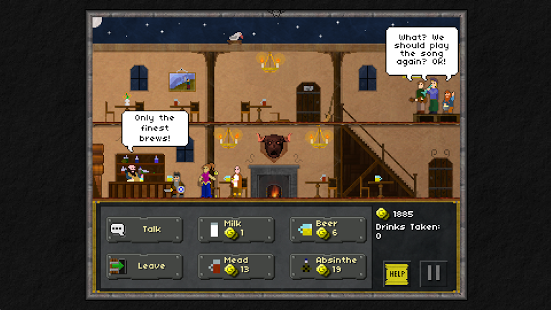
In Pixel Heroes: Byte & Magic, you begin your adventure in a pub where you must assemble a party of three adventurers from seven unique classes. Each class has its own strengths and weaknesses, which are of the standard RPG tropes of Strength, Dexterity, Faith, Life, and Intelligence. Additionally, each class has two specific skills that can turn the tide of any battle. There are a lot of characters to choose from, which is a really nice feature. Initially, these character options are limited to a handful, but through the course of play you'll unlock 30 unique characters, each with their own skills, strengths, and weaknesses. This massive amount of variety and options are a huge bonus to the game's replayability, and you will do a lot of replaying.
After getting your team together, you will set out to complete three different adventures that get progressively more difficult. Within each adventure, you will encounter six randomized dungeons. After completing these six dungeons, you will come to a "final" dungeon for the adventure. Beating the final dungeon will unlock the next adventure difficulty.
Each dungeon has its own unique style. Figuring out a dungeon's weaknesses while defending against its’ strengths is can be very difficult. There are 16 different status effects and four different elements at play within Pixel Heroes. Knowing the weakness and strengths of each dungeon and being able to defend and attack against those is the biggest challenge within the game.

Being able to gear up your party is the most important part of the game. Unfortunately, there is no inventory stash of any kind to keep items. As you move on from dungeon to dungeon, you'll almost certainly have to re-gear your party from scratch with either found loot or items and spells purchased in town between dungeons. It’s really frustrating when you have to discard a weapon or some sort of equipment because you know it won’t be of any use during the next dungeon, only to need it at the following dungeon after that. Some kind of a stash at towns between dungeons or something would have been great.
The controls in Pixel Heroes are very simple and straight-forward, which you would expect in this type of game. However, while the UI is pretty basic, I found it to be very hard to navigate and understand what I was doing. The game features no instructions on how to use the UI and it took me awhile to get a basic understanding on how to equip and unequip items, as well as what these items do. It also took me awhile to figure out how to get rid of items and which items I need and didn’t need. Since you're not allowed to advance to the next room in a dungeon if you're overburdened, this took some time to figure out. While the controls are simple, not all of the buttons are used. It would have been nice if there were buttons to do the simple tasks, such as throwing away items or equipping. A tutorial or built-in instructions would have been helpful as well.
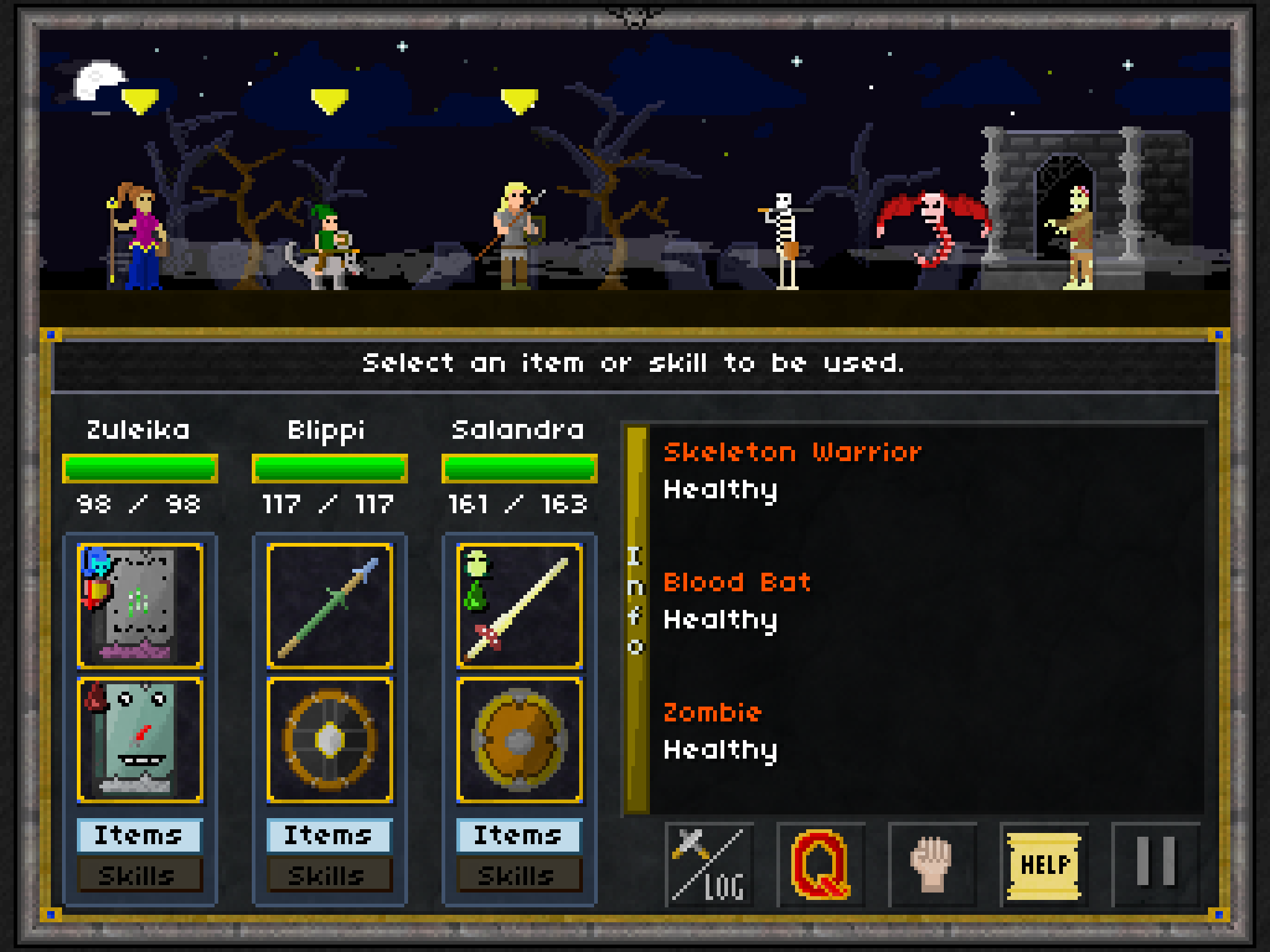
The combat in Pixel Heroes is pretty good. During each battle your three heroes go up against three enemies. Only one hero and one enemy may act each turn. After each turn, the hero/enemy must then rest the next turn. This makes for a nice, tactical experience. Each hero is limited to two attack actions and two special skills that have cooldowns that can last for multiple battles. While this may seem like a downside to some, it makes preparation for each dungeon even more important. When a hero dies in battle, their ghost follows along with the team for the remainder of the dungeon. If you complete the dungeon and get back to town, you will have the option to resurrect your fallen heroes. If all of your heroes die in a dungeon, your adventure ends, and your heroes get buried in the Graveyard, which you're able to visit from the main menu.
Overall, Pixel Heroes is a successful blending of that classic, turn-based RPG gameplay with a modern, rogue-like twist. The UI, lack of a "stash" feature, and lack of general instruction are my biggest gripes, but the combat system and deep replayability make up for those gripes.
3/5
Toby: The Secret Mine Review (Xbox One)
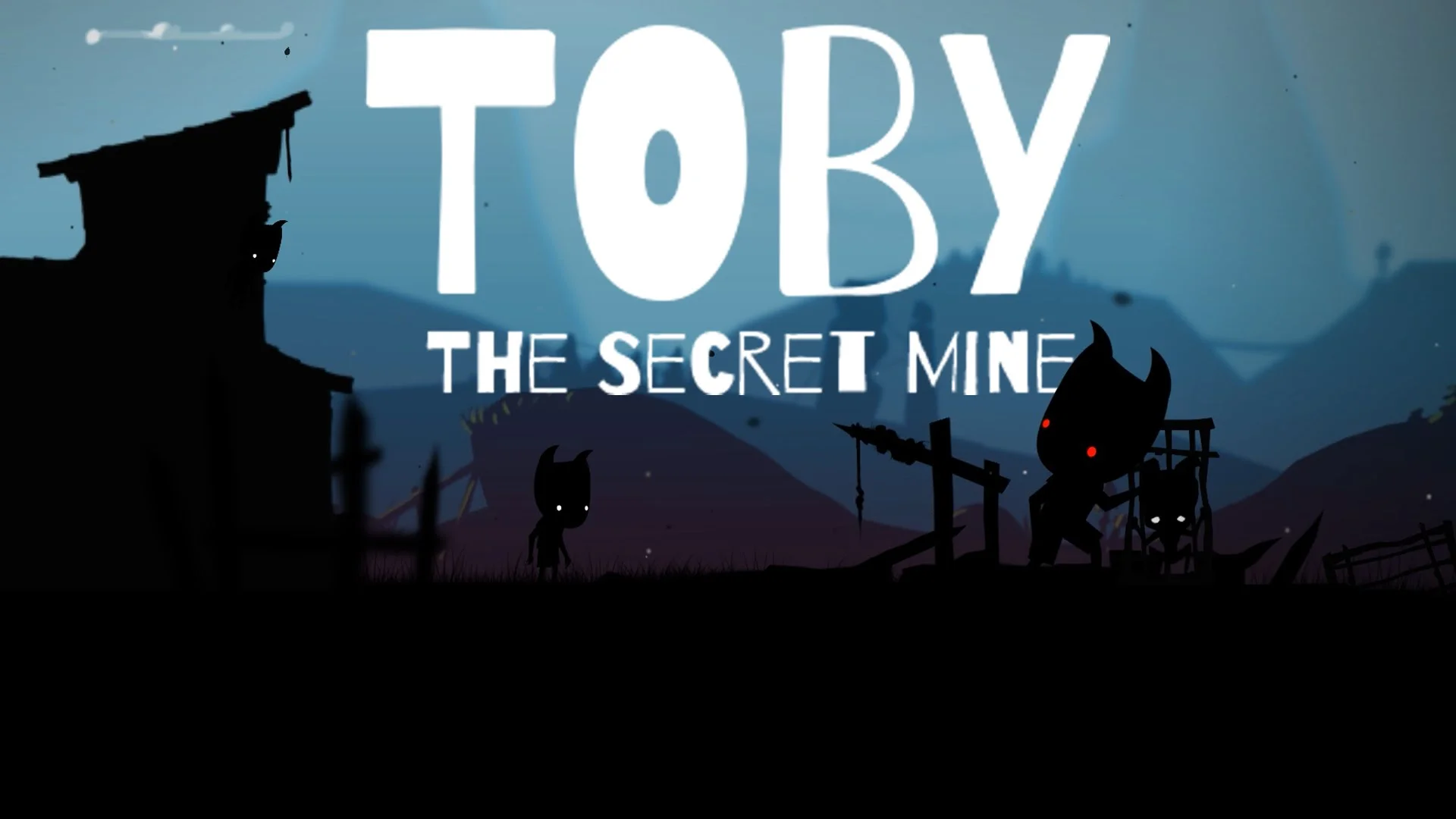
In Toby: The Secret Mine, developed by Lukas Navratil and published by Headup Games players control Toby, who races through levels and solves puzzles in an attempt to save his friends that have been held captive by a mysterious species. Unfortunately, players will do little more over the course of this 2D puzzle-platformer than solve puzzles and execute simple platforming segments.

In Toby: The Secret Mine, developed by Lukas Navratil and published by Headup Games, players control Toby, who races through levels and solves puzzles in an attempt to save his friends that have been held captive by a mysterious species. Unfortunately, players will do little more over the course of this 2D puzzle-platformer than solve puzzles and execute simple platforming segments.

The gameplay in Toby: The Secret Mine is very straight-forward and simple. Anyone that has ever played a platformer should be able to pick up this game and play it. Controls are very simple and that is not a criticism against the game. I usually don’t complain about a game being too simple as long as it doesn’t get too repetitive. This is where Toby lacks. After getting about half way through the games 21 levels, which you can complete in a day or less if you try, I began getting bored and tired of the same types of puzzles and levels. As stated above, you must save as many of your friends, whom are trapped in cages throughout the levels. Unfortunately, there is no indication on how many of these friends are in each level or how many you have left to find, so it can be hard to find them all.
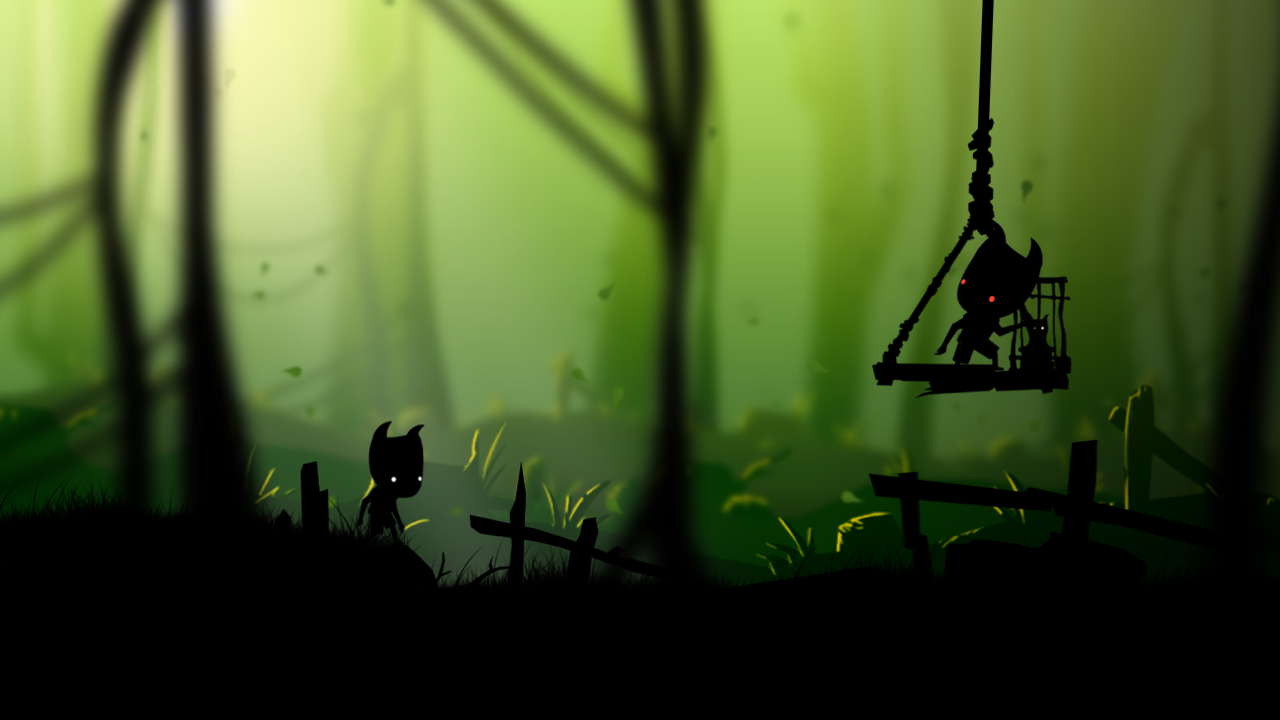
The graphics in Toby: The Secret Mine are by far the game’s biggest strength. The Limbo-esque visuals are amazing and change enough between levels to help keep the game fresh and interesting, at least for awhile. Backgrounds look amazing and the use of effects and lighting are honestly some of the best I’ve seen in platform games.
Overall, Toby: The Secret Mine is a short, decent platformer. It is available on the Xbox Store for $9.99. I’m not sure I would spend the $10 on this game, unless you are really wanting a short platformer to play through. The puzzles are way too easy and repetitive and there is no real storyline to keep players engaged. There are plenty of other similar platformers out there that are better.
2/5
Rise and Shine Review (Xbox One)
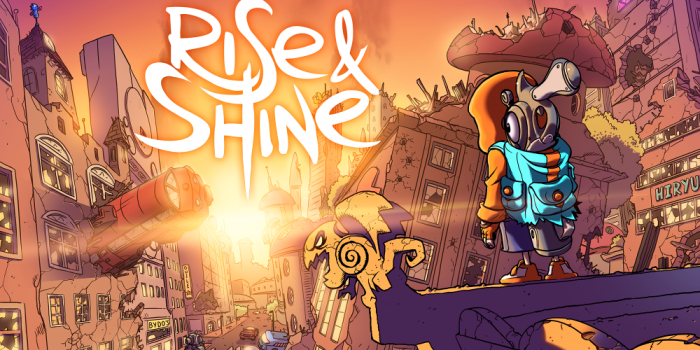
Rise and Shine is a side-scrolling platformer/action game, published by Adult Swim Games, with a comic book art style and (sometimes) brutal gameplay. Players play as Rise, a little guy who’s thrown into a war between humans and aliens on his home planet of Gamearth.
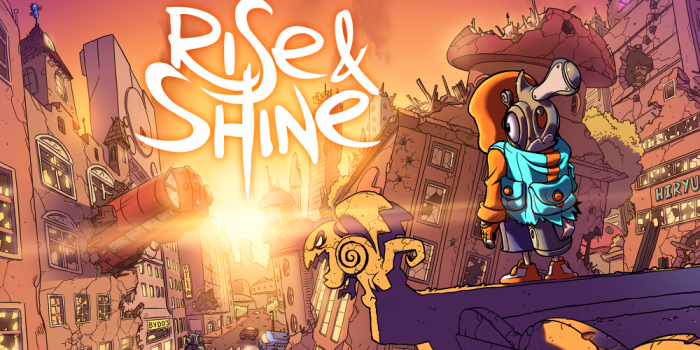
Rise and Shine is a side-scrolling platformer/action game, published by Adult Swim Games, with a comic book art style and (sometimes) brutal gameplay. Players play as Rise, a little guy who’s thrown into a war between humans and aliens on his home planet of Gamearth. After a brief encounter with a giant robot, you wake up in a mall filled with chaos and destruction. There you meet a guy who gives you a gun named Shine. Shine is no ordinary gun, Shine is a revolver that has special abilities such as a homing system, and a range of different types of bullets. After getting out of the mall, you embark on a constant mix of firing Shine, manipulating his bullets and contemplating your next move.
The control system is fairly basic, but can be a little wonky at times. Players move with the left stick, jump with A, hide behind cover with B, very simple controls. Shooting is done by bringing up the aiming reticle by holding the left trigger, using the right stick to aim and pressing the right trigger to shoot. The left bumper is used to change gun enhancements and the right bumper is used to change bullet types. These enhancements and bullet types have different uses throughout the game.
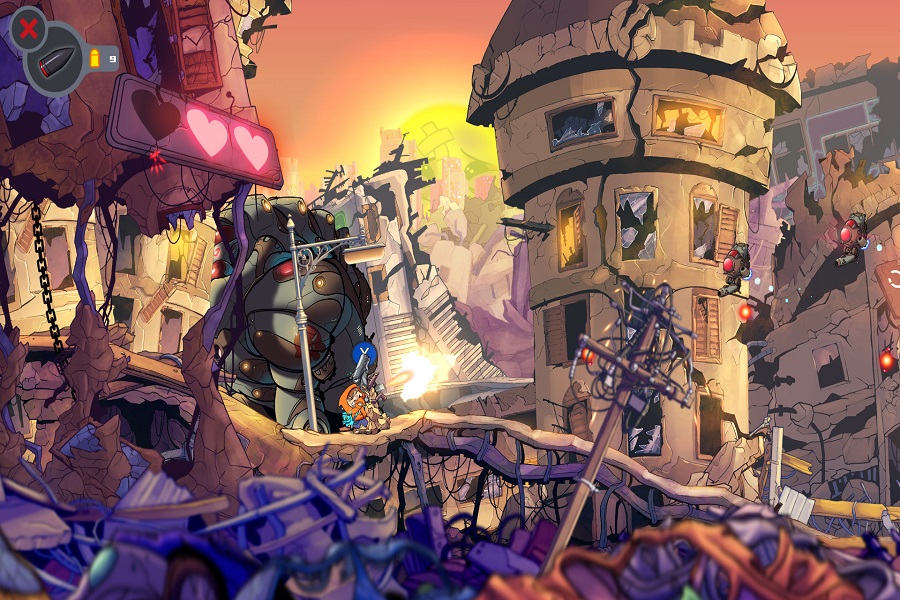
Gameplay-wise, Rise and Shine is really difficult at many points, but it is fun enough to keep players engaged and wanting to get through the tough parts. One of the main things that makes the game so difficult is that, for the most part, it takes only one enemy bullet or strike to kill you. Thankfully, you restart at the closest checkpoint, which are abundant enough to keep you from having to go back too far in a level.
Rise and Shine incorporates a lot of puzzle mechanics in its campaign, which really helps keep the game entertaining. For example, you’ll come up against a door that won’t open, but by selecting the homing bullet, you can use it to move through tight gaps and past unsuspecting gun turrets to blow up the generator.

The artwork in Rise and Shine is very, very good. There’s a rich palette of color, plenty of variety in each scene, and a real attention to detail. From the beginning of a stage to the end, nothing seems to repeat itself. There is a lot of over the top violence and gore, especially for the comic-book style artwork. There is lots of blood, as well as heads and other body parts rolling around. This caught me off-guard at first, but is actually pretty cool.
Overall, Rise and Shine is a really fun game. It is very fast paced and keeps you on your toes and thinking both at the same time. The puzzles really help save the game from being a boring side-scroller.
3/5

Spareware Review (Xbox One)
Spareware on Xbox One, developed by Rusto Games, is a twin-stick shooter with light RPG mechanics with player leveling, skill trees and a unique cell management system. At first glance you might assume you just try to survive as long as possible against hordes of enemies. While you wouldn’t be completely wrong, you’d be overlooking the surprising amount of depth to the game. With 4 player local multiplayer, it becomes even more fun, just try to avoid shooting your fellow comrades.

Spareware on Xbox One, developed by Rusto Games, is a twin-stick shooter with light RPG mechanics with player leveling, skill trees and a unique cell management system. At first glance you might assume you just try to survive as long as possible against hordes of enemies. While you wouldn’t be completely wrong, you’d be overlooking the surprising amount of depth to the game. With 4 player local multiplayer, it becomes even more fun, just try to avoid shooting your fellow comrades.
The story of Spareware is pretty simple; It’s the year 2186. The environment has turned destructive and humans now live in protective city domes. Robots are rebelling against humans and that’s about it. Gain new abilities and destroy any human that stands in your way. Nothing special, but it does the job.
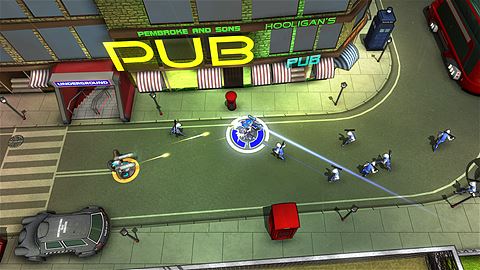
Before playing each level, the player can equip new gear in five categories: head, torso, left arm, right arm, and feet. At the beginning of the game you won’t have many options, as most of the gear is locked. You can collect new gear throughout the game, but if you die, you will lose everything. You can unlock gear permanently by earning achievements, a decision by the developers that I found interesting. For most players, it will become a priority to earn these achievements to unlock gear permanently. Each piece of gear will increase your stats in some way, whether it be speed, strength, magazine capacity, etc.
Every level has objectives, such as: collect an item, destroy an electric barrier, or reach the level exit. Standing in your path are hordes of human enemies wielding guns, bats and riot shields that would love to turn you into scrap metal. Leveling up earns ability points that you can use to upgrade your robot. There are passive abilities such as extra health and faster movement; or you can spend on active abilities such as mines, invincibility, or even saw-drones that circle the player and slice enemies into scrap human.
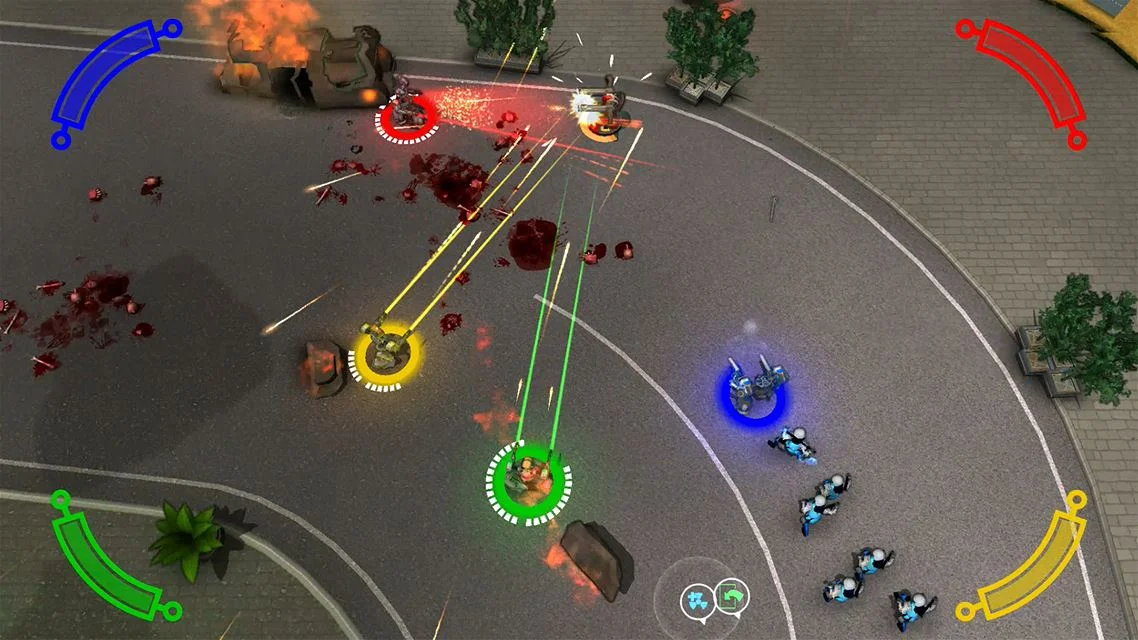
Players also need to collect cells in each level. In some ways this is more important than anything else. All of the gear you collect requires cells to equip, with typically the better gear and weapons requiring more cells. Cells are earned by destroying cars and picking up the blue cells that drop. You also are credited the cell value of any gear not destroyed at the end of the level. As you take damage you will slowly break down, piece by piece starting with the head. If your guns happen to be destroyed, you can pick up new ones laying around the level.
The graphics, sound and music are all fairly generic. Like most twin stick shooters, you play from a top-down perspective. The graphics are cel-shaded graphics that are not very detailed. Pretty much every stage takes place in the same city environment, which is a big disappointment. The music is as very plain and generic soundtrack, and it tends to repeat itself quite a bit. The sound effects are nothing spectacular but they get the job done.
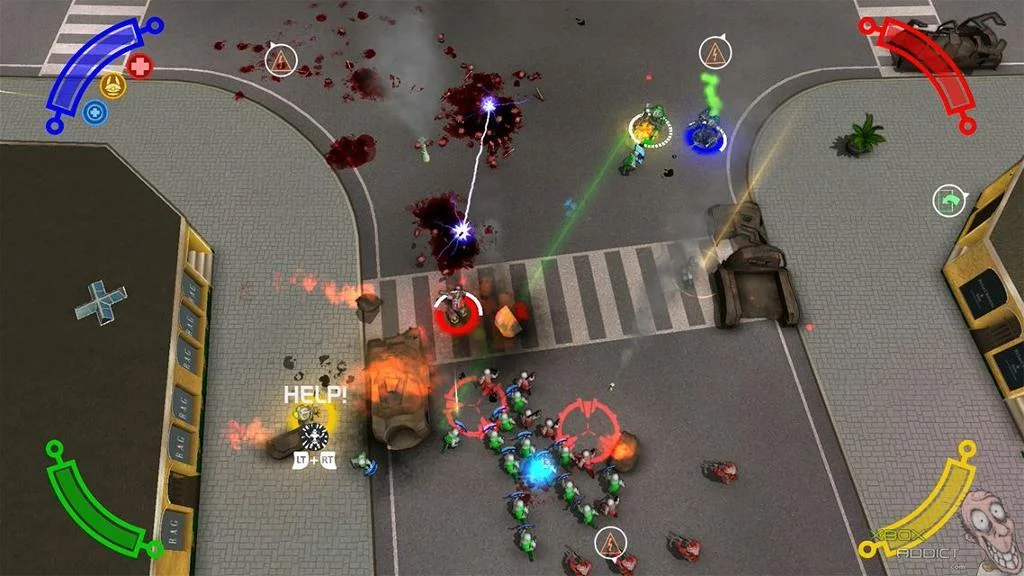
I found the controls to be quite responsive and well laid out. You control your character with the left stick and aim with the right stick. Shooting is done with the left and right triggers. Manual reloading is performed with the left and right bumpers respectively as well. Active perks such as bombs or drones can be mapped to the X, Y or B buttons. There is also a transparent map that can be called up and kept on screen using the D-pad.
While I can deal with most of the issues in the game, there is one that bothers me most, friendly fire. Yes, that is right, friendly fire. As if there is not enough going on with 4 players and tons of enemies, throw avoiding friendly fire in as another thing to accomplish. You might think, well I will just disable friendly fire. Good idea, but there’s no way to turn off friendly fire. At least you can revive fallen enemies, but the option to turn friendly fire off would be nice.
Overall, Spareware is a decent twin stick shooter that is fun with buddies, just don’t shoot each other, unless they deserve it. It is available on Xbox One via the Microsoft Store for $9.99.
2/5
Mutant Mudds: Super Challenge Review
Mutant Mudds: Super Challenge is a retro-style action-platformer developed by Renegade Kid. I haven’t had a chance to play the previous Mutant Mudd game, so keep that in mind. The story, as well as most other features of the game, is fairly minimal. Players play as Max and Max receives special intel, revealing the location of the original meteor impact site and the fact that mutant mudds are still being spawned from it. Max sets out from a secret hideout in the jungle to locate the meteor and destroy it for good.

Mutant Mudds: Super Challenge is a retro-style action-platformer developed by Renegade Kid. I haven’t had a chance to play the previous Mutant Mudd game, so keep that in mind. The story, as well as most other features of the game, is fairly minimal. Players play as Max and Max receives special intel, revealing the location of the original meteor impact site and the fact that mutant mudds are still being spawned from it. Max sets out from a secret hideout in the jungle to locate the meteor and destroy it for good.
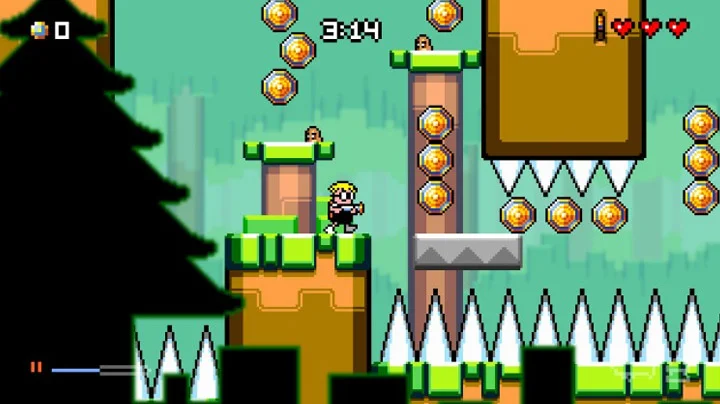
The graphics in Mutant Mudds: Super Challenge are really good considering the style of the game. For the most part, the levels and enemies look great. It appears to be a fun, family friendly game, although the gameplay may tell you differently. The game also features a depth-of-field effect used which allows the character to move to different layers. Any other layers are blurred just enough to pull the focus to the one where your character resides, but not enough that you cannot make out the dangers and pitfalls should you find a jump pad. I found this feature to add quite a bit to the gameplay.
When it comes to gameplay, the Super Challenge in the title doesn’t steer your wrong. The game is in fact super challenging. Be prepared to die and die often. Sometimes, it will happen slowly as your three hearts are extinguished by the Mutant Mudd, and other times it will be instantaneous, like when you are impaled on a shiny spike. While trying to avoid these Mutant Mudds and shiny spikes, your main mission is to pick up gold tokens, one hundred of them per level to be exact. Some are hidden behind walls with only a small crack revealing a glimpse of the treasure that lies in wait. You still have to find a way inside and some can be quite tricky. As stated before, being able to jump into the background adds another layer of complexity to an already precise game.
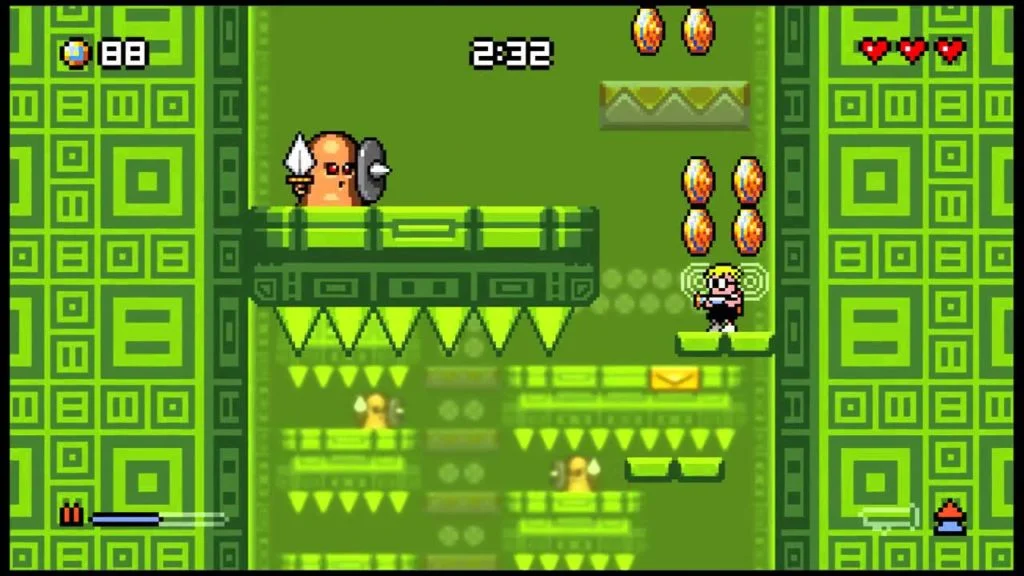
While the game is very challenging, there are things along the way to help you out. There are three different power-ups in each level, if you can find the secret room to equip them. The first is a power-shot, handy for clearing away doors blocking your way to secret places. Second, is an extended in-air hover. Last, there is the vertical boost at lets you rocket up into the air, once per jump. You might need one or more of these power-ups to collect all the coins in each level. That means you need to revisit some levels more than once. One plus to this is that all the coins you collect each time stay will stay, as long as you reach the exit.
If you are looking for a challenge and enjoy retro-style platformers, definitely check out Mutant Mudds: Super Challenge, but remember to be prepared to die, ALOT (the game even trolls you with a display of how many times you have died.) It is available on PSN for $9.99 and is cross-buy with PS Vita.
4/5

Lost Sea Review
Lost Sea is a 3D strategy-action game, developed by EastAsiaSoft, that takes place inside a procedurally generated archipelago. Players must form a crew of survivors and explore the surrounding islands as they hunt for the necessary resources to upgrade their ship and escape the Bermuda Triangle.

Lost Sea is a 3D strategy-action game, developed by EastAsiaSoft, that takes place inside a procedurally generated archipelago. Players must form a crew of survivors and explore the surrounding islands as they hunt for the necessary resources to upgrade their ship and escape the Bermuda Triangle.

Lost Sea reminds me of some of the old-school action titles that you can pick up, play and beat in a few (3-4) hours. Players start off by choosing a character from a few choices, which include a mix of male and female characters. The only difference I could find in the characters is cosmetic, which is a little disappointing. Some differences between the characters would have be nice for replay value. The game starts off with your character getting stuck inside the Bermuda Triangle. Before long you find a machete and come upon a survivor that gives you a tutorial of the game. The entire first stage is a tutorial, which you can skip past and get to the other stages if you would like.
The game has five levels, or archipelagos, to explore that are split up into several islands that each lead to a boss fight. Players must lead their character through each stage and find stone tablets and survivors. These stone tablets are required to move on to other islands. Each stone tablet allows you to sail a certain number of islands through the archipelago and then you have to find more to continue on to other islands. Along with finding tablets, you will come across survivors. You can choose to have these survivors accompany your main character to provide assistance with hauling the tablets back to the dock area and also use one of their many skills, such as opening locked chests or repairing bridges, among other types of skills.

The graphics in Lost Sea are presented very well. The environments look great and is presented with a 3D top-down sort of view of your character, with the ability to move the camera with the right analog stick. The environments are full of color and the characters are all unique. Every island you explore is randomly generated, so you'll never truly play the same island each time you play the game, but I found the islands to have features that seem to repeat quite often, such as the same bridges or arches. Each archipelago have different types of environments, such as a desert island or a snow covered island, but as I stated, many of the features on these islands will be the same. The randomness of each island make the game replayable, but I think it would be even better if there were more features instead of repeating features all of the time.
The gameplay in Lost Sea is very simple. As I stated earlier, Lost Sea reminds me of some of the old-school action games from my childhood. One of the main reasons this game brings back those memories is that there is very limited saving in the game. Upon dying and restarting, you get a certain amount of coins and experience based on your progress during your previous play-through. There is also a stage select where you can choose between which archipelago to start at based on the areas you have reached in a previous play-through. There are no in-progress save files, so you have to worry about dying and losing much of what you have. At some points of the game I wished there was a one-time save where you could stop playing and then pick up progress later, but the game is just the right length to not be a necessity.

The combat system in Lost Sea is simple, but effective. As I mentioned before, while exploring the islands you will find fellow survivors that you can have join your crew. While they are helpful in many ways, combat is not their strong suit. Your crew members actually hide and cower in fear, instead of helping you in battle. I found this to be a little irritating at times.
Overall, Lost Sea is a good game to pick-up and play when you have a few hours to spare and want to feel some nostalgia from the days of past when there was no saving your game and coming back later. The game is fun and a great concept, I just wish the developers had put more environmental features in the game to avoid so many repetitions. You can purchase Lost Sea for $14.99 on the PSN Store.
I give this game 3/5

The Magic Circle (PS4) Review
In The Magic Circle, you are the hero of an unfinished fantasy game. You have all of the powers the developers of this game have, including the ability to trap their creations and reprogram their behaviors and swap their body parts. This allows you to uniquely solve puzzles and make your way through the game, ultimately finishing and “releasing” it, being as creative as you want.

In today’s world of console gaming, it seems that a majority of games that come out are “broken” or unfinished. Developers have to push out patches at, or shortly after, launch to fix glitches and bugs and have to continue pushing out these patches for a good amount of time after the game has released.

Developer Question took this practice of releasing unfinished games to a whole new level with their game The Magic Circle. In The Magic Circle, you are the hero of an unfinished fantasy game. You have all of the powers the developers of this game have, including the ability to trap their creations and reprogram their behaviors and swap their body parts. This allows you to uniquely solve puzzles and make your way through the game, ultimately finishing and “releasing” it, being as creative as you want.
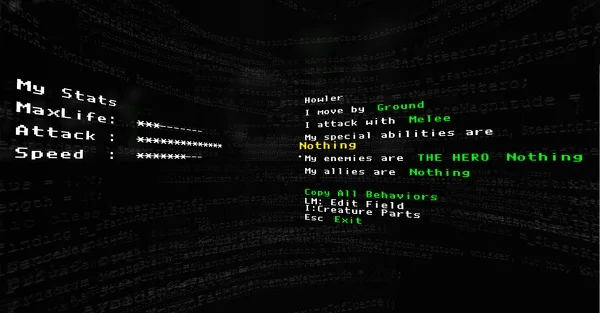
In The Magic Circle, you have no weapons or ways to attack, so when you are attacked by one of the many monsters in the game, you have to trap them and change their code to make them your allies, which makes them follow you. Doing this makes for highly flexible interaction with a simple interface. You can make one creature enemies with another and have them battle it out, or make every creature your ally with no enemies and have a huge army following you. With this being said, there are puzzles to solve and obstacles to overcome, many which require some creativity without much help from the game. This makes for a nice ‘Aha-experience’ when you realize what you can do to solve some of these puzzles.

The graphics in The Magic Circle fit the game very well. It contains a nice open-world style map that really gives off the unfinished look. The soundtrack really keeps the game interesting and gives you an idea what it is like to work on a game development team. The “developers” of the game, represented by floating eyeballs, are working on the game as you play. Most of their work amounts to them bickering loudly with each other, which you might expect in a game about an unfinished game. The “developers” joke about crowdfunding, development, game tropes and media, providing some insightful and funny observations on those fronts.
I’ve always been interested in game programming and development and The Magic Circle gave me a very unique perspective on the topic. I found it fairly easy to pick up and go and the “programming interface” of the objects in the game is simple but very flexible. I found it very entertaining to try different methods of solving puzzles. Overall, I found The Magic Circle to be very unique, fun and entertaining.
4/5

The Witch and the Hundred Knight: Revival Edition (PS4) Review
The Witch and the Hundred Knight is about a witch and a knight, who is named Hundred Knight. Metallia, the witch, summons the Hundred Knight from a magical realm to act as her personal servant and henchman. With the Hundred Knight’s help, she hopes to spread the mud of her swamp to the four corners of the world so that she can be recognized as the greatest witch of all time.

** The Witch and the Hundred Knight on PS4 is a re-release of the PS3 version. I have not played the PS3 version, so this review is based on the first time playing, not a comparison to the PS3 version. **
The Witch and the Hundred Knight is about a witch and a knight, who is named Hundred Knight. Metallia, the witch, summons the Hundred Knight from a magical realm to act as her personal servant and henchman. With the Hundred Knight’s help, she hopes to spread the mud of her swamp to the four corners of the world so that she can be recognized as the greatest witch of all time. I found the storyline to be very thin and bland. There are many pointless side-stories throughout the game before finally having an actual storyline in the final chapters of the game.
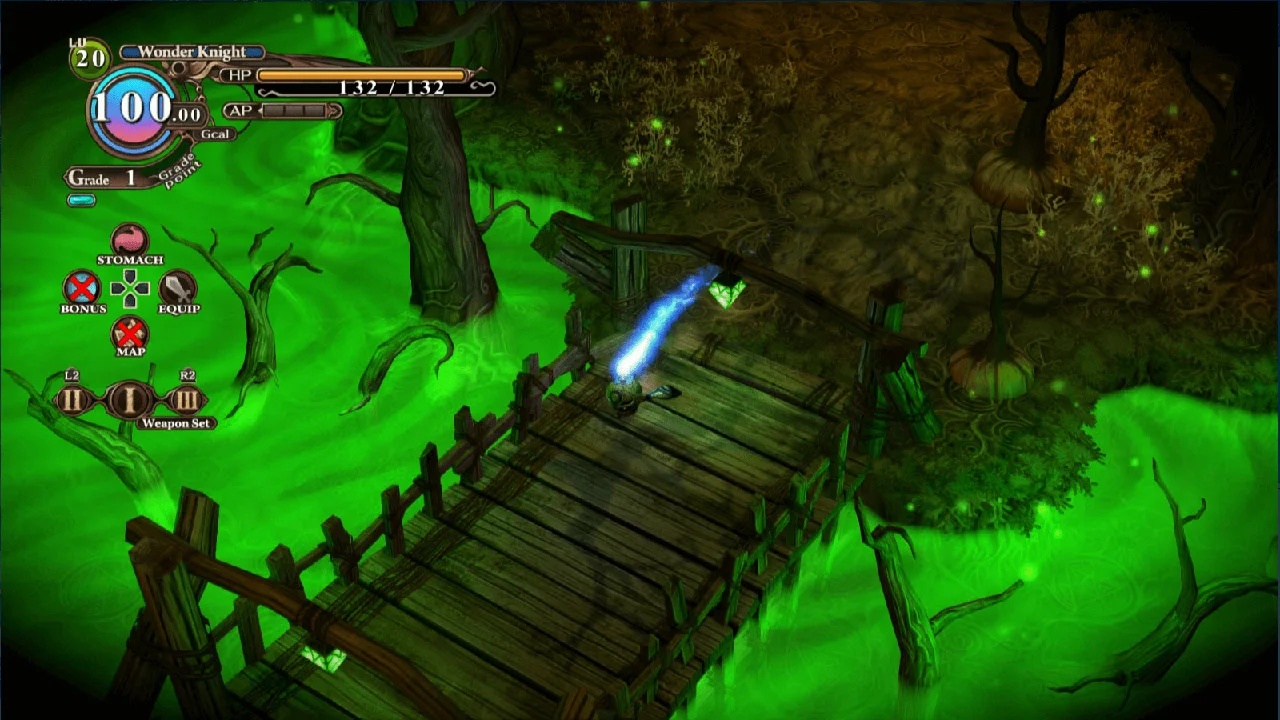
I also found the gameplay to be just as bland. Players control of the Hundred Knight and explore a variety of large, open areas, many of which I found were too large and too open. Hundred Knight can equip up to five weapons at a time, which come in multiple varieties and different types of damage. Your weapons are set from 1-5 and make up your attack combo chain, using each weapon in order. You can also dodge and summon Tochkas, which are beings mostly used for support. I found only two of them useful for anything other than clearing obstacles. Most of the time, combat simply comes down to hitting the attack button until everything is dead. Even boss fights typically don't require any more strategy than this. I found myself running around and button-mashing a majority of the time, which left very little strategy to the game.
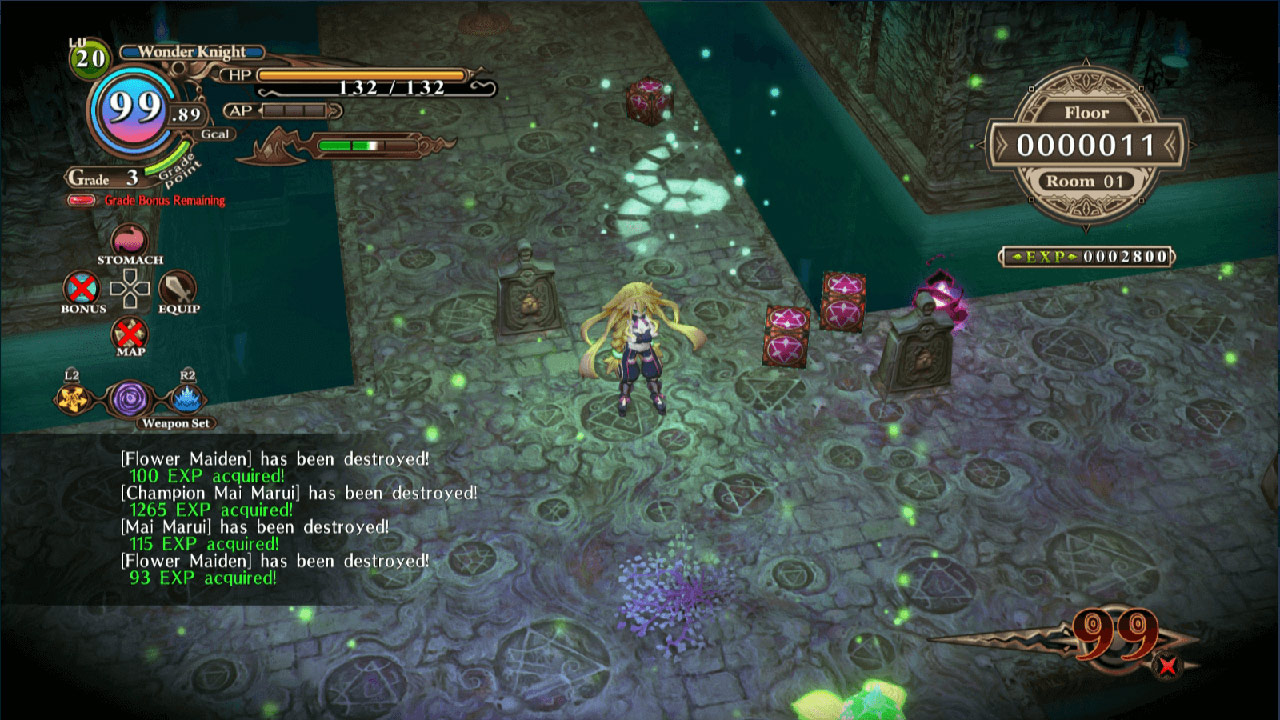
The very little strategy that I mentioned is a mechanic in the game called the GCal system. GCals are a time limit placed on the Hundred Knight in each area. Performing actions in the game such as attacking, running, healing, or exploring an unexplored area costs GCals, which drain down from one hundred each time the Hundred Knight enters an area. GCals are fairly easy to restore. The easiest way is by spending grade points earned in combat, which restore 10 GCals each. Grade points can be spent at any of the pillars that are found throughout each level, and can also be used to grant the Hundred Knight temporary stat boosts. The Hundred Knight can also consume nearly dead foes in order to regain a small amount of GCals, but doing so also fills his inventory up with junk. I found the GCal system to be a little annoying at times, but it also gave the game some strategic points and kept it a little more difficult.
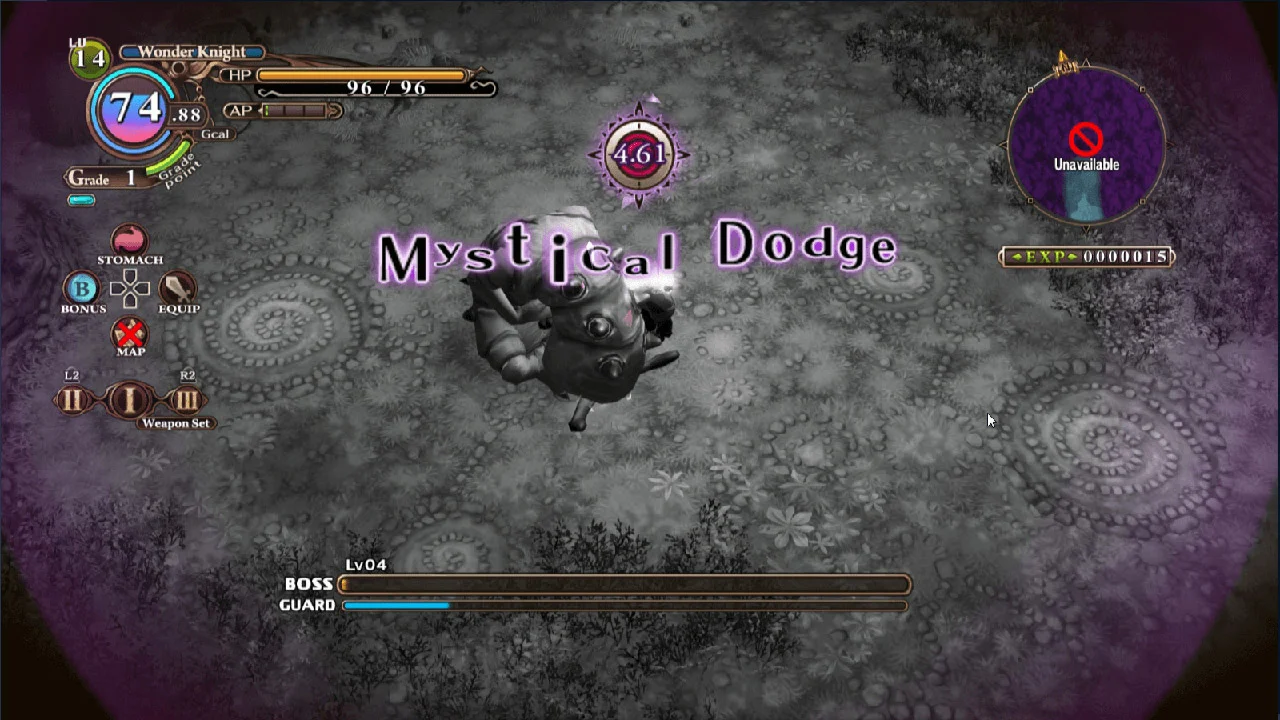
As I said before, this is a remake/re-release of the PS3 version, so I am judging the graphics strictly based on the PS4 version. Having never played nor seen the PS3 version, I am not sure how much they updated the graphics, but I found the visuals in the PS4 version to be quite good. The game is played in a ¾ top-down type view and the colors and details pop nicely. The worlds have unique artstyles and the characters have great detail to them. The visuals in this game may not be mind-blowing, but they help keep the game interesting, which it needs due to the lack of strategy.
Overall, The Witch and the Hundred Knight: Revival Edition is a decent button-masher with very little story line. It is currently priced at $39.99 on the PS Store and unless you are a fan of the PS3 version, I would definitely pass on it.
Score a 3 out of 5.
Thanks to NIS America for providing a copy for review.