
Galactic Inheritors Review
I don't like having to pontificate on things like this. I get that it's my job, but it's kind of annoying when I can see the game for what it is, see where it could possibly be, and then be forced to lament that it wound up like this.
Galactic Inheritors is a game that seems like its ambitions exceeded its grasp. It might just be the way the game presents itself, or it may be that it seems like a very intelligent 4X game with some definite perks to it. That those perks are weighted down with a variety of bugs, strange design choices, and just in general failure to seem like an interesting game is more of a tragedy than a delight.
I don't like having to pontificate on things like this. I get that it's my job, but it's kind of annoying when I can see the game for what it is, see where it could possibly be, and then be forced to lament that it wound up like this.
Galactic Inheritors is a game that seems like its ambitions exceeded its grasp. It might just be the way the game presents itself, or it may be that it seems like a very intelligent 4X game with some definite perks to it. That those perks are weighted down with a variety of bugs, strange design choices, and just in general failure to seem like an interesting game is more of a tragedy than a delight.
Galactic Inheritors is more or less a standard low-budget empire builder with a space setting. You have a number of different races at your disposal, including Humans, cat people, frog people, and the like. You choose a race, galaxy size, distribution, and difficulty for your game, and then you're unleashed into the galaxy to conquer, plunder, and colonize to your heart's content. The game starts you off on a large galaxy map, and for the first few turns, the issues with the game are far from obvious.

For the most part, there are some interesting and innovative touches. You can't immediately start building warships, as you don't have the tech at the start of the game. Instead, you have to buy the warships from various corporations, and then pay a certain amount of upkeep each turn to keep them running. There's also an entire "media" feature to play around with, where you manage your image both internally and towards other empires. Skilfully manipulating your PR gives you bonuses with diplomacy, causes other empires to leave you alone out of fear, or grants other perks.
I also like the way the advantages and disadvantages are worked into the setting of the game. Each race has a several-paragraph write-up on the character selection screen, and the bonuses and penalties they have are worked into their setting information. Most 4X games I've seen tend to boil these down to the most basic of traits rather than give the complex history, and it's good to see the complex history get its place somewhere other than the flavor text.

But the game commits a rather large sin. It's boring. It doesn't feel like anything's moving at all. To compare, even in the slowest-paced 4X games, ending a turn feels like something is happening for you. Even if it's just research, even if it's waiting around for your ships, there's a sense of pacing. For all Galactic Inheritors does, you might as well be playing in a vacuum. This is immediately cut with sudden bursts of tension as the various other races in the galaxy make themselves known, usually by suddenly colonizing everywhere near you.

Despite this, the game slows down again moments after making contact. You just sit there, watching your opponents explore the universe and colonize stuff. There's nothing particularly satisfying, and eventually I got bored and turned it off. It felt like I was just waiting for things to happen, like I had absolutely no stake in the game. For a game to have no stakes is pretty much a death knell as far as I'm concerned.
I've spent hours building colonies on gigantic sentient planets in Alpha Centauri. I've spent days micromanaging a burgeoning empire in Civilization. Hell, I'm even a decent hand at Master of Orion, as far as that goes. But I guess I'll have to leave someone else to inherit this galaxy.
Final score: 2/5
Full disclosure: The reviewer received a copy of this game via Steam
More Like War Crimes: Chariot Wars for PC
This game has broken me
I've tried every possible angle of attack, from sarcastically framing it as the perfect game for the "offended set" to long pontifications on exactly why this game was made and managed to be released through Steam when it's clearly a quarter of a game. But in the end, I keep coming back to the person whose words have impacted my life far more than anyone's should have, especially his: Roger Ebert.

This game has broken me.
I've tried every possible angle of attack, from sarcastically framing it as the perfect game for the "offended set" to long pontifications on exactly why this game was made and managed to be released through Steam when it's clearly a quarter of a game. But in the end, I keep coming back to the person whose words have impacted my life far more than anyone's should have, especially his: Roger Ebert.

All right! Boring menus, ads, and astronomical load times await!
Ebert always started out his critical viewings by asking himself who the movie was for. If you're a genre film freak but hate the French New Wave, for example, you're going to consider The Dead Matter to be superior to Breathless*. If you're the kind of person who only sees movies if they're limited release, in subtitles, in black and white, and about the disintegration of a marriage, you are not the target audience for The Avengers, and your review is going to carry less weight with the people who might be interested in seeing the movie.
It's the same with games. While games are technically for everyone, intake is kind of specialized from person to person, and quality is kind of relative to what people enjoy. So when someone critiques a game, it's important to figure out who the audience of the game is, to kind of put yourself in their place and critique it so they know it's the best game for them. Or not, as the case may be.
Which brings us (finally) to Chariot Wars. As far as I can tell, this game is for people who hate themselves. I cannot fathom this game being for an actual audience other than the easily hoodwinked and gullible on Steam. The only way I can see this being bought by anyone is if they somehow accidentally clicked on it or got it for free from one of their enemies with no way to fob it off on some other poor bastard.

Ahh, the opening cinematics. State of the art for 1996
The graphics are bland. Not in the sense that they're drab or anything, but in the sense that they have made something interesting incredibly uninteresting. Due to the racing logic being based almost entirely on luck, you will see a lot of samey scenery with really no variation whatsoever. From the back of the pack. It's pretty clear they're using fairly basic backgrounds with a skybox, and I'm glad they found something that worked, but when the sky does not move and the backgrounds are kind of boring and somehow the backgrounds look like walls against the sky, it creates something I wouldn't want to take a relaxed drive around, let alone see in a racing game. Even in games where the vehicle sections mostly suck, at least they try to present interesting scenery to drive around in. This is not the case with Chariot Wars. In fact, it's surprising how limited everything is, since the load times from one screen to another are absolutely astronomical.

Yes, that is me racing against myself. You'd think they wouldn't do that.
The character animations are similarly limited and boring. In fact, it looks like the characters are fresh out of a 3D modeling program and then barely animated-- they stand in the center of their chariots and flap their wrists in a lackluster manner. Combined with the slow movement of the chariots themselves and the bog-standard racing, it's ugly to look at, and not in the interesting way Pathologic is ugly to look at. It's plain, incredibly boring, and I'm actually a little insulted this was called a game.

Sure do love the variety here.
Which brings me to the controls. Again, things are pretty standard. W makes you accelerate, S brakes, and A and D turn you left and right, respectively. As you roll around the track at a movement speed that would infuriate and offend most snails with its slowness, you can occasionally pick up boost coins that allow a small amount of speed. Of course, all of this is immediately lost when you hit another racer, as you don't just bounce off but go careening off into the side of the track and spin around backwards like collision detection forgot physics existed. While the game does warn against this, at the same time, you'd have thought that they'd at least made some attempt to fix this rather than claiming it as a feature.
And then there's the way the game will spontaneously switch into "tablet mode" at even the slightest provocation, switching the window size and making the controls stickier. Since the luck-based racing already makes everything difficult, suddenly switching the controls on the player for seemingly no reason is especially frustrating. Oh, and then there's the luck based racing. While you can accelerate and take corners and do all the things required of you in racing games, none of it really matters, as you will quickly be left in the dust and have to make your way around the track in the hopes that perhaps, just perhaps, you will finally catch up with someone.
In the end, the presence of games like Chariot Wars makes me wonder why people are insisting gaming's moved on as a medium. It makes me seriously doubt the need for artistic criticism as long as crap like this is being put out. This game has made me doubt the entire art form of games criticism. Do not give this any attention. This isn't worth it. Find something better do do with your time.
Score: 0 out of 5
Full disclosure: The reviewer received a free copy of this game for review
*For the record, just about any film is objectively superior to Breathless.
Windward Review
So disclosure time: I loved Sid Meier's Pirates.
I bring this up because Windward is similar in a lot of respects to Pirates. Both are games where you and your crew sail around a large chain of islands and mainlands representing your chosen faction, attacking other ships, trading goods, fighting in wars, and gaining standing and reputation.
So disclosure time: I loved Sid Meier's Pirates.
I bring this up because Windward is similar in a lot of respects to Pirates. Both are games where you and your crew sail around a large chain of islands and mainlands representing your chosen faction, attacking other ships, trading goods, fighting in wars, and gaining standing and reputation.
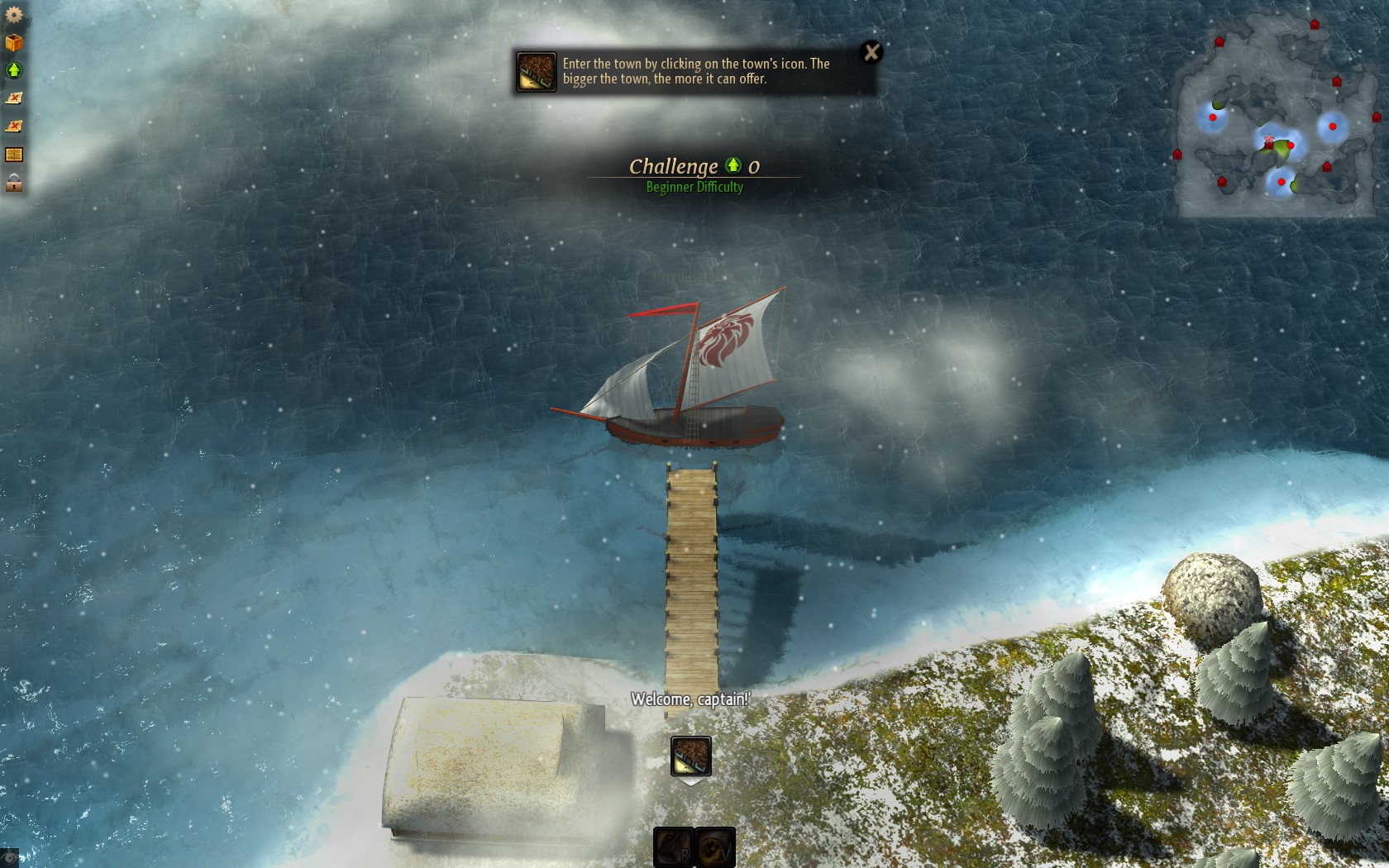
Where Windward differs, is in that it's a procedurally-generated game, and unlike Pirates, you never leave the ship. You sail from port to port, taking missions and leveling up your ship and equipment as you go. Occasionally, you can also get hot tips about commodities from different ports and various other rumors.
The experience of Windward is actually very meditative in a lot of places. There are a lot of moments where you don't have to go anywhere, just spend your time swanning around the immense map to a soundtrack of soothing flutes and occasionally getting into pirate battles. It actually reminds me a little of what a single-player game of Merchants and Marauders would be like. Which brings me to the multiplayer.

The multiplayer in Windward seems to be what the single player bulks everyone up for. The general structure is the same (go around doing missions, getting in fights with other factions, etc) but the game opens up a lot more when you're pitted against human opponents. It also gets a lot more into the base building/base defense part of the game, where you can build guard towers along the edges of settlements to better protect them. And the decision to strike colors and go pirate.
Yes, in Windward, you can strike your colors and go rogue, hunting down your former faction mates and plundering towns to your heart's content. You have a time limit before you're able to, of course, but it creates interesting new political moves, as you can plunder opposing factions' settlements to destroy their influence and then raise colors and claim them for your own faction. There's an interesting bit of strategy to controlling the regions that I really appreciated for the most part, as it made a game about moving a ship from place to place a lot bigger and more interesting.

Granted, the multiplayer also includes the same jackasses in every multiplayer game, including those who spend their time posturing about how they can "change this whole region pirate", but it's a lot of fun to drift along for a while, constructing guard towers and occasionally butting heads with rival factions.
While it may not be the best game of its type, I fully recommend you give Windward a try. At the very least, it allows for a lot of very deep, but easy to learn, gameplay. At the most, you'll find yourself drawn in to a surprisingly relaxing game of pillaging. While it may not be as deep as others on the market (see also: Pirates), it's well worth looking at.
Final Score: 4/5
Full Disclosure: I received a Steam key to do this review.
Shadowrun Chronicles: Boston Lockdown Review
The Shadowrun franchise is enjoying something of a renaissance recently. The tabletop game franchise; where the players take the roles of hackers, cybernetically enhanced mercenaries, and mages in a dystopian future; has been streamlined and cut down on at least some of the crunch that gives everyone issues with it. Shadowrun Returns (and its superior sequel Dragonfall) has made waves as the first successful licensed game for the franchise since the Genesis iteration back in the '90s.
Now with the online multiplayer game Shadowrun Chronicles: Boston Lockdown, there's a way for people to link up with their friends, break into some corporate buildings, and cultivate an irrational fear of the words "milk run" just like fans of the franchise have done so for years, but with less of the bookkeeping, crunch, and confusing die pools of the tabletop version. And I'd love to say it's every bit as fun as the isometric single-player iteration, but...well, read on.

The Shadowrun franchise is enjoying something of a renaissance recently. The tabletop game franchise; where the players take the roles of hackers, cybernetically enhanced mercenaries, and mages in a dystopian future; has been streamlined and cut down on at least some of the crunch that gives everyone issues with it. Shadowrun Returns (and its superior sequel Dragonfall) has made waves as the first successful licensed game for the franchise since the Genesis iteration back in the '90s.
Now with the online multiplayer game Shadowrun Chronicles: Boston Lockdown, there's a way for people to link up with their friends, break into some corporate buildings, and cultivate an irrational fear of the words "milk run" just like fans of the franchise have done so for years, but with less of the bookkeeping, crunch, and confusing die pools of the tabletop version. And I'd love to say it's every bit as fun as the isometric single-player iteration, but...well, read on.
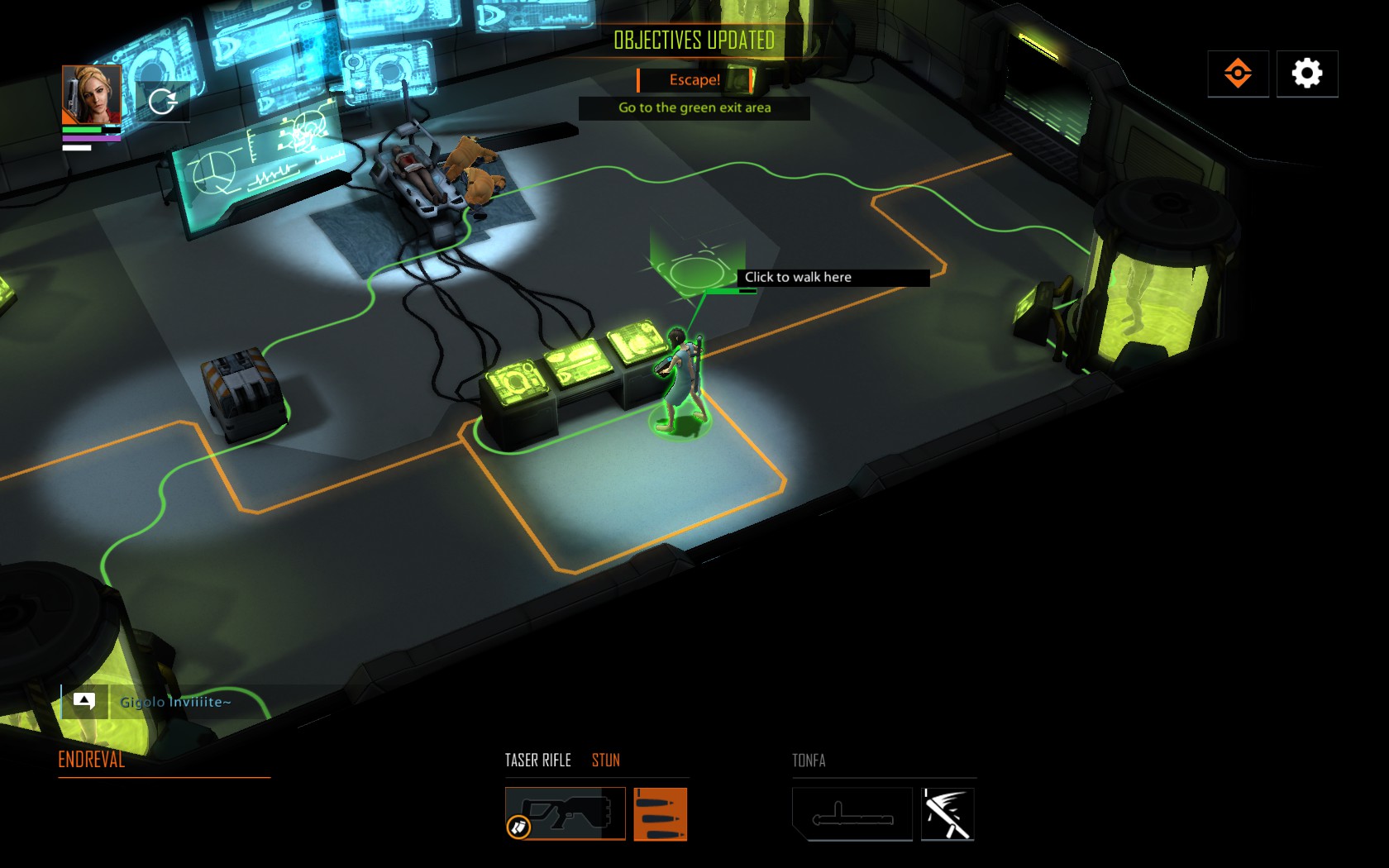
2077. Due to several unusual factors, a second age of magic has been ushered into the world, turning various people into elves, orcs, trolls, and dwarves among others. Dragons have taken their rightful place at the top of the food chain, ruling over some companies and even countries. Those not touched by magic have mostly decided to go the technological route with cybernetic enhancements and hacking. Corporations and privatized police now rule most of the world. And you have decided to take a career in shadowrunning, off-the-grid operations undertaken for a variety of contracts, usually dangerous.
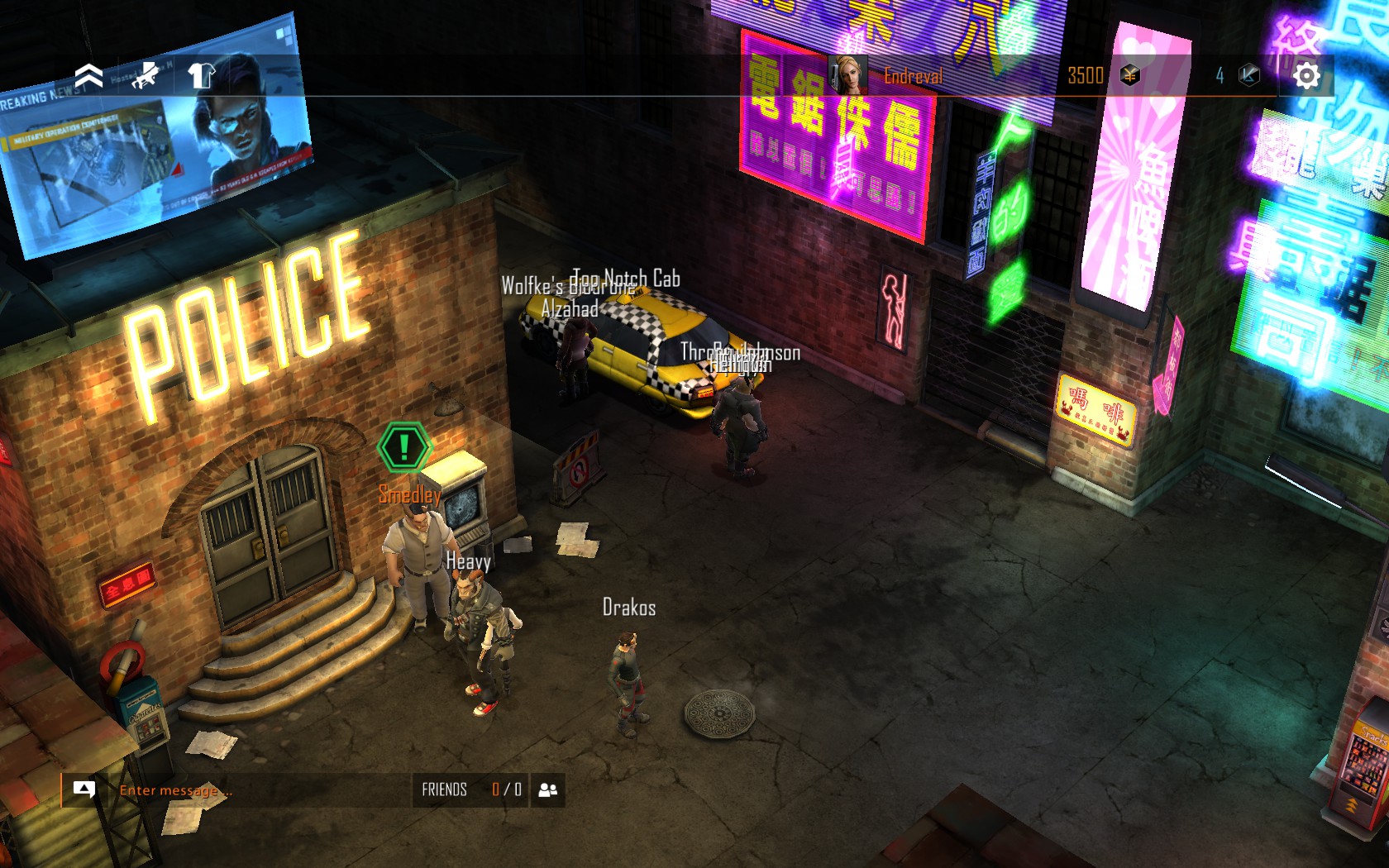
Shadowrun Chronicles plays out as a tactical turn-based roleplaying game with a hub level in between where you can recruit people to your party, buy better equipment, and level up. There are a few early tutorial levels, and after that the game settles into a rhythm of "do missions, sell stuff at the hub, rinse, repeat."
However, this is where the issues begin to set in. The game doesn't truly open up until several missions after the tutorial, with a series of linked story missions that see you raiding Fenway Park after a dragon attack and attempting to escape with your lives. The linked Fenway missions are awesome, but until that point, the game feels kind of small and blocked-off. It gets slightly bigger after that, with a variety of side missions you can undertake for extra XP and cash, but I've also never really liked those "the game begins at (x)" chants that every MMO game seems to have by default.
I also wasn't really a fan of the voice acting. It seems "Boston" means everybody talks like they're spoofing The Departed, and some of the performances rang a little wooden. As this is really the only form of plot conveyance apart from what happens during the missions, it hits a little harder than perhaps it should. (Granted, I was doing a similarly bad Boston accent while I was playing it as well, but that's in the privacy of my weird little monk's cell/office, not out in public.)
Finally, the single-player options feel a little empty. I'm not a fan of games where you can't have an experience on your own as well as having the multiplayer experience, unless it's things like Team Fortress 2, where no matter what, you're shoved into a room with a whole bunch of other people to play with. You have to afford the players ways to play the game in the manner they want, and the game feels kind of sterile just playing botmatches, far more than it should be.

And all of this is a shame, because the game is actually pretty good. The turn-based sections allow for simultaneous turns between players, with barely any hiccups in play. I think the one issue I had was that I'd plan a specific move out, only to find that the other members of my team had cleared the area I was going to grenade, or already cleaned out the lockers I'd been moving towards. The setting's history works really well, with the eponymous "lockdown" shutting down different districts of the city and limiting who you can talk to. And the graphics, while a little simple in places, are beautiful with a clean interface and very little chance of making the wrong move.
It also gets the feel of Shadowrun down. The feeling of desperate firefights, jobs going wrong on a dime due to human error, and the way the world balances the grit of street-level ops with the sleek corporate towers all comes right off the tabletop game, only without a lot of the drawbacks of the RPG. It also does away with most of the gear optimization, which I'm sure would make most regular Shadowrun players throw up their arms in frustration. While there's still a little gear optimization, it's not nearly as prominent.
In the end, I think if you have a group of friends who regularly mount up and play games, then buy this. If you don't, you'll soon find yourself missing the interactions this game can provide. It's weird when solitary, and I'd imagine it loses interest significantly faster.
Final score: 3/5
Full Disclosure: I received a steam key for this review. Also, to midnight, Voidwalker, and Walter: Thanks for running with me.
0rbitalis Review
0rbitalis is the most obtuse game I've ever played, and I love it.
Perhaps I should explain: 0rbitalis is an abstract gravity-puzzle game. The object is to keep your tiny red dot orbiting on screen as long as possible, arcing it around planets and stars (represented by larger and smaller abstract shapes) as it swirls and whirls around the screen. While you only have to do so for a very short set amount of time, there are online leaderboards that encourage players to keep their orbits going for as long as possible, with some frankly unbelievable times in places.
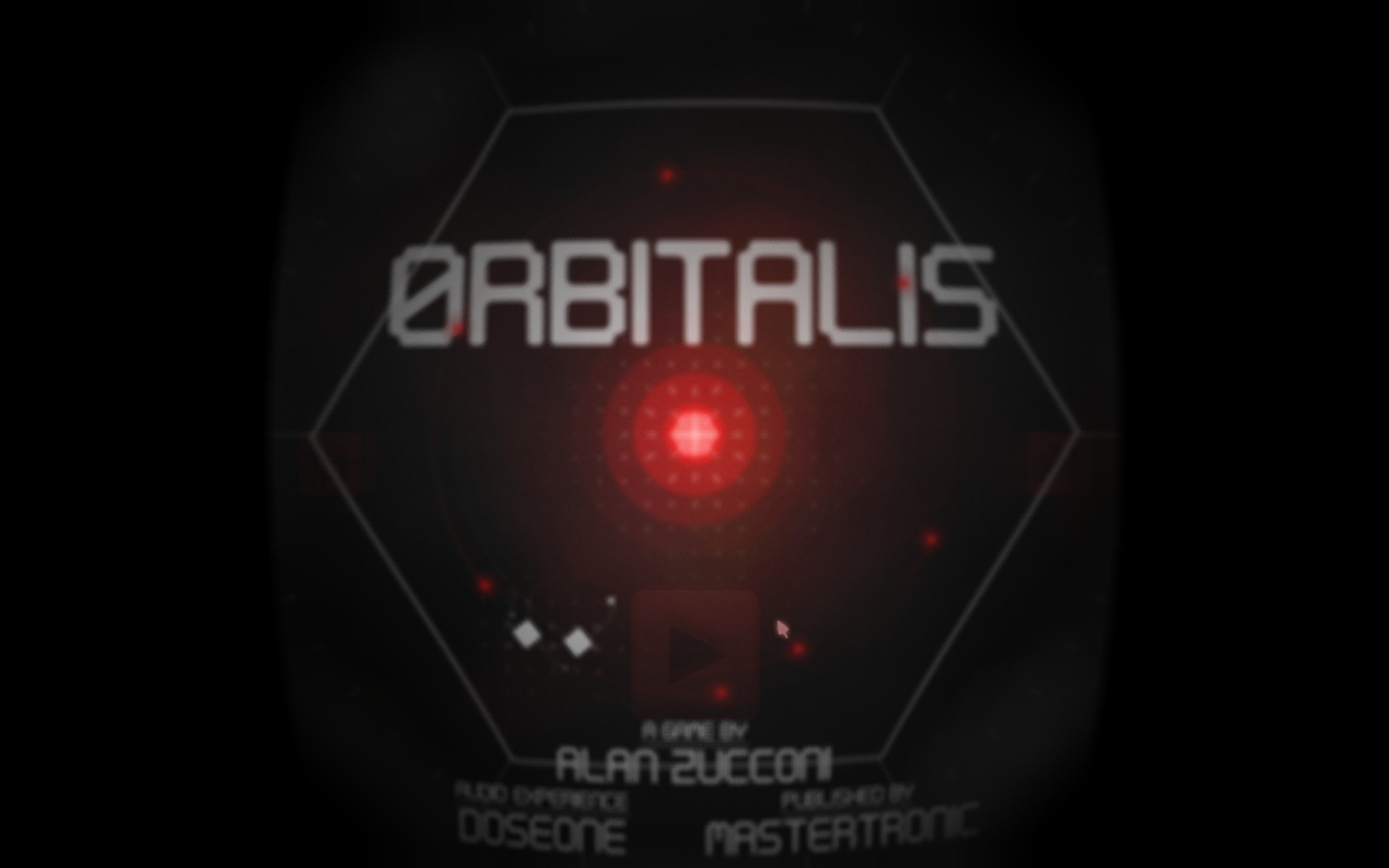
0rbitalis is the most obtuse game I've ever played, and I love it.
Perhaps I should explain: 0rbitalis is an abstract gravity-puzzle game. The object is to keep your tiny red dot orbiting on screen as long as possible, arcing it around planets and stars (represented by larger and smaller abstract shapes) as it swirls and whirls around the screen. While you only have to do so for a very short set amount of time, there are online leaderboards that encourage players to keep their orbits going for as long as possible, with some frankly unbelievable times in places.

But what really makes the game shine is that there are no tutorials, no hand-holding, just you and the simplistic interface you have to manipulate. Everything is learned by intuition. The later levels require you to send your orbit through a geometric shape multiple times, but since it doesn't state that, then you can only figure it out through repeated trial and error. It lets you explore on your own, with just you, the dots, the planets, and the stars.

It's got an interesting sense of accomplishment to it, too. There's just something really satisfying about figuring out the correct arc for your projectile, then following through and watching it curve and loop around the screen. There's something equally relaxing about watching that small red dot arc around until finally it's orbit decays and it drops offscreen or crashes into something on the screen. It's even more satisfying when you cause the dot to loop around for what seems like forever, it's lazy orbit winding down into nothing as you wonder how much longer it can hold out.

A doomed orbit
And then there's the sound design. The sound is mostly ambient tracks, with the most dramatic sounds in the range being the "ignition" sound when you start the orbit (and I love the way the music grows in intensity as your little projectile orbits around) and the sound when you either crash or complete the level. It's especially satisfying when played through headphones, which only enhance the small sounds used in the piece. Also, the sound designer, Doseone, is actually a really good musical artist, so getting to listen to more of his work is awesome.
I think 0rbitalis is a rarity in the modern indie gaming scene-- a game that actually functions as art and an enjoyable game experience. It's interesting to look at, and even if you aren't particularly adept at the mechanics, you can get drawn into it. There's a lot to discover, and that to me is what makes art art. Not that it conveys a message or can be interpreted in some greater way, but that it evokes a personal experience. Everyone is going to come at 0rbitalis from a different angle, and all of them are going to find their own way through the game. Art connects with people on a personal level. It's what makes art what it is.
So give 0rbitalis a shot. It's simple, elegant, and surprisingly deep. And you may find something new and interesting in the world it presents.
Score: 5 out of 5
Thanks to the publisher for providing a code for review.

Sym Review
Sometimes, a game doesn't need to be complicated or big to be interesting
Sometimes, a game can just be odd black and white scratch art and a way to bring its concept to fruition by forcing everything in its world to try and kill you. Sometimes being as simple or as basic as a flash game forces you to look at the game, try to see what it says, and apply those things outward.
Sometimes, a game's just beautifully dark.
All these things are Sym.

Sometimes, a game doesn't need to be complicated or big to be interesting
Sometimes, a game can just be odd black and white scratch art and the way to bring its concept to fruition is by forcing everything in it's world to try and kill you. Sometimes being as simple or as basic as a flash game forces you to look at the game, try to see what it says, and apply those things outward.
Sometimes, a game's just beautifully dark.
All these things are Sym.
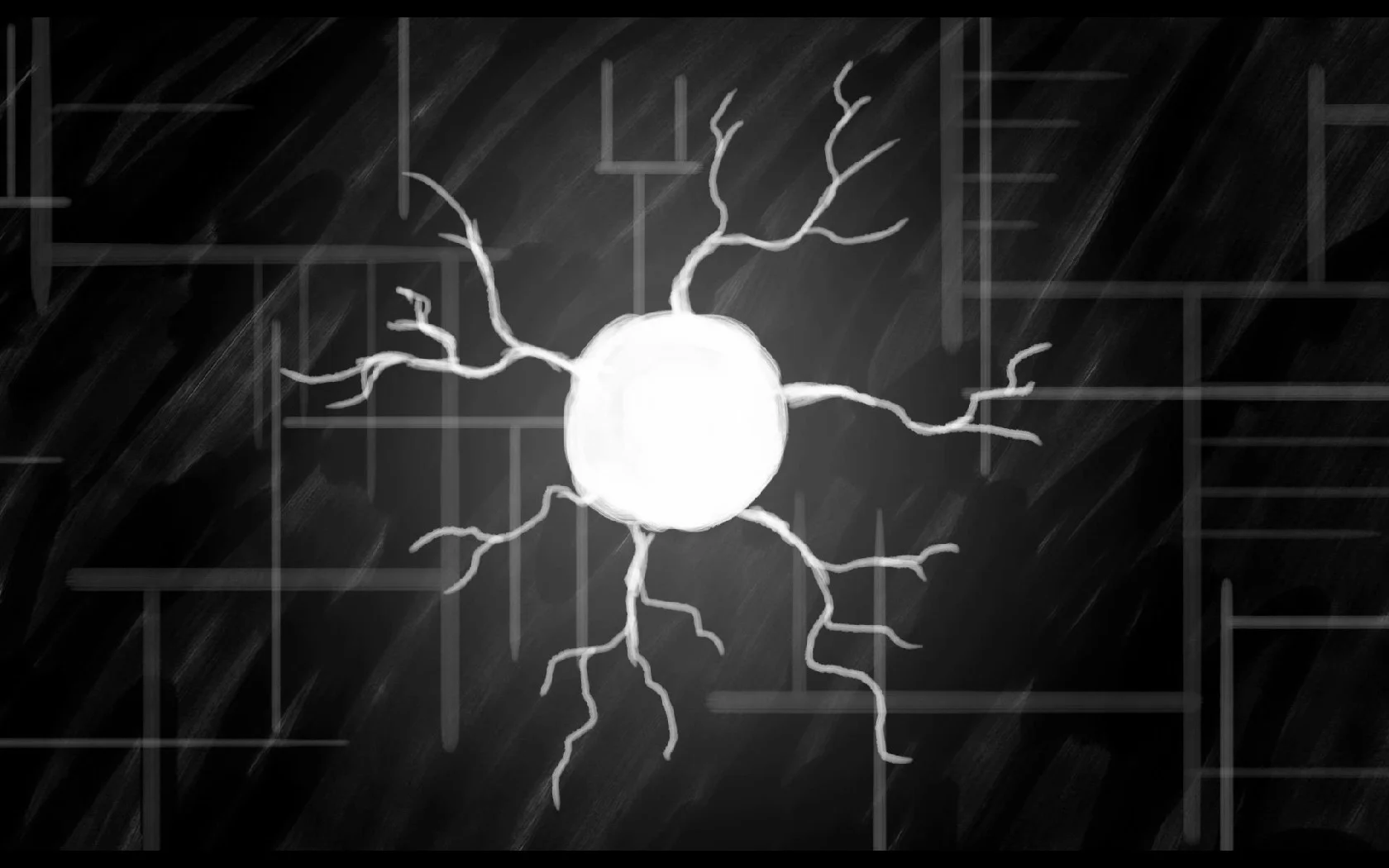
Sym casts you as a teenager with social anxiety disorder. Not actually, since as someone with social anxiety disorder I can tell you that there is absolutely zero chance that you will be ripped apart by saws, eaten by carnivorous plants*, or any of the numerous other fatalities that the game will throw at you. Sym casts you as a kind of metaphorical representation, a long-armed, long-legged creature with the power to enter a "dark world." You must navigate through this hostile world, avoiding the numerous dangers and things that would like nothing more than to kill you, to the exit of the level, solving numerous puzzles along the way.
The scratchy black and white art gives it an eerie feeling, as if something's always slightly off or something is about to leap out from around the corners. Combined with the creepy ambient music, the atmosphere reminded me a little of Limbo (another black and white game filled with traps and things trying to kill you) which isn't bad company to have. Sym is, however, its own game.
For those familiar with puzzle-platformers, there isn't much new here. You run through the level flipping switches and pressing buttons and evading enemies to find the exit to the level and escape. The light world/dark world mechanic comes with different dangers: Plants won't eat you if you're in the Dark World, you can walk right over saws in the light world, and so on and so forth.
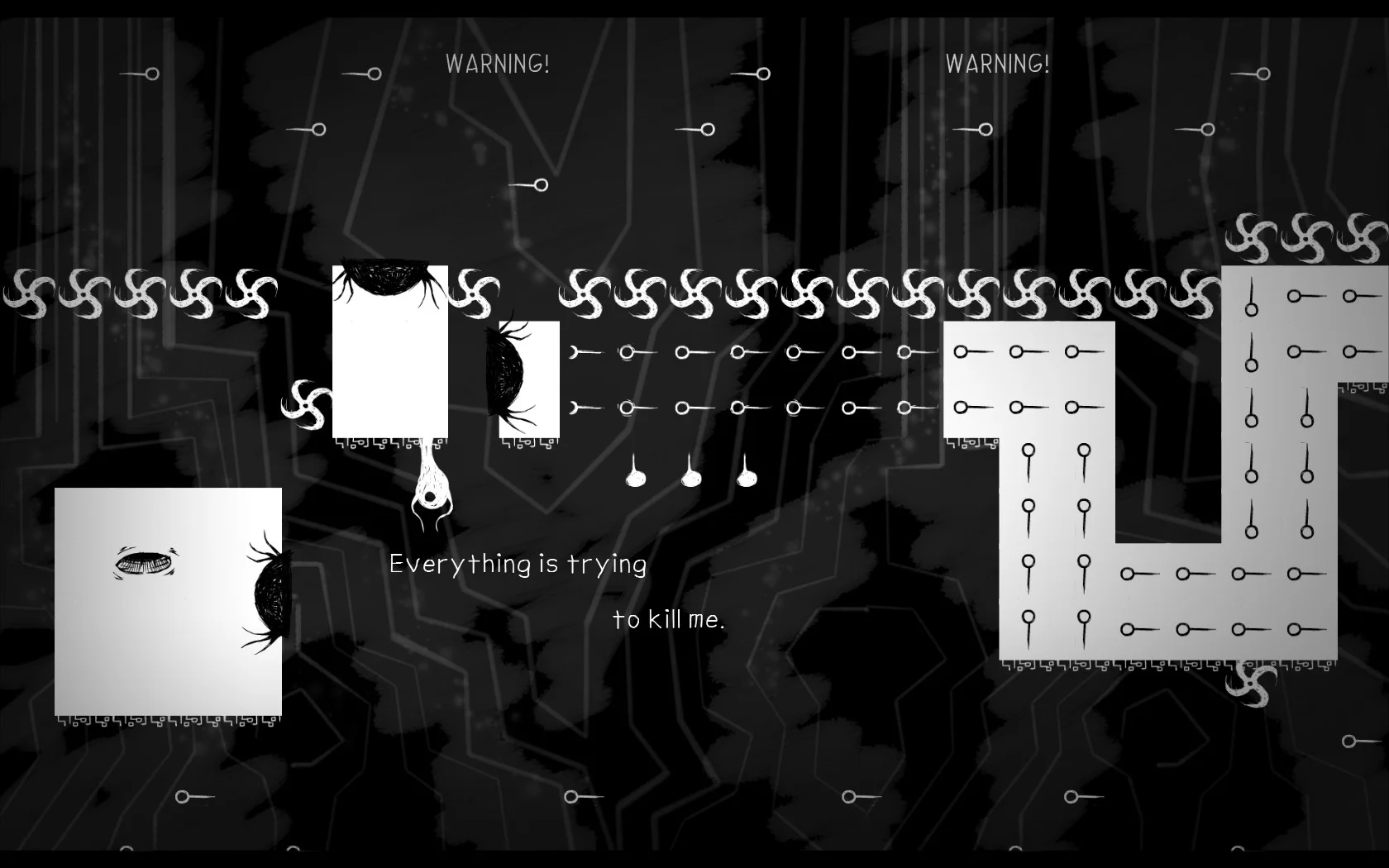
But what got to me as I was playing it was that this was more or less a metaphorical story. The main character (named in press materials as "Joshua" but nameless in the actual game itself) goes through his life trying to find a safe space, finds himself beset on all sides by things that want to kill him, gets treatment and is rehabilitated, and finally either decides he's better off alone or finds a way to rejoin the world. At this point, the level editor unlocks, leaving the game with the statement "Now you are free to create your own worlds". I wasn't directly dragged through the story by the nose a la Gone Home, nor was it dizzyingly abstract the same way, say, some Twine games are. It left me with just enough to figure out the plot.
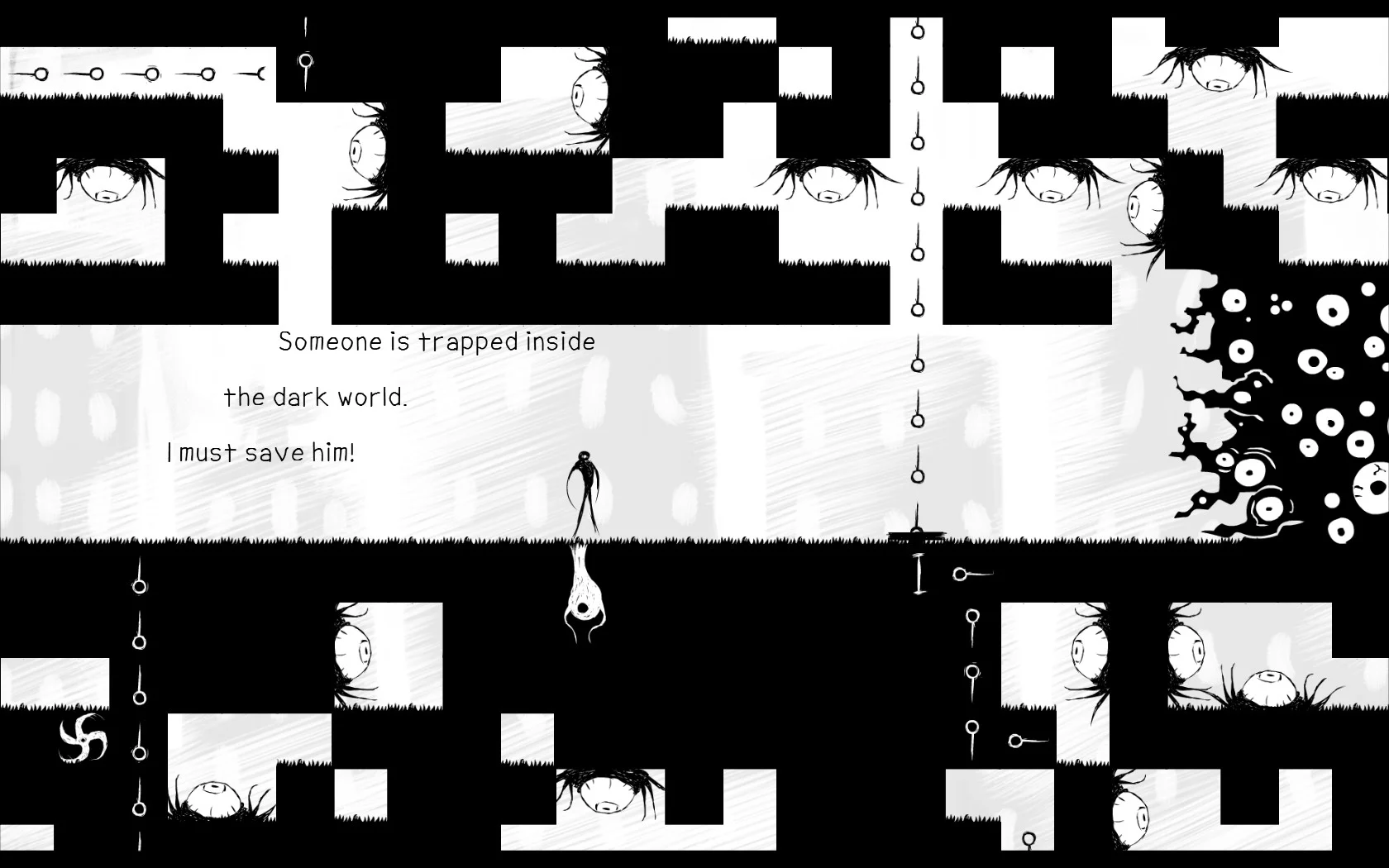
I feel bad about dinging the game for being incredibly frustrating at points (especially the "compactor" level in the "Rehabilitation" section and the entire ending sequence, which involves man-shaped figures running to and fro and who kill on contact regardless of dark or light world), but there were definitely points when I felt the game was a little too unforgiving for its own good, and thought about putting it down. However, this appears to be part of the point, more or less. I mean, it's portraying an unforgiving world, so maybe the sheer difficulty spikes in the middle of the levels are actually part of that? But a game should never be so frustrating that the player actually stops playing it. That is not, and should not be, a thing that happens. If a player stops playing, then the message gets lost. People don't usually come back, and you've failed at conveying whatever point or story you're trying to get across.
But in the end, I fully recommend Sym. It's an interesting game with some very deep levels, and well worth the challenge. I especially enjoyed the exploration aspect to the level-select menu and the bizarre twists of the "Rehabilitation" section. I suggest you give it a try.
Score: 4 out of 5
Full Disclosure: The reviewer received a copy of Sym for this review
*I'm still afraid of this, though.
The Weaponographist Review
When I sat down to write this review, I found myself at a loss. With a game that fails this way on so many levels, what could one possibly address first?
It's pretty clear the game isn't good. There's not really a unifying theme, a lot of the mechanics are better implemented in other games, the weapons boil down to "mash attack as hard as you can," there's no real way to pick a loadout other than blind luck, and the near-constant waves of enemies are actually numbing at a certain point. I found my sensory input dissolving into generic music and bright colors as my fingers tapped the attack keys for reasons I could no longer understand.
But, even with all of that, it's hard to pinpoint somewhere to start. Somewhere to point out where in the horrifying and sad mesh of monstrous machinery things begin to go wrong.
When I sat down to write this review, I found myself at a loss. With a game that fails this way on so many levels, what could one possibly address first?
It's pretty clear the game isn't good. There's not really a unifying theme, a lot of the mechanics are better implemented in other games, the weapons boil down to "mash attack as hard as you can," there's no real way to pick a loadout other than blind luck, and the near-constant waves of enemies are actually numbing at a certain point. I found my sensory input dissolving into generic music and bright colors as my fingers tapped the attack keys for reasons I could no longer understand.
But, even with all of that, it's hard to pinpoint somewhere to start. Somewhere to point out where in the horrifying and sad mesh of monstrous machinery things begin to go wrong.
But if it wasn't clear from the paragraphs above, I'd give The Weaponographist a wide berth. Despite the occasional good joke, there's really nothing to recommend the game when there is a glut of roguelikes that do it better and with more style than this one.

The game at its most distinctive
The Weaponographist stars Doug, a jerk of an adventurer who refuses to help the town of Hellside, and so is cursed to have all his weapons and gear disintegrate after repeated use. To save the town and weaken the curse, he must journey repeatedly into a dungeon full of strange monsters, clearing out each level with a variety of weapons he finds on the bodies of his foes, and the occasional chests that gallop across the screen. While death sends him back to the town above, Doug can weaken the curse and strengthen his abilities by giving the various denizens of the town "demon goo" in exchange for upgraded weapons, abilities, and chests.
The game is a top-down arena shooter with elements of a roguelike. You charge into the dungeon, lay waste to as many monsters as you can with the weapons you can pick up, die, and then are resurrected in town to spend goop on upgrades and do it all over again. At the end of each "depth" of the dungeon, there's a big boss fight against a large enemy and a bunch of smaller ones, and then it's on to the next one. Lather, rinse, repeat. It's a formula many games use, and when you play a roguelike, it's half luck and half learning the systems through trial and error, then applying what you know to future delves into the dungeon.
But the game doesn't seem to be able to make up its mind. It gives you procedurally generated rooms, but limits them to the same three basic types per area, with little variation. It fills the dungeon up with monsters, but the enemy designs are kind of plain and have no real ties to any overall theme. The weapon degradation mechanic is interesting, but since not all enemies drop weapons, it's possible to face down an entire room of people armed only with the fists that serve as an ineffective default weapon. It feels like a lot of thought went into the idea of these systems, but not very much into the implementation of them.

Get used to this screen. You'll see a lot of it.
This is a problem that extends to the art, too. While the drawn art is well done with distinctive styles and ideas, from a top-down perspective, it looks like you're fighting clipart. Between the generic dungeon design and the painfully generic designs of ninjas and tommy gun-toting mobsters, The Weaponographist's visual style is best described as "boring cartoon fantasy". In fact...actually, I have the perfect way to describe this.

One of the better rooms, but still not great.
It looks like a lazy online game. It plays like a lazy online game. In fact, if this had shown up in some form or another on Kongregate or Newgrounds, I would have killed an hour or so playing it, then promptly forgotten about it entirely. It's not a particularly good arena shooter, as waves of the same four or five enemies careen around an empty room until you kill them all and a door opens to do it all over again and hope you're closer to the boss. It's not a particularly good roguelike, in that there's no strategy or skill or discovery. There's just persistent wave after wave of shooting. It gets frustrating after a while, because no matter how long you play, there's no appreciable difference in the gameplay.

In case you're wondering, this is from Depth 2. Look how similar it is to Depth 1
To compare and contrast, I loaded up The Binding of Isaac recently. Isaac, a shooter/roguelike hybrid released in 2011, plays in some respects similar to Weaponographist: It's a dual-stick shooter with RPG elements where you go from dungeon to dungeon fighting monsters and bosses with a variety of weapons. But the difference is that Isaac is actually a lot of fun to play, combining a bizarre atmosphere with a vast weapon variety, distinct artwork, some interesting strategic quirks in gameplay, and haunting, discomforting music. Isaac feels like you're going somewhere even when you lose. The Weaponographist feels like you're going nowhere, and then slightly further into nowhere when you win.
In the end, I'd say I don't recommend The Weaponographist very much. The Binding of Isaac is currently on Steam for a little cheaper. If you want a better roguelike or a better arena shooter, both are in ample supply. I suggest playing any of those, and leaving this one alone.
Score: 1 out of 5
Full Disclosure: The reviewer received a review copy of this game

Crypt of the NecroDancer Review
There are rare times in art when everything works exactly the way it's supposed to. Where everything clicks so perfectly into place that it's almost elegant the way everything is so finely-tuned. And that's what playing Crypt of the NecroDancer from Brace Yourself Games feels like. Elegant. Refined. Like a well-oiled machine. In its unpolished state it was fun and interesting but heavily flawed, but now that it has reached its final polish, it is a beautiful thing to behold.
There are rare times in art when everything works exactly the way it's supposed to. Where everything clicks so perfectly into place that it's almost elegant the way everything is so finely-tuned. And that's what playing Crypt of the NecroDancer from Brace Yourself Games feels like. Elegant. Refined. Like a well-oiled machine. In its unpolished state it was fun and interesting but heavily flawed, but now that it has reached its final polish, it is a beautiful thing to behold.

The story isn't anything much to go by. It begins with a young woman named Cadence following her missing father's notes, where she unearths the crypt of a malevolent lich known as the Necro-dancer. Cadence must journey through the crypt, collecting an arsenal of weapons, armor, and items as she delves into level after level in search of the secrets the crypt holds. It lays out the path for a standard dungeon crawler, but there's a little extra wrinkle that builds in nicely.
When Cadence first encounters the Necro-dancer in the game's opening animation, he pulls her heart from her body and infuses it with magic, forcing her to follow a specific beat. As Cadence journeys, all of her movements and actions must be on an exact beat as well, otherwise she simply won't move.
And that's the premise. A dungeon crawler where absolutely everything has to move to a specific beat. Everything syncs up with this premise. The enemies and even the people in the upgrades screen move to a specific beat. When you find a shop in the dungeons, the shopkeeper actually sings along with the background music. Do well enough, and the ground beneath your character lights up like a disco floor and strobes to the beat. The background music isn't just another part of the ambiance, it's integral to the game. I once made the mistake of loading the game up while listening to music in the background, and I failed utterly, because you need to be listening to the cues. It's not all periodic button presses.

Another wonderful feature of NecroDancer is that, unlike most roguelikes and dungeon crawlers, it doesn't just pit you against increasingly stronger enemies by butting your head against them over and over again. Each zone has a unique set of enemies (hey Weaponographist, you taking notes?) that move in specific ways. While it takes some getting used to, with a bit of planning and some pattern recognition, it's possible (and this is rare outside maybe Binding of Isaac and a few others) for someone to get through the entire dungeon without getting hit once. Incredibly difficult, and takes more luck than skill, but it's possible.
That's something I enjoy that I've been seeing more of in Rogue-likes these days: strategy. There's actually a lot of this in Crypt of the NecroDancer, because the range of movement given allows for a larger playing field. For instance, instead of travelling down a hallway normally and having to take damage from enemies, why not let them get a little closer to you by digging into the side of the hallway, then surprising them? Or, if you know a boss is going to chew you up up close, set a bomb and dance away from them, allowing the bomb to go off in a specific area. Combined with destructible terrain, this causes bosses to sometimes bust through the walls of the dungeon to attack, turning the stage into a desperate race for resources, all to a pounding techno beat.

Additional characters such as Bard (doesn't have to move to the beat, making the game move at ludicrous speed) and Eli (no weapon, upgraded shovel, and infinite bombs) significantly change the game's topography, causing players to find new solutions and tailor things towards their play style. The game can further be changed by trading rare items for unlocks in the dungeons, unlocking upgrades.
Normally, this would be where I put some of the things they didn't like. While I did have issues with the way the dragon bosses moved and attacked, making them incredibly difficult with anything but the small supply of ranged weapons, I can't really think of much I'd change in the game or improve. It's a classic all on its own.
Play this game. It's a game that deserves to stand the test of time. If nothing else because it's executed so flawlessly.
Score: 5/5
Full Disclosure: The reviewer received a steam code to review the game

A Review of The Charnel House Trilogy
I want to like The Charnel House Trilogy, really, I do.
It's an atmosphere-heavy point-and-click adventure game by a small indie company. It's got a strange plot like nothing else I've really played, except maybe for Downfall. The art has a handmade feel to it that reminds me of older adventure games, so it has the nostalgia factor going for it. And let's be honest, as someone who enjoys Jacob's Ladder and horror games a little more than anyone would ever admit, there is really no reason that I shouldn't have had an amazing time with The Charnel House Trilogy.
But as much as I'd love to trumpet Charnel House to the heavens, I found that the game falls a little short of what it could possibly deliver. While there are some great ideas overall in The Charnel House Trilogy, there's too much here for me to suggest giving this anything but a miss.

Well, whatever you do, don't play The Charnel House Trilogy. You don't need more incoherent weirdness in your life.
I want to like The Charnel House Trilogy, really, I do.
It's an atmosphere-heavy point-and-click adventure game by a small indie company. It's got a strange plot like nothing else I've really played, except maybe for Downfall. The art has a handmade feel to it that reminds me of older adventure games, so it has the nostalgia factor going for it. And let's be honest, as someone who enjoys Jacob's Ladder and horror games a little more than anyone would ever admit, there is really no reason that I shouldn't have had an amazing time with The Charnel House Trilogy.
But as much as I'd love to trumpet Charnel House to the heavens, I found that the game falls a little short of what it could possibly deliver. While there are some great ideas overall in The Charnel House Trilogy, there's too much here for me to suggest giving this anything but a miss.

The Charnel House Trilogy is three linked adventure games in one: "Inhale", the first chapter, introduces the character of Alex, a young woman living in New York City who is about to take a train voyage to a place known as Augur Peak. Before her big trip, a series of mysterious events occurs in her apartment, including a blackout, a strange apparition, and sudden panic attacks.
"Sepulchre", which can be downloaded for free from Owl Cave's website, picks up sort of where the first game left off, with Professor Harold Lang, Alex's fellow passenger on the late train to Augur Peak, as he wakes up after a nap to find the train completely empty save two members of the staff. From there, he is drawn into a surreal investigation that hinges on his past, and the massive black bags present on every room of the train but his.
And "Exhale" concludes both the story of the train and Alex's story, revealing some (but not all) of the truth of what is actually going on. In this segment, Alex awakes on the train to discover that while it isn't deserted, there is something strangely familiar about all the denizens of the train and its compartments...
So first, this is a game that gets what a lot more horror games should get about horror: Horror trades on atmosphere. Entirely on atmosphere. Horror is the hardest-working genre out there because it has to unsettle you from the norm. It has to get into your head. It has to disturb you. And The Charnel House Trilogy gets that. The game starts out with an oddly subdued feeling that everything is slightly off. The feeling only grows as the story progresses, beginning with a few gently surreal quirks and then building to full-on disturbance by the final scenes. In terms of mood and setting, the story is fantastic.
The setting is great, too. The three chapters take place in very confined spaces-- the first in Alex's apartment, and the second two on the train. Because there isn't a huge diversity of setting, the places in the game begin to feel familiar. Like you've been there for a while. When the plot really kicks into high gear, it affected me because these were places and people I remembered. It also made backtracking a little easier. But even with a lack of people, the train had a great sense of place.
But there are some serious issues that have to be addressed.

The least of this game's worries is Alex's out-of-nowhere poetry about New York City
First, I strongly suggest that you go into the advanced settings menu for the game and disable the voice pack. I wouldn't disable the music, because in spite of the annoying radio (and the even more annoying DJ) during "Inhale", the music is actually pretty good. But the voice acting ranges from "Pretty decent for an indie game" to "a script read for the first time in the recording booth at knifepoint", with all but maybe three roles congregating near the bottom end of the spectrum. And the few roles where they got someone who did sound good aren't worth the ones where they didn't. It got so bad that the voice acting actually started to pull me from the narrative, rather than draw me in, and I made a neat metagame of guessing whether the characters weren't supposed to be reacting to the things going on around them, or whether the actors were just doing a bad job of conveying emotion.
Second, speaking of things that break immersion, there were a a few in-jokes that, even knowing what they were talking about, felt forced and took me out of the experience. The big one is a scene near the beginning that talks about drama involving a game reviewer giving a game a low score. I'd be fine with this if it were something optional, something you could click through, something you could find as you go through the game.

GET IT? GET IT? IT'S TOPICAL! Now only if it had, um, ANY BEARING ON THE GAME
But making it something you have to see to progress through the game, forcing me to read your comment on modern game criticism and drama, isn't going to start me out on your side. I also thought the Phantasmagoria references in the later segments were a little forced.
Finally, while repeated play-throughs did clear up some of the less coherent story elements, the plot winds up going...nowhere. The story picks up speed as it goes along, and there's no way I'd want everything tied up in a nice neat little bow, but the pacing is way off. Most of Alex's character arc is resolved by a single villain's monologue, a lot of the story threads are left dangling, and then the story ends on a cliffhanger that sets up the sequel...a year from now. I'd like to stress, I'm fine with the central mysteries being somewhat open to speculation or unsolved. But even the most feverish droppings from Suda51's brain-anus are going somewhere. They're saying something.

Hope you like a lot of rants and monologues basically saying this.
They're doing something other than shrugging. There's obscuring, and there's having to play a game multiple times to figure out something where the plot points tend to obfuscate for no reason, come out of nowhere at times, and wind up ending on a big question mark and the words "to be continued". The second one shouldn't be done.
Another issue with this is that "Sepulchre", arguably the strongest chapter of the three by virtue of its self-containment, is kind of orphaned amidst Alex's story. It feels like a side-plot while "Inhale" and "Exhale" are going on, something that reveals more of the train's nature, but ultimately doesn't matter when taking the story holistically. Doctor Lang is barely introduced as a side-character to Alex's plot in "Inhale", and is only seen sleeping at the end of "Exhale", while "Sepulchre" focuses on him. I'd have liked to see him interact more in the plot during the "Exhale" chapter, which, while it might have diminished Alex's story a little, would have made the connections between the two characters seem a little stronger.
In the end, it's a good game weighted down by its own self-indulgence, and I can't in good conscience give it a positive review when that's the case. But, since it's not entirely a bad game, I have a solution. If you really feel like playing this, either download Sepulchre from the link above, or simply play the "Sepulchre" and "Exhale" chapters with the voices turned off. You miss nothing by skipping "Inhale", there's a chapter-select screen on the main menu, so there are ways to make it work.
But as a whole package, this is one train I'm glad left me at the station.
Score: 3 out of 5
Full Disclosure: The writer of this review received a review copy of this game.