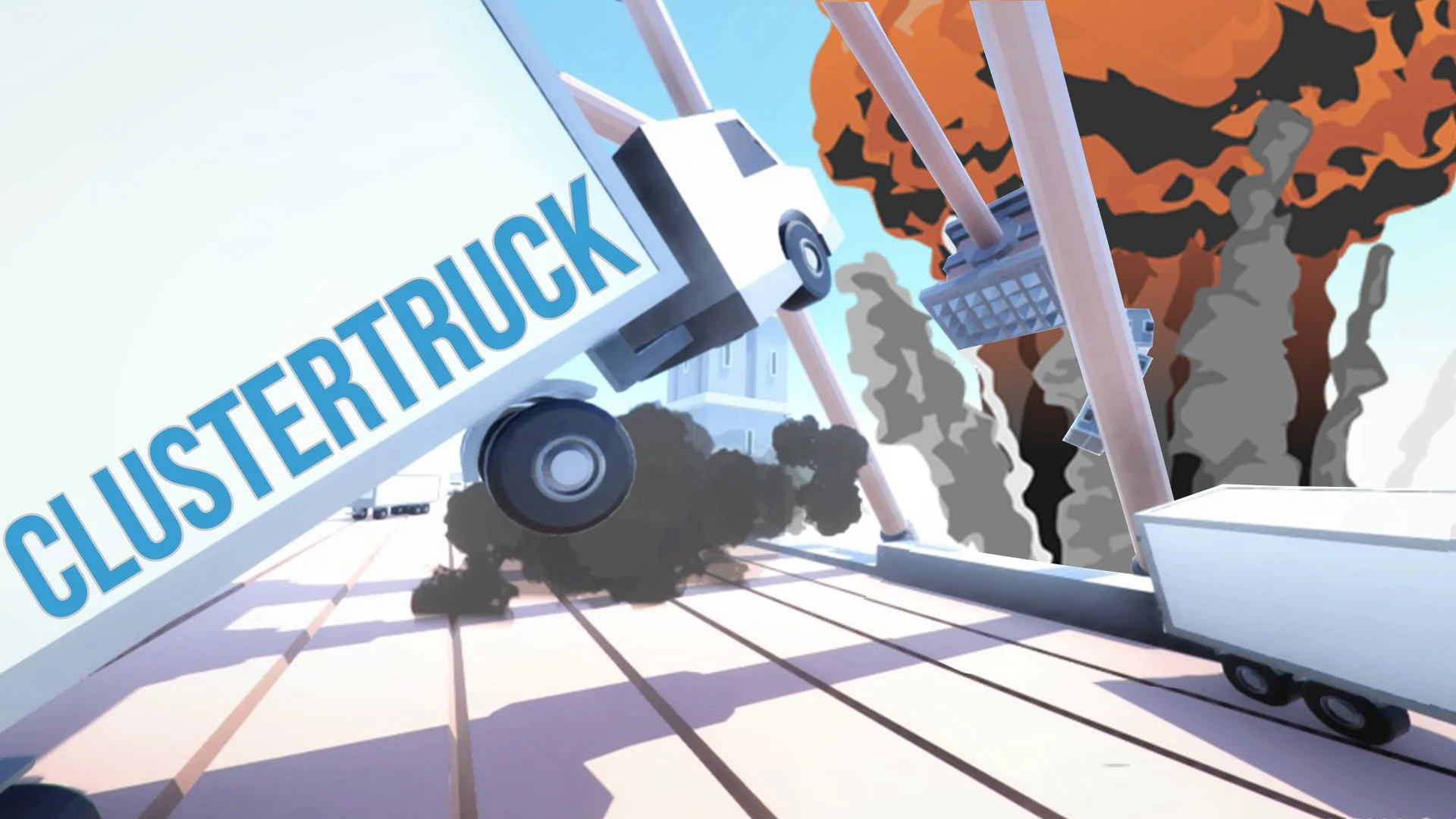
Clustertruck Review
Imagine someone took the simplicity and design philosophy of SUPERHOT and applied it to a platformer, and you'd get Clustertruck, the latest by Landfall Games. A platformer that finds you playing "the floor is lava" on the back of featureless trucks, where one bad bounce leads to a hilarious demise and making your way through the level is about as much luck as it is skill, Clustertruck is one of those few games like the aforementioned SUPERHOT or Nidhogg where adding anything more to it would be stupid. It only has to be what it is. And it's fun like that.

Clustertruck is simple. Run across the trucks, don't hit anything else, don't touch the ground. You can also get a number of "style points" for achieving a certain amount of hangtime in the air, leaping across trucks as they fly over the terrain, dodging obstacles, and other things like that. Annoyingly, they do not give you points for back or frontflipping, which is awesome to pull off and should definitely be added in a later update. Especially since the mouselook goes three hundred sixty degrees. You will frequently see the "YOU LOST" screen, whether it's missing a jump, getting hit by a rock, or even winding up beneath the wheels of those faithful trucks.
Get used to seeing this.
Adding to the fun, the trucks seem to collide and drive forward randomly, forming the titular clusters and unforming with equal speed as they jostle about, sometimes crashing into each other to cause explosions. What this leads to is not the normal, firm layouts of platform games, but in fact a complete anarchic scramble across dissonantly pleasant terrain.
It all adds up to something incredibly simple, but also both incredibly frustrating and rewarding. When you figure out how not to ram nose-first into the ground on a level, there's a wave of relief not unlike defeating a difficult portion of Dark Souls or Superhot. When you finally finish a level, it's so worth it that often times, I don't even replay the level for better times. Once you begin unlocking abilities, it gets slightly easier, but never enough to ever relax you to a state of complacency. You will keep falling off of trucks until you finally get fed up and rage-quit, and then go back to falling off trucks all the more. It's a classic game, and one simple enough that it's well worth playing.
5/5
Full Disclosure: The reviewer received a copy of this product for review.
20XX Review
The new Mega Man-themed roguelike platformer from Batterystaple games combines two genres known mainly for their difficulty: old-school platform games, and roguelikes. The issue with this combination is that old-school platformers trade on repetition, muscle memory, and pattern recognition to move their players through the game, and roguelikes usually throw most of this out the window, meaning the players have to learn more to rely on skills and powerups than figuring out level layout.
In theory, it's an excellent idea, marrying the difficulty and skill-honing of roguelikes with the quick-reaction ethos that drives older platformer games. In practice, however, it's a nightmare.
There's been a trend recently for "difficult" games, and I hope we see the end of it soon. For all the reputation Dark Souls has, it's not actually difficult so much as it is a game that rewards learning and incentivizes a certain method of play. But because gamers apparently want "bragging rights," or to know that they've defeated something with a certain degree of challenge, some developers and designers tend to front-load their games with a bunch of content designed to stack the deck against the player and make the game that much more difficult to get through. The peak of this is of course Darkest Dungeon, but other games have definitely been stepping it up.
Which leads us to 20XX. The new Mega Man-themed roguelike platformer from Batterystaple games combines two genres known mainly for their difficulty: old-school platform games, and roguelikes. The issue with this combination is that old-school platformers trade on repetition, muscle memory, and pattern recognition to move their players through the game, and roguelikes usually throw most of this out the window, meaning the players have to learn more to rely on skills and powerups than figuring out level layout.
In theory, it's an excellent idea, marrying the difficulty and skill-honing of roguelikes with the quick-reaction ethos that drives older platformer games. In practice, however, it's a nightmare.
An average round of 20XX goes like this: You leave your home base to a procedurally generated level (it's either Vaculab, the jungle level, or Agnisort, the lava/factory stage.) You fight your way through the enemies and hazards to the boss, and on defeating the boss, gain their power as a weapon for later stages. You then re-up, get some upgrades, and continue on to the next stage from there. Or you die, forfeit everything except the upgrade points (known as "soul chips) that you collected up to that point, and are dropped back to the base to upgrade and try again.
This is kind of frustrating. While the upgrades offer some grading to the overall difficulty cliff, the game can get repetitive quickly. Further compounding things, the way the level structure, or as they call it "the network" changes every time but seems to spit out the same or similar boss combinations each time also gets a little repetitive and frustrating. I'd like it to show me more, but it doesn't really show me enough. And while the variety of upgrades (both passive and active) make up for it a little, it still falls short.
Which is a shame, because, and I will say this, unless you're getting some kind of nostalgia fix via emulator, this is the best Mega Man game you will play all year. The controls are smooth, the enemy placement makes sense in spite of the procedural generation, and learning the patterns and movements is actually a fairly painless process. This is a good game. It's also a significantly more fair game than a lot of the "difficult" games that wind up making it into general prominence.
Before I go any further, however, I should say this: The game is in Early Access, so I have no idea what it'll be like when it finally makes it to shelves. Hopefully, the challenge is lowered a little, and the game is tweaked a little more so the process doesn't seem so Sisyphean as it does now. Once the game opens up a little after that first level, it really starts to shine, but before that, it can just be kind of a slog.
In the end, though, if you're craving decent Mega Man action or a new roguelike to add to the shelf, you can't really go wrong with 20XX. It's one of the rare games where what you see is exactly what you get, and there's nothing wrong with that, I just see it as something that could be a little better.
3/5
The reviewer received an early-access copy of this game in exchange for an honest review