

Slain: Back From Hell! Review
The successfully Kickstarted game Slain makes its console debut on the PlayStation 4. Find out if this 80s / 90s inspired gothic hack and slash is worth your time in this review.
Slain follows the adventure of a Bathoryn, a doomed hero, who wishes nothing more than to sleep. Unfortunately for Bathoryn, duty calls and he must wake up from what seemed to be like a very long nap to cleanse six different lands from demons, monsters, and the living dead.
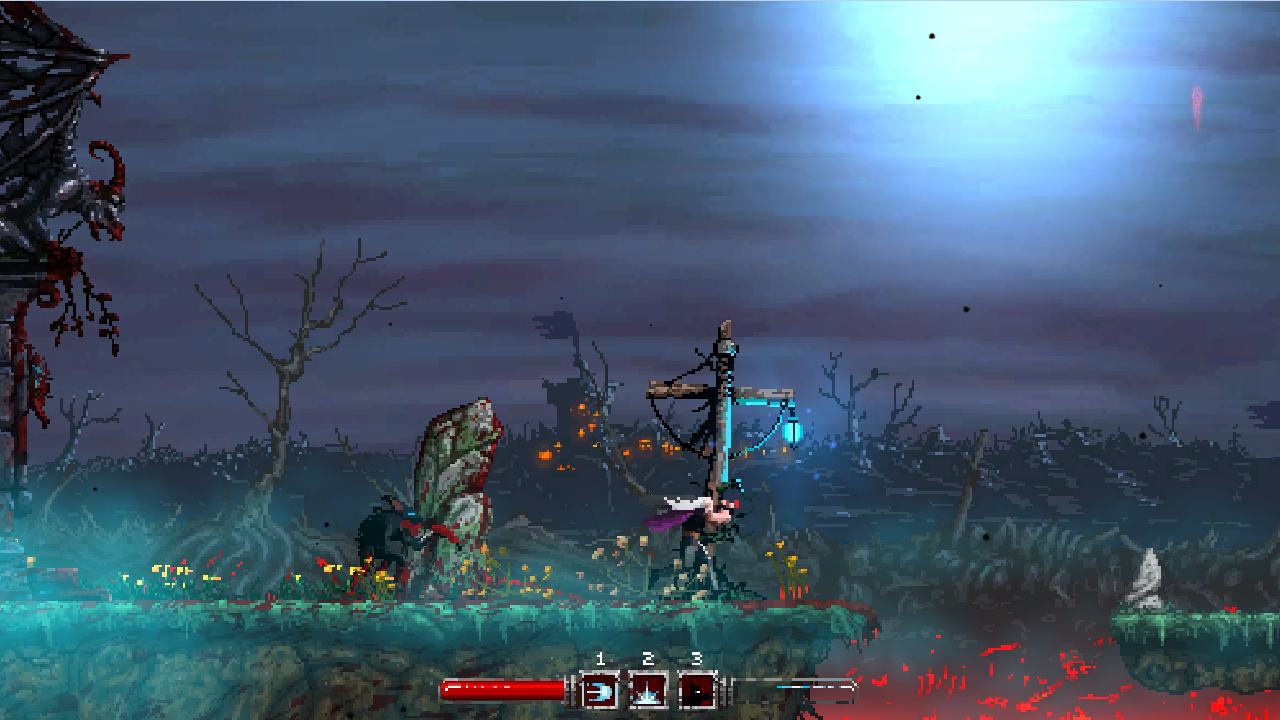
Within the first few minutes of Slain, I died, and then I died again, and then I died again. If Slain’s objective was to die over and over, I would be the grand master of Slain. Luckily, the checkpoints are so frequent that you never get stuck anywhere for too long. There were plenty of times where I had killed all of the enemies, only to be killed by a trap, causing me to completely redo the part that I had just finished. I really only have myself to blame for constantly underestimating the world of Slain. There is never a moment that just lets you breathe. Whether it’s a group of enemies or a boss fight, you’re going to experience your fair share of deaths.

Most of my early deaths could have been prevented if I would have taken a step back from trying to murder everything and embrace the complexities of the combat. One of the main features of Slain is the ability to reflect almost every projectile - and there are a ton of enemies who shoot different types of projectiles. There is also a parry system that allows you to time your blocks and then land critical hits. Parrying enemies is the best way to get through difficult encounters.

Overall, there is a decent variety of enemies. There are a few reskins, but their difficulty has been increased. I never got to the point I felt that I saw the same enemy too much. Because Slain has such a wide variety of enemies I always felt that I had to stay on top of my combat game. The game even introduces new enemies right before the final the boss fight.

The boss fights in Slain are all intense. They use every aspect of the game’s combat mechanics which makes it critical that you never let up. One constant throughout the game is that once the boss starts to lose health they start to speed up their attacks making you have to work even harder. There were plenty of times that I felt that I was about to execute the boss only to get them down to a quarter of their health and die.

Slain's biggest issue is that there is a lack of any sort of upgrades. The health and mana you start with are the same that you end with. Eventually, you're able to switch your regular weapon to fire or ice, but it doesn't feel like much of an upgrade. I find myself torn if this is a major issue or if it's just something that I'm not used to. Traditionally, games will have an upgrade system, so when you run into one that doesn't have one it's kind of odd. In the end, this was okay for me, but other gamers may find this to be an issue.

I had a great time playing through Slain: Back From Hell. It took me roughly about 7 hours to finish which is a great length. If you like difficult games, heavy metal, and tons of gore, then this game is right up your alley!
4.25 out of 5 stars
Thank you to Wolf Brew Games for providing the code.

Headlander Review
Is Double Fine's first Metroidvania style game worth your time? Find out in this review of Headlander!
When I first played Headlander at the 2015 PlayStation Experience I got the impression that it was a puzzle game, but within the first 30 minutes, I realized that I was wrong. Headlander has rich environments, a lot of useful upgrades, and a good amount of reasons to want to explore.
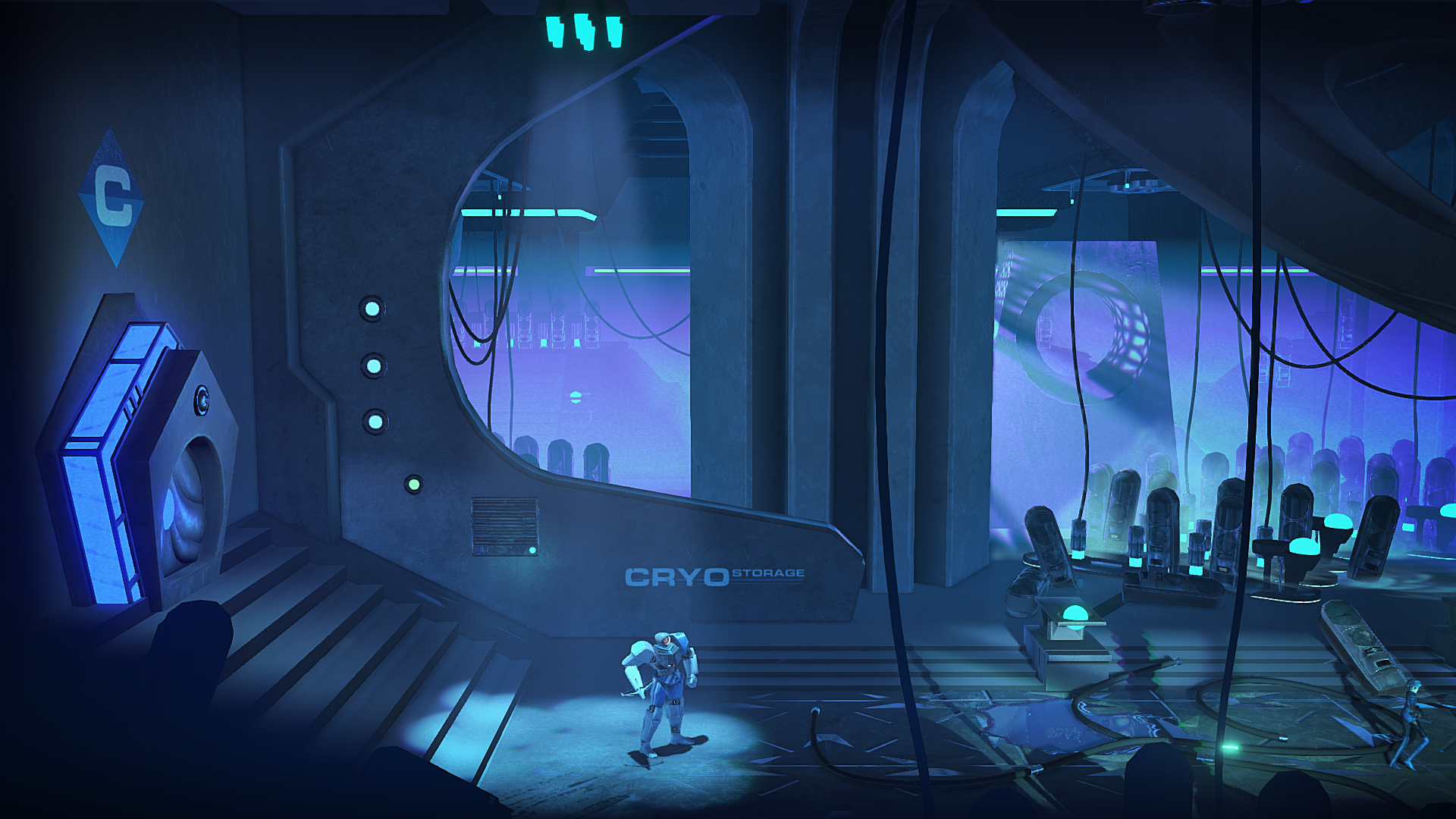
The first thing you’ll notice is the 1970s sci-fi aesthetic – and of course, the fact that you are just a floating head. Your primary ability is being able to tear the heads off bodies and then taking over the body. As the game progresses, you’ll encounter different colored enemies. These different colored bodies grant you access to different areas of the map. For the most part, the correct enemies that you need to progress are pretty close or will spawn within a few seconds allowing you to continue on your adventure without much effort. In fact, I found that even though Headlander touts itself as a Metroidvania style game, most of the time I was going forward and completing objectives without really having to backtrack. This sort of contradicts what I typically think of Metroidvania games, which is slightly unfortunate because I wouldn’t mind spending a little more time in the world of Headlander.
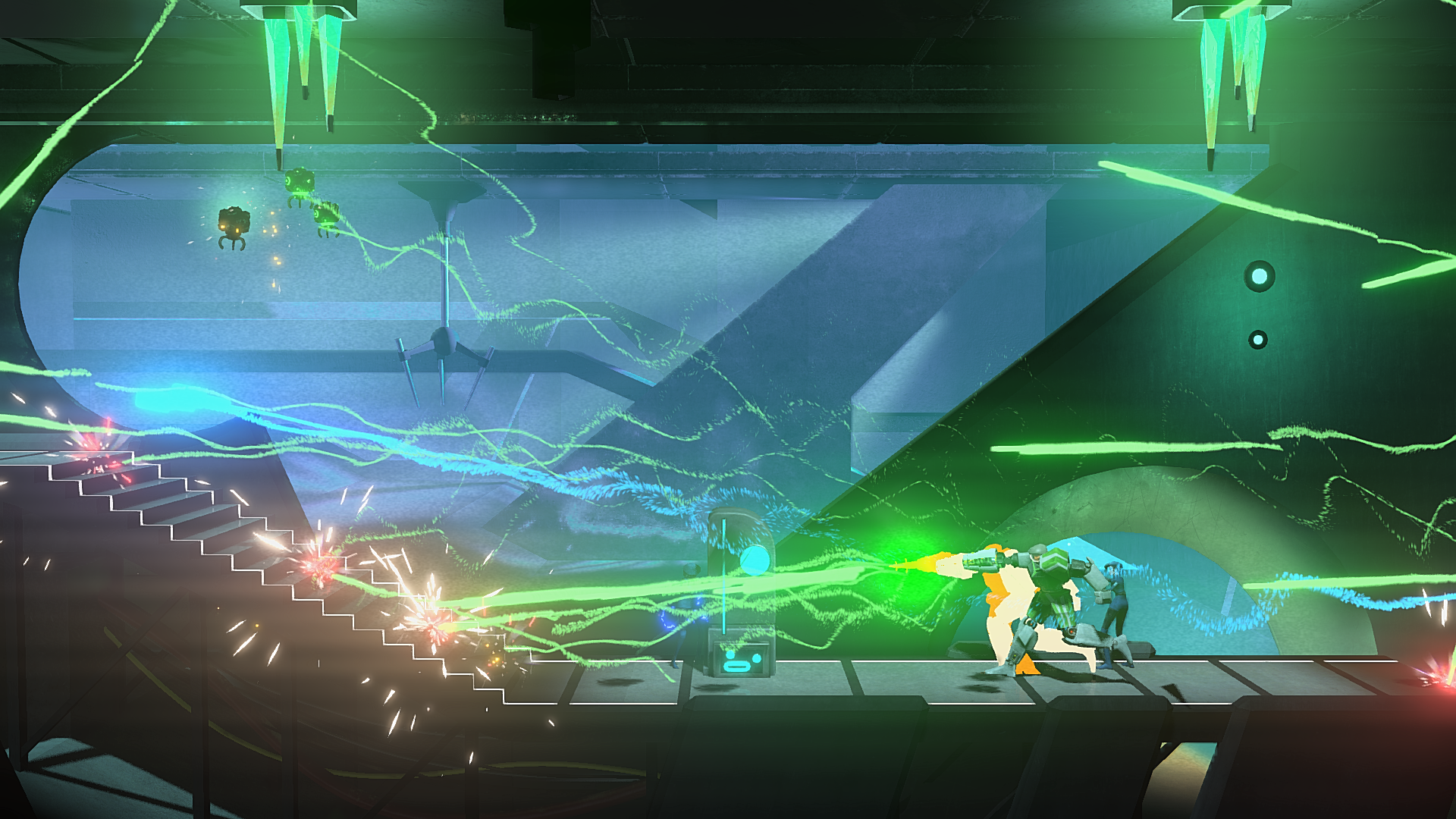
You can upgrade both your body and your head abilities by finding orbs, secret rooms, and completing side missions. By upgrading, you can increase your ability to suck enemy heads off, speed up your regeneration, increase your thrust and health and plenty more. Even if you just tried to blast through Headlander you would still find a decent amount of upgrades, which is great because some of the abilities that you earn are absolutely essential to making sure that you succeed on your adventure.
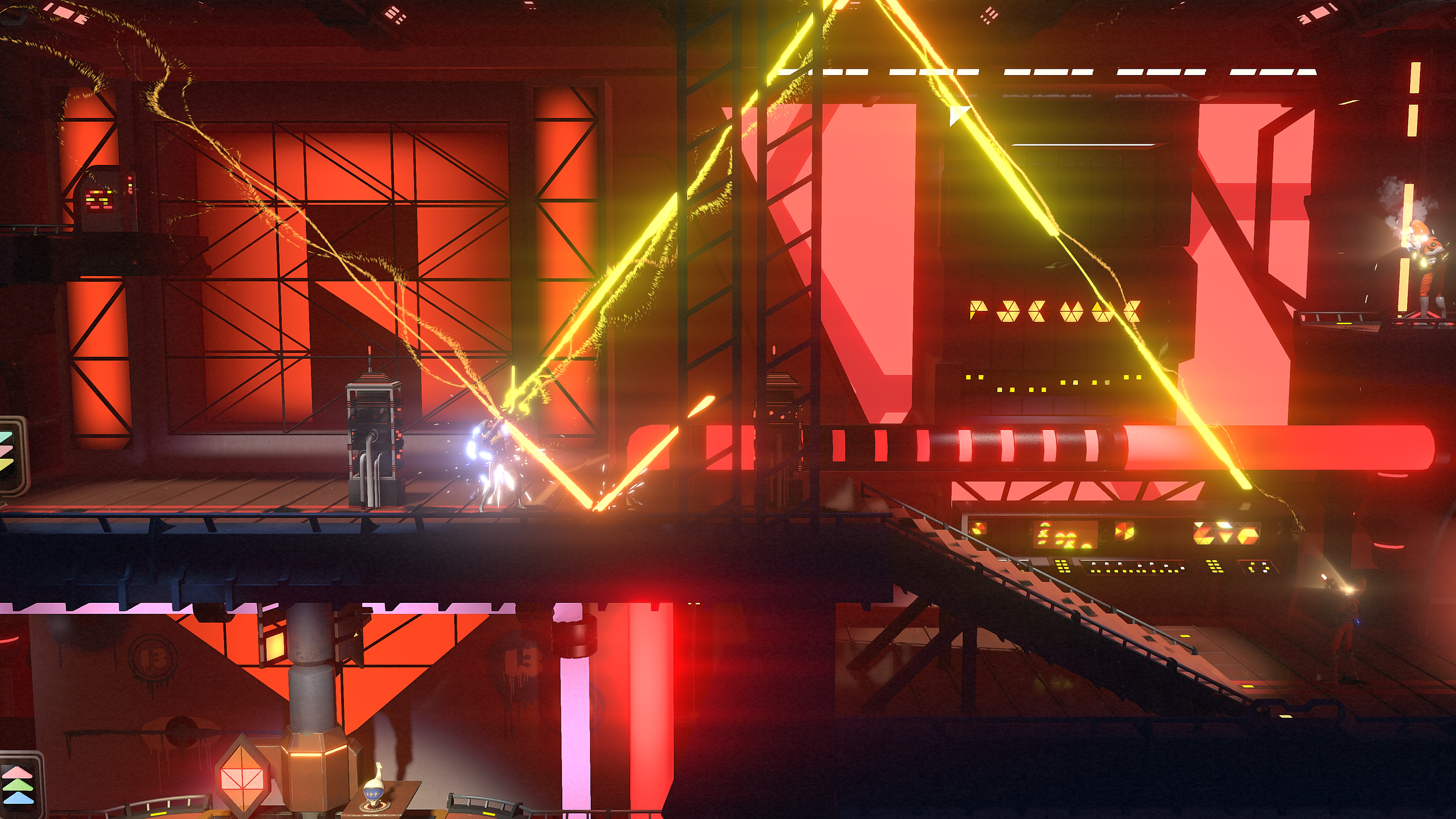
The combat in Headlander gets progressively more intense. The early bodies that you get have a pretty simple shooting mechanic that will slightly bounce off of the walls, but as you continue your laser shots will start to bounce a lot more. The bad news is that the enemies also get these upgrades. So what starts off as a cool little mechanic eventually makes you feel like you are playing a hell-shooter. Luckily, dying doesn’t punish you too much.
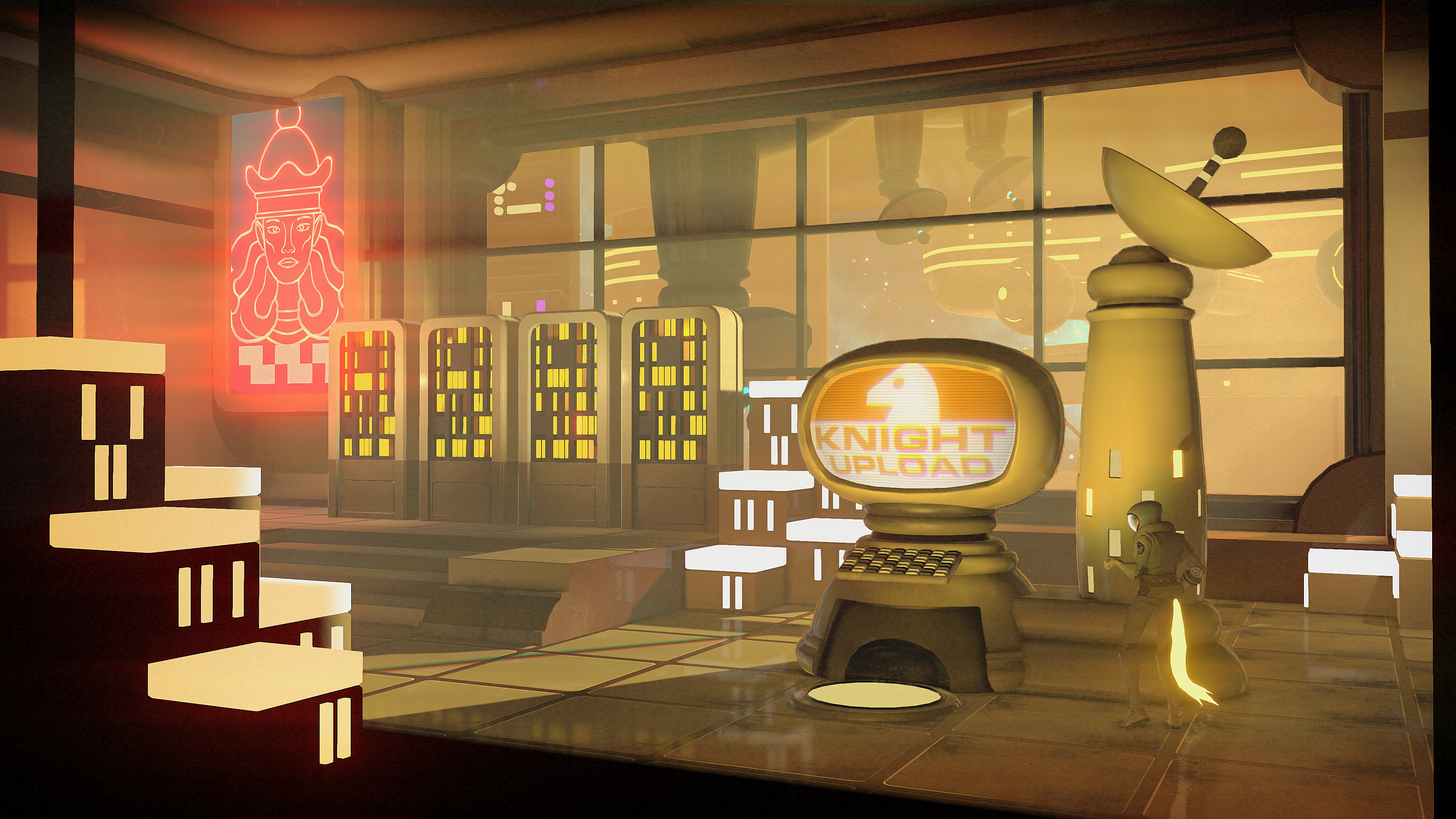
Headlander features a couple awesome bosses, but unfortunately, there were only two. They both require you to use both the head and body mechanics to destroy them, which I really enjoyed. The game could have easily just made you use your shooting abilities and completely ignored the power of your head. Although Headlander is not a very long game there should have definitely been at least one more boss – especially since the ones that are in the game are a lot of fun.
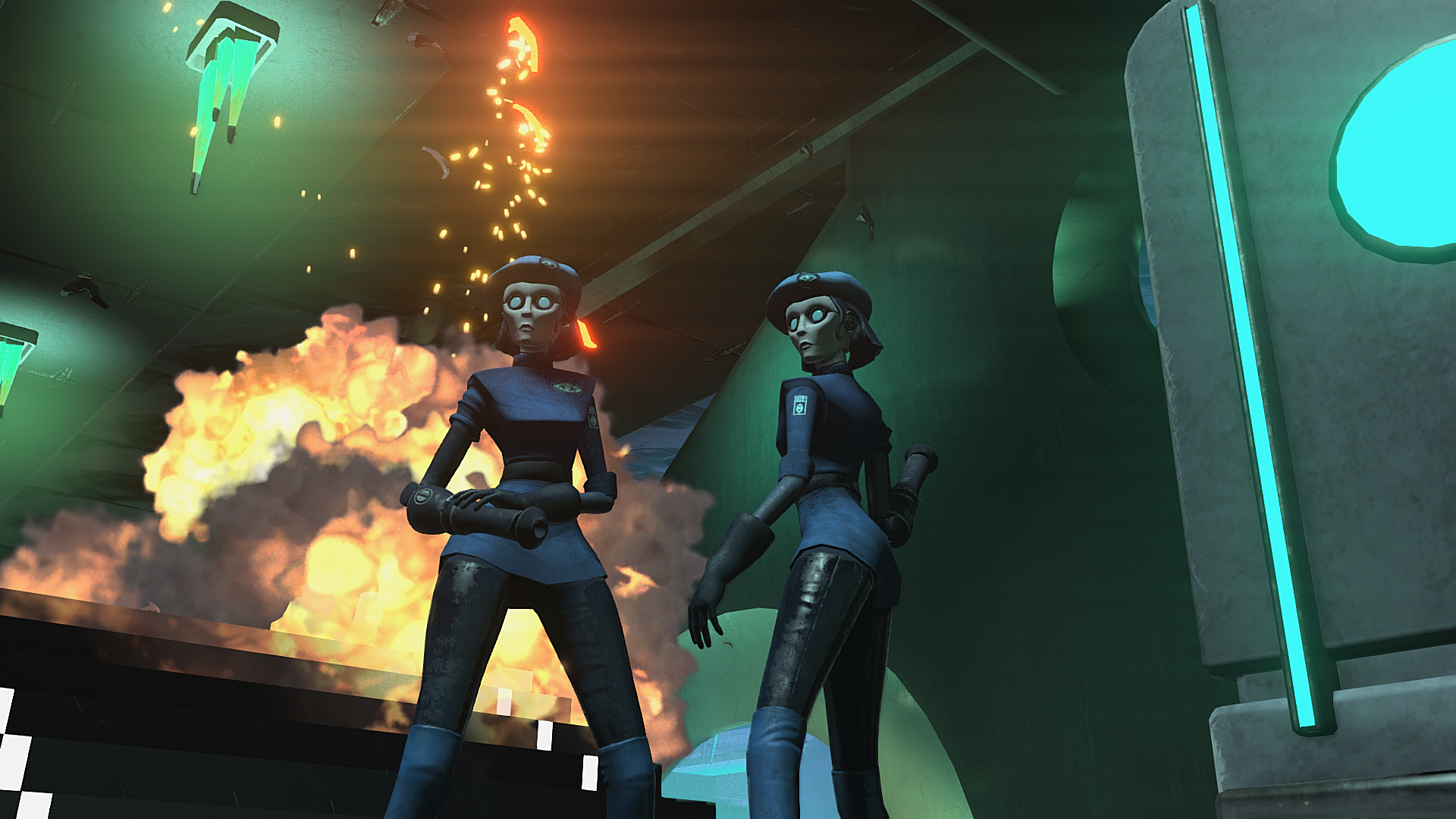
Now being a Double Fine game, Headlander features a quirky story and a ton of humor as you might expect. This specific game was created from Double Fine’s Art Director, Lee Petty, who was the project lead of the hilarious and brilliant, Stacking. I bring this up because if you played Stacking and enjoyed it, then Headlander is definitely a must play and if you haven’t played Stacking, I couldn’t recommend it enough.
The overall experience took me a little over five hours to complete. Because I was constantly making progress, I felt that I didn’t get to enjoy the world as much as I’d like. Also, Headlander could definitely benefit from adding one or two more boss fights.
4 out 5 stars
Thank you very much to Double Fine for providing the code.

Fenix Furia Review
The critically acclaimed Fenix Rage comes to consoles under the new name! Find out if Fenix Furia is worth your time in this review!
Jump, dash, die, repeat. That's pretty much what you're going to be doing over the 4-6 hours of Fenix Furia and you wouldn't want it any other way.
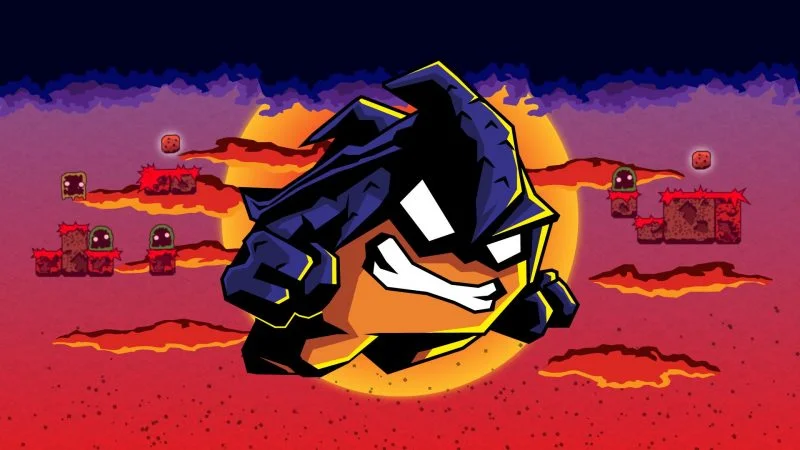
Fenix Furia is one of the most frustrating and addicting games I've ever played. As with most games, the beginning is fairly easy, but this doesn't last long. There are 10 worlds in Fenix Furia, each with 20 levels, as well as an Arcade where you can unlock extra games. Your objective is to use your unlimited jump and dash abilities to weave in and out of enemies who are moving up and down and all around. I would say once I reached the later levels I would die around 10-15 times guaranteed with a high of being 48 deaths on one level.

There are five modes when you select a level: Easy, Rage, Two, Challenge, and God. Easy mode gives you an extra hit and there is no time goal. Rage mode has one-hit kills as well as a time goal to beat. Two, which is the multiplayer, puts two people in a race to finish the level. Challenge restricts the amount of jumps and dashes you can use. God mode makes you invincible and you have to kill all the enemies on the map before time runs out. When you successfully complete these different modes, you are rewarded with stars. You can use these stars to unlock mini-games that are actually fun.

Along your journey you will also find cookies - that's right, cookies. Collecting all of these cookies will unlock 10 Fenxi Furia themed recipes. Just let that sink in for a moment. Besides earning trophies you can get a delicious recipe. How cool is that?

The only real issue I had with Fenix Furia is that the levels in each world don't progressively get harder. You may come across a level that feels like it's impossible and the next level you breeze right through. I don't feel like this is something to knock points off the games total score for, but at times the difficulty does feel inconsistent.

Fenix Furia is an absolute blast. My stats show that I died over 2500 times and I have no issue with that. The game is challenging and rewarding and that's exactly what you want from a game. I'm holding out hope that one day Fenix Furia makes it way on to the PlayStation Vita because I think it would be the perfect console for it. Do yourself a favor and buy this game!
5 out of 5 stars
Thank you to Green Lava Studios for providing the code.

Hands On With The Golf Club 2
The Golf Club 2 looks to expand on the success of the franchise by adding a ton of new features. Find out what's new in this hands on!
I think it’s safe to say that golf games are designed for golf enthusiasts. The Tiger Woods series definitely opened up the genre to a wider audience, but without a big star’s name on the cover, most people probably wouldn’t give a golf game the attention it deserves. While these games may not be at the top of everyone’s priority list, Golf Club 2 has a good chance to be the golf game that returns everyone to the genre.

Usually when a golf game comes out, you can expect it to have licensed courses, but being a small developer HB Studios has decided to go a different route by creating an incredible course editor. In the first Golf Club, users created over 108,000 courses. This allows HB Studios to rely on an obviously healthy community and invest money in improving gameplay, as well as updating their course editor. One major improvement to the course editor is that users will be able to import their maps from the original Golf Club and add new features like waterfalls to their course.

The gameplay is fairly straight forward, but by no means easy. You use the right analog to pull back on the club and then push forward to drive the ball. The key to success is timing your swing and making sure the ball goes straight. After playing the game for about 30 minutes, I felt comfortable getting to the green, but putting is a whole different beast.

Putting uses the same mechanics, but trying to figure out how far you should pull back and how fast you should push forward can really become a challenge. The best I could do out of all the courses I played, was getting a birdie on a par 5, which means 4 shots total.

Having an easily accessible golf game with one of the best course creators I’ve ever seen in any game makes my Golf Club 2 experience a hole in one! Yes, I did go there.

Hands On With Warhammer 40k Inquisitor: Martyr
Just how much blood and destruction is in Warhammer 40k Inquisitor: Martyr? Find out in this hands on preview!
The Warhammer series is back with another installment! Warhammer 40k Inquisitor: Martyr is an open-world sandbox action-RPG sent in the universe of 40k. You play as different Inquisitors who travel around a massive star map completing missions.

There are 3 Inquisitor classes that have different skill sets that alter the play. Each class has different skills and skill trees. For example, the Assassin has a sniper rifle that is exclusive to her. Warhammer 40k Inquisitor: Martyr may seem like a traditional action-RPG but the open world star map has randomly generated maps. This is completed by having pre-generated puzzle pieces that the game puts together when starting a map.

Staying true to the 40k universe, there is a cover system, destructible environments, and tons of gore. All of this means that Inquisitor is a very tactical action-RPG, rather than one that you can just run into waves of groups of enemies and take them down like Diablo. You’ll find that the AI displays a great deal of strategy. You can expect to be met by smaller groups who will try to outwit you.

Inquisitors also have secret fortresses that you can customize and use as a safe haven. You’ll also have groups of followers and defensive systems. This introduces the an indirect PVP since Inquisitors can not attack each other.

Warhammer 40k Inquisitor: Martyr will be out sometime in 2017; first on PC and PS4 and then Xbox One later.

Epistory - The Typing Chronicles Review
Any other fans of Mavis Beacon out there? It’s probably pretty hard to make any type of typing game without being compared to the program most of us probably used in middle school, but as I made my way through Epistory – The Typing Chronicles I realized that I was embarking on something much greater. Find out more about this adventure here in this review of Epistory – The Typing Chronicles!
When you are first dropped into Epistory – The Typing Chronicles you can’t help but be impressed with the paper-look of the game. A path of pages opens up around you as you walk along it, opening up a rich environment of trees, grass, rocks, and flowers while holding on to the look and feel of paper. Before you know it, the soothing soundtrack mixed with crashing waves and the beautiful narration has fully immersed you into the story.

While discovering everything the land has to offer, you are of course met with obstacles. To get through these obstacles or defeat enemies you must press the spacebar and type the corresponding words. Whenever you revive the earth, destroy an enemy, or get through an obstacle you receive Inspiration Points. Inspiration points are used to buy upgrades and to unlock certain parts of the game. Gating certain parts of the game may sound annoying to some users, but Epistory does a great job keeping you moving, never making you feel like you have to grind out extra words just to advance. There is also a combo meter that allows you to receive more Inspiration Points the longer you string words together.

The upgrades for the game make a huge difference. You can upgrade your movement speed, combo time, knockback, but more importantly you can upgrade your unlockable skills. For example, your fire attack has a great feature that will add a unique twist on damage over time on an enemy letting you destroy them faster. You can upgrade the speed of this damage over time and get yourself out of some serious jams.
As I mentioned before, you have to press the spacebar to hunker down and then type your words. In fact everything in Epistory can be controlled with the keyboard. You move with W, A, S, D and you can just type in whatever commands you want in the menu. Not being a primary PC gamer, this took me a little bit to get used to, but any seasoned PC gamer should have no trouble at all.

One downside that I frequently ran into was when I unlocked the Fire and Ice skills. The further you get into Epistory you must switch your skills to kill enemies who are only vulnerable to that element. The problem arises when you’re using the Ice skill and you need to kill something that has an “F” as it’s first letter. Once you type that “F” Epistory will prioritize your skill selection and expect you to complete word “fire” rather than prioritize the enemy which is coming to kill you. Luckily, Epistory does two things to alleviate some of this pain. First off, when you die, it’s not the end of the world. You can easily pick up where you left off in a matter of minutes. Secondly, if you reach a point that you just can’t pass, Epistory will adjust and give you a little bit of an easier time. At times, I felt like this was necessary.

I type pretty fast and Epistory did a great job pumping up the difficulty with long difficult words (some I had never even heard of before) and increasing the speed and frequency of enemies. As great as this is, I still ran into the problem that my character and her fox weren’t able to shoot at enemies fast enough. There are times when these little flying enemies come out and they only require one letter to kill them. Well, when you queue say five at one time, the attacks don’t come fast enough, resulting in your death. Do this enough times, the game will make it easier for you and bada bing bada boom you’ve advanced.

Epistory also has a lot of puzzle elements. To receive your skills you must retrieve them from a dungeon. The most frequent puzzle is where you must light up blue tiles by stepping on them without stepping on the same one twice in a row or stepping on a red tile. It’s really not a terrible thing when you step on the same tile twice, but stepping on a red tile will result in the puzzle being completely reset. This makes it much more stressful when you have to do these tasks on ice. With the nature of the game being a story, the puzzles don’t feel like they are to frustrate you. With a little trial and error and some critical thinking, you can get the puzzles fairly quick.

One element that I definitely feel needs improvement is the map. It sort of looks like a zoomed out Minecraft map. While the map does have some handy icons on it that will help you find treasures and gates, a little more interactivity would go a long way.
I don’t want to end on a sour note. Epistory – The Typing Chronicles is a solid game that is absolutely worth trying if you’re looking for something new to try. Combine this with a great story, beautiful music, phenomenal world building and an outstanding narration, you have yourself an adventure you won’t regret taking.
Final Score: 4.5/5
Thank you to Fishing Cactus for providing the code.