

Hands On With Maximum Games Road Rage
Come take a ride on the wild side with this hands on of Maximum Games, Road Rage!
Remember how much fun it was to cruise around the streets and bash people with chains, bats, and billy clubs in Road Rash? Motorcycle combat games have basically disappeared, but Road Rage plans on bringing them back in a big way with a large open world, four player online, and (possibly) four player split screen.

When you first drop into the fictional world of Road Rage you’ll find yourself wanting to explore this massive city. I cruised around the downtown area known as Subtroit bashing pedestrians with my bat before I even thought about starting a mission. The feeling that I had been missing since the days of sitting around playing Road Rash had returned.

Once I returned from my childhood memories and came back to reality it was time to play a mission. Road Rage features checkpoint based races, circuit races, escort missions, races across the city and assassination missions where you have to attack a specific rider. I started up a checkpoint point expecting to bash and crash my way to victory! Except that didn’t happen. The AI is definitely out to get you. This isn’t a game that puts the power into your hands and the AI will just let you crack them in the back with a baseball bat. You always have to be aware of your surroundings.

Road Rage also features tons of performance and non-performance upgrades that you can do to your bikes. Each bike has separate upgrades as well, so leveling up all of your bikes is going to take a fairly long time. I couldn’t get a solid number of characters, but was told that there will be more than 10 and less than 20. Each character has different attributes and you have to unlock them. There isn’t a character customization, but we can always hope for that in Road Rage 2.

I was so desperate for a motorcycle combat game that I even pre-ordered and played through Ride to Hell: Retribution. If you don’t know what Ride to Hell is all about, go watch a few YouTube videos - it’s not pretty. Road Rage seems like the game that will finally deliver the experience we’ve been waiting for and will be released in the fall of 2016.

Kick and Fennick Review
The underrated PlayStation Vita game, Kick and Fennick, makes it console debut! Find out if a game about a boy, a friendly robot, and a psychotic mech is worth your time in this review!
Kick and Fennick originally made its debut February 3rd, 2015 on the PlayStation Vita. It launched as a free PlayStation Plus game, but was overshadowed by the critically acclaimed Transistor and Rogue Legacy, which were also free that month. The fact that it was developed by a small studio without a long history, published by a company not a lot of people know, and put it on a console that doesn’t get much attention, you find a recipe for a game that is bound to go unnoticed. Now with Kick and Fennick coming to Xbox One, PlayStation 4, and Wii U it’s getting another chance to find a place in the hearts of gamers.
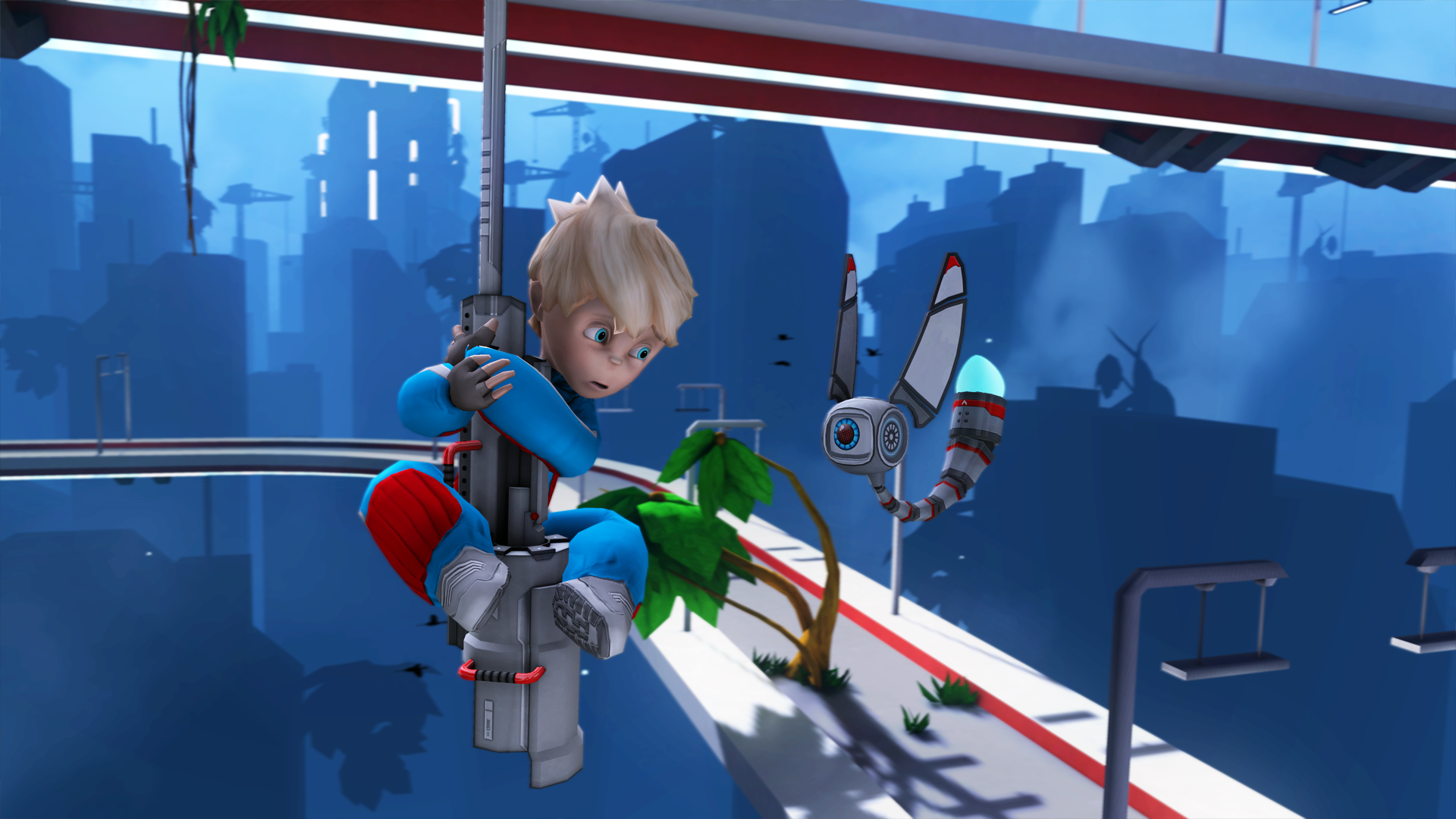
After waking up in a mysterious place, Kick meets the flying robot, Fennick. After Fennick saves Kick from a large robot that is set on destroying everything that it comes into contact with, the pair realizes that Fennick’s battery is broken and they must find a replacement. You basically get an introduction to a story and then it’s never developed into something bigger. It’s easy to overlook this while playing on the Vita, but console gamers may not be so forgiving.
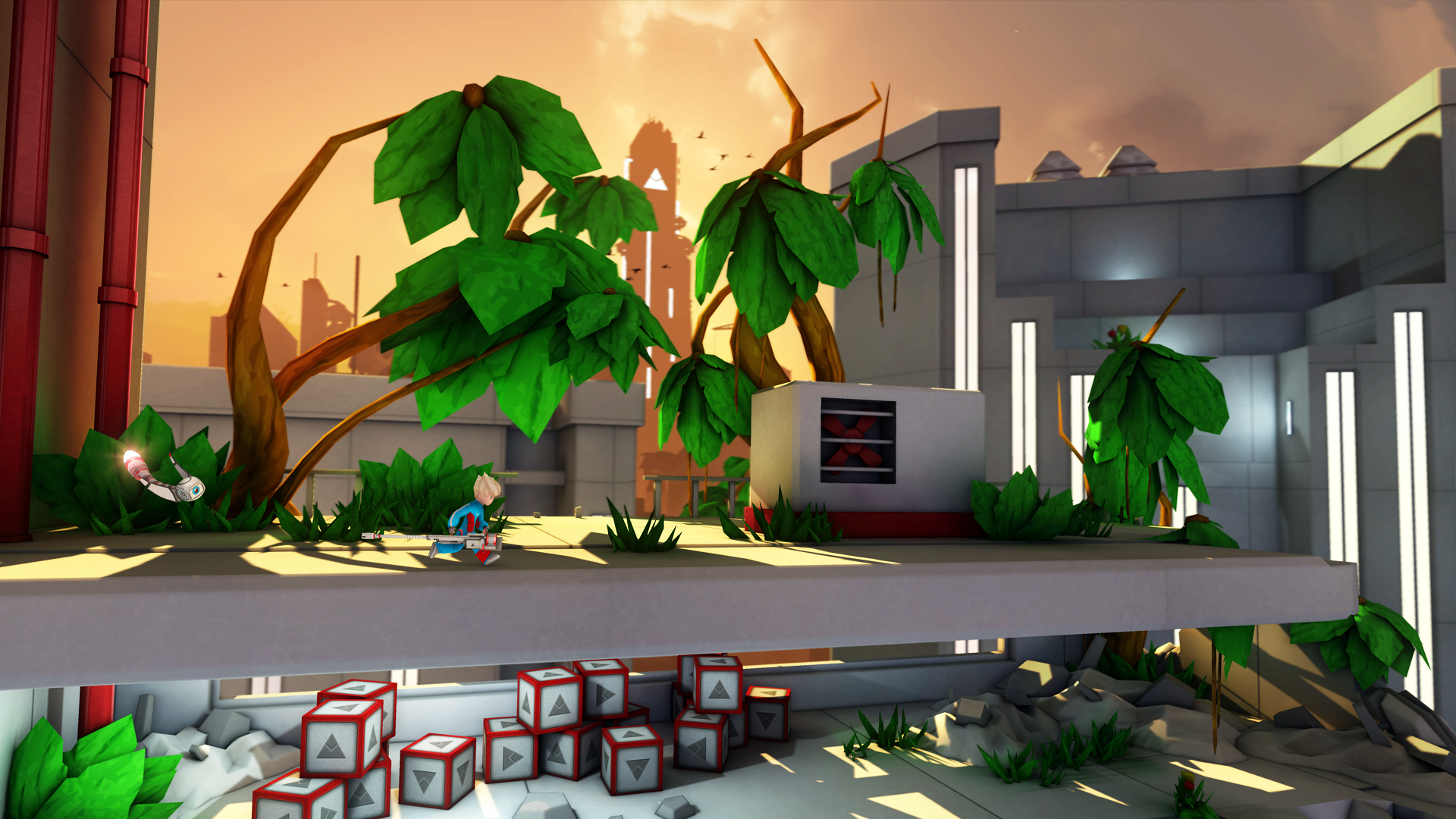
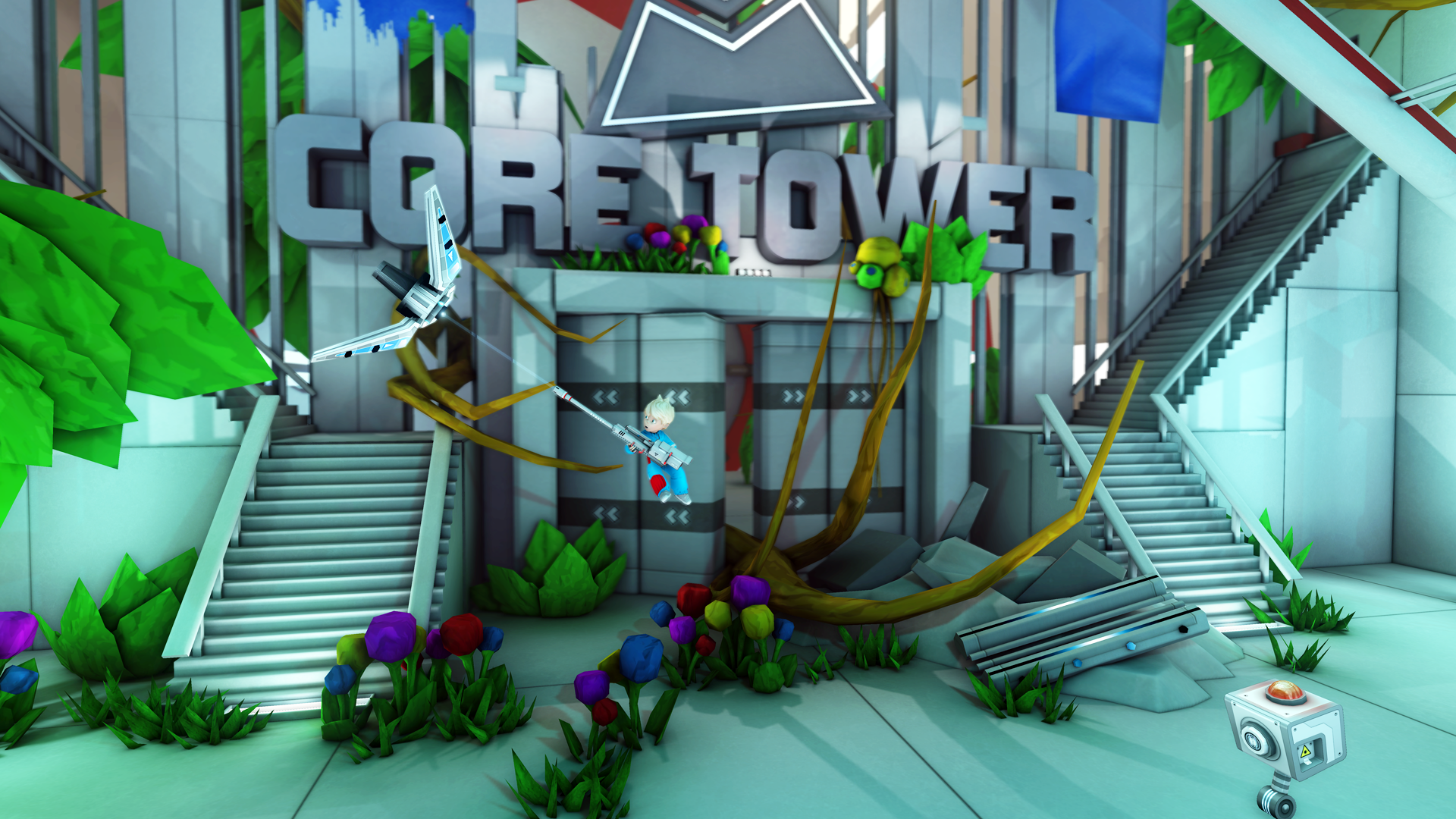
The game spans over 5 worlds and 45 levels. Your main tool is a gun that both propels you through obstacles and shoots enemies. Precision is the key to Kick and Fennick. There are times when you’ll need to launch yourself through lighting rods, bounce on moving platforms, and slide along rails that move you at a high rate of speed. Whenever you miss your target and fall to your death you are respawned at the nearest platform, but if you die too many times you have to restart the level.
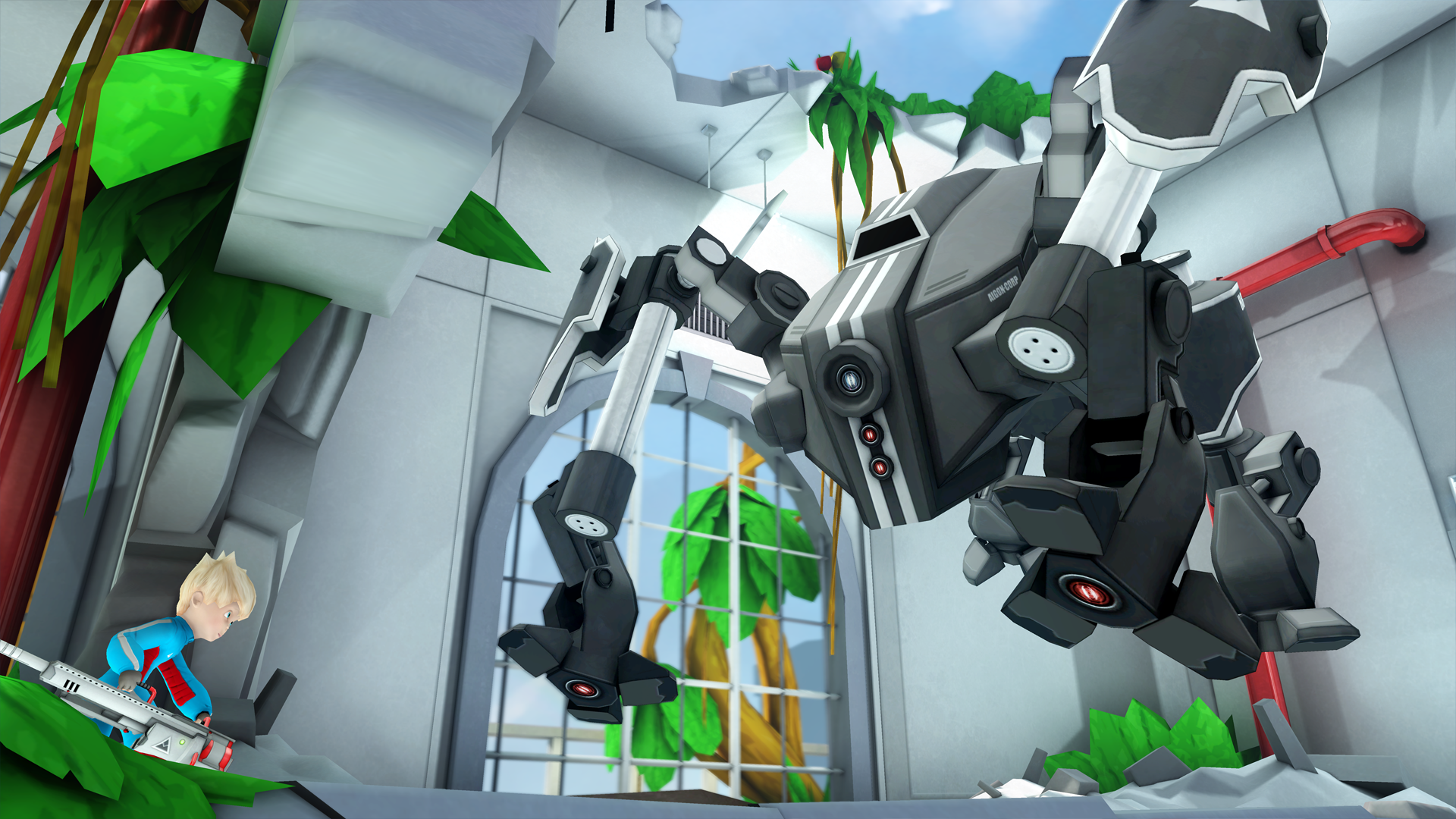
At the end of each world, you are confronted by the mech that is set on annihilation. Luckily, Kick and Fennick can get creative and use their wits to outsmart the silly, psychotic robot. For the most part, the boss fights use the skills that you develop over the course of your adventure, but the final boss fight throws something completely brand new in and it’s really confusing. I’m not going to spoil anything, but this didn’t set well with me. By the time I reached the final boss I was roughly 5 hours into my journey. I had played Kick and Fennick before on the PlayStation Vita, so I knew what to do this time around, but without any indicators that something new is required will leave some gamers confused as what to do. Also, the jump mechanic gets really extreme at the end of the game and it’s hard to get your bearings for a little bit.
Overall, Kick and Fennick is a fun adventure that will take you around 5-7 hours. The lack of an engaging story is biggest shortcoming of Kick and Fennick, but even without that I do think that this is a game a lot of people would enjoy.
3.75 out of 5 stars
Thank you to Abstraction Games for providing the code.
Persona 4: Dancing All Night Review
Your favorite Persona 4 characters take their battle to the dance floor as they try to solve the mysterious situations surrounding the Love Meets Bond festival. Does this game have enough moves to keep you engaged? Find out in this review of Persona 4: Dancing All Night!
Persona 4: Dancing All Night has two distinct modes: Story mode and Free mode. Being a Persona game, the story mode is very interesting, a tad bit weird, and heavy on the dialogue. From the beginning of the game there is a very eerie tone. This isn’t what you may expect from a rhythm game, because dancing games generally have an overall positive feeling, but that's okay. The dark tone of Persona 4: Dancing All Night is balanced by the uplifting soundtrack that is really enjoyable.

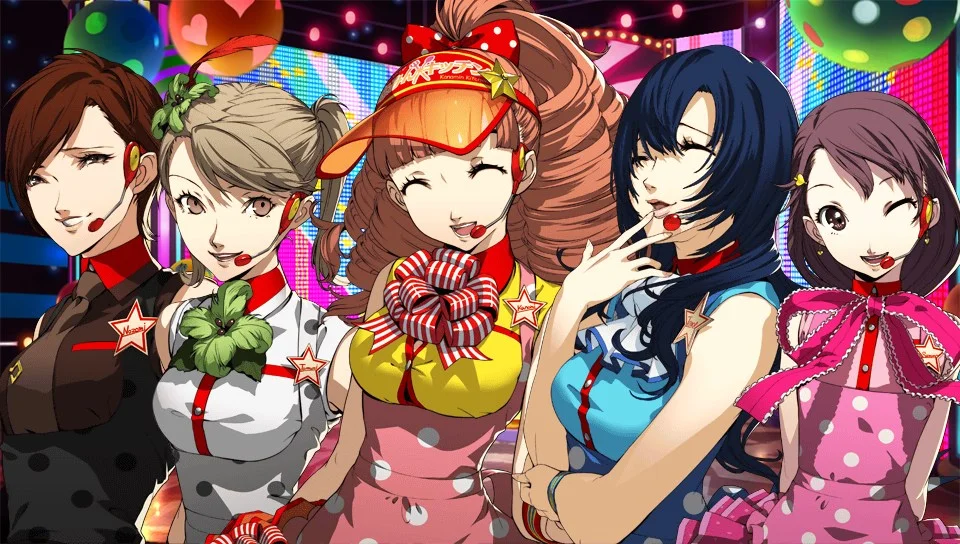
The game’s major events are all surrounding the upcoming “Love Meets Bond” music festival. The two main acts of the festival are Rise Kujikawa, a former idol making her return after she has taken a brief hiatus and the Kanamin Kitchen Girls, a very popular group of idols. Rise asks the familiar faces of Persona 4, Yu, Kanji, Teddy, Naoto, and a few more to be her back up dancers. Shortly after Rise introduces the supporting act of the Kanamin Kitchen Girls to the rest of the gang, the Kanamin Kitchen girls get sucked into a mysterious world known as the Midnight Stage. The Persona 4 team decides that they should enter the Midnight Stage world and rescue the Kanamin Kitchen Girls and thus the adventure begins.
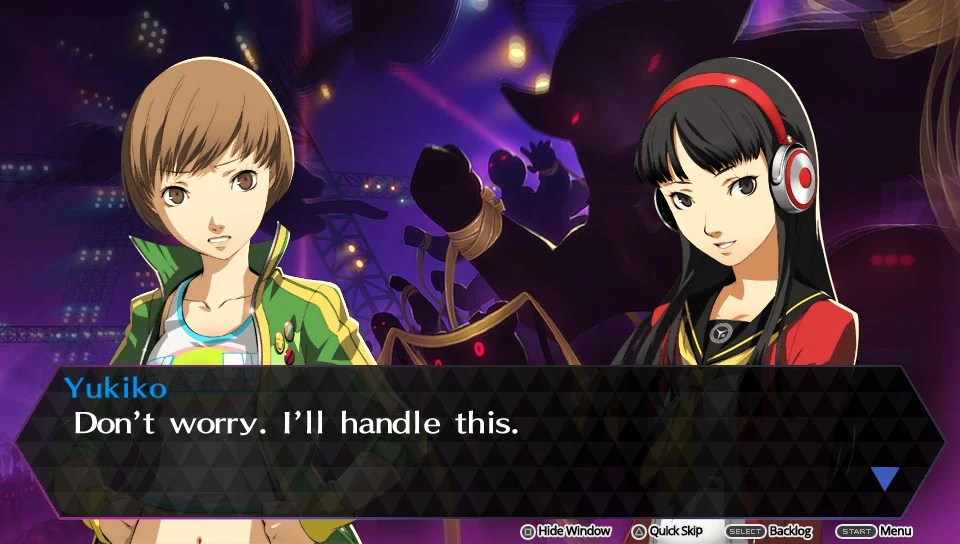
Now that we’ve gone through the introduction, we know the premise, and exactly what are our goal is. This means that we get to dance, but why dancing? Inside the Midnight Stage, you are unable to get hurt or inflict pain. There are shadow-like monsters that reside in the Midnight Stage that can only be dispersed by showing off your best dance moves. As long as you can keep the shadow monsters happy by getting high combos with a low amount of misses, the monsters will be forced to leave and you will live to dance another day.

At first the dancing mechanic feels a little confusing, because the game uses controls rather than the touch screen. This feels like a missed opportunity, but it quickly becomes a welcome feature. Persona 4: Dancing All Night doing away with the touch screen means that you use the up, left, and down arrows as well as the triangle, circle and cross buttons to connect with beats. You also frequently use the left and right stick to add optional bonuses to your combo score and Fever meter, which gives you a score boost. Don’t worry if you miss these score boosts though, because there is no negative impact on your overall combo or score if you do miss. For me, using the controls for Persona 4: Dancing All Night rather than the touchscreen was better because it never felt like I was blocking what I was doing on screen.This is an issue that I've run into with touch screen games in the past. There were even times where it was hard to see my character was dancing, but I was successfully completing the objective. Luckily, there is a handy replay mode that allows you to watch your performance after you finish the dance.

While the gameplay is fun and there are a lot of songs to play, Persona 4: Dancing All Night does have a downside. The actual dancing is great and you can’t wait for the next song, but you're going to have to get used to waiting around for a long time. The game is so dialogue heavy that the time between dances can feel like an eternity. After the first few hours of the game the dances become more frequent, but then comes another problem. There are four Kanamin Kitchen Girls that you have to rescue individually. This wouldn't be a big deal, but with a limited amount of variety between scenes it causes a lot of repetition. This repetition can quite honestly feel like a chore a times, because you are conflicted. You don't want to skip the story, but you really want to get to the next song. I think it’s commendable for any rhythm game to have a story mode, but maybe there is a reason why the majority don’t.

I found myself very tempted to use the quick skip option to get through the text, but I never used it. Persona 4: Dancing All Night is considered canon, so it is important to the story arch of the Persona series. As a true fan of Persona, you definitely want to keep track of what’s happening, but even at times the most hardcore Persona fans may find themselves eyeing that skip text button. The good thing is, once you get toward the last few hours of the game it really starts to pick up. You find yourself dancing more and the story becomes much more engaging.

The other aspect of the game is Free Mode. This is exactly what it sounds like, a mode where you are free to dance as much as you’d like! This is where Persona 4: Dancing All Night really shines. You start off with a select amount of songs and as you progress you unlock more songs. On completion of songs, you also receive a certain amount of money based off the difficulty you select: easy, normal, hard and eventually the unlockable difficulty All Night. The higher the difficulty and the better you do, the more money you earn. The money you earn is used to buy costumes, accessories, and items. While costumes and accessories are purely aesthetic, items can make dancing easier or harder. If you decide to select something that makes your dance routine easier, you will receive a negative bonus on your score and it will lower the amount of money you earn. If you choose to make your difficulty harder, you get a positive bonus that increases your points and the money you earn. Despite having a rough time making it through the story mode, I still find myself making playing the free mode, even after I completed everything 100%.

The verdict on Persona 4: Dancing All Night is that the Story Mode can drag on for what feels like too long at times, but whenever you need a break from the story you can always get your dance on in free mode. When I first played through the game, I focused solely on the Story Mode. I don’t know if this was the right way to go, because I really wanted to get to the next dance. I recommend mixing it up whenever you feel like you just want to engage in some gameplay and then head back to the story to discover all the hidden secrets of the Midnight Stage.
3.75 out of 5.
Thanks to Atlus for supplying a code for review.
Dungeon Travelers 2: The Royal Library & the Monster Seal Review
Dungeon Travelers 2: The Royal Library & the Monster Seal is a hardcore JRPG that isn't for the faint at heart. To find out if you have what it takes to rid the world of evil take a look at this review!

For the last few weeks I have been playing Dungeon Traveler’s 2: The Royal Library & the Monster Seal. My time with the First Person dungeon crawler was spent sweating through tough battles, leveling and re-leveling my characters, dying, and then quickly regretting the fact that I wasn’t saving often enough. When I first started the game, I figured I would be able to move through story, rapidly press X during the the battles and experience some fan service, however this was not the case. Dungeon Travelers 2 isn’t a game that you can just grind while you watch Netflix. Each encounter can quickly turn deadly forcing you back to your last save.
During the story you play as Fried, a member of the Royal Library, who is putting together a “suppression team.” Fried is very serious about his mission and even though his team is filled with beautiful women, he doesn’t let this distract him. Fried’s team is dedicated to clearing the monsters out of the different dungeons in hopes in restoring peace to the Kingdom of Romulea.
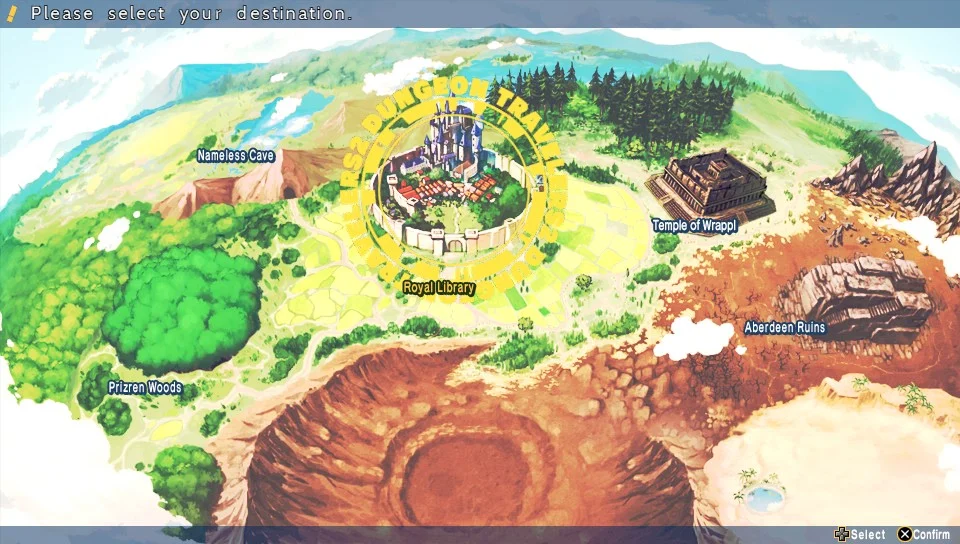
At the beginning of your adventure you’ll start with a small team, but it will eventually grow to five playable members. You and your crew will head to many different dungeons with individual themes such as a forest, cave, catacombs, village, and more. As you progress, the dungeons will begin to introduce different elements that will increase the difficulty of your task. You may find yourself walking into anti-magic zones, where as you may have guessed, make it to where you can’t use magic, dark zones which don’t let you look at your map, warps that take you to another part of the dungeon, and traps that can poison, freeze, and inflict your party with all sorts of debuffs. There are also fake walls that you can only walk through if you have a flashlight or an active light spell. Pair these with epic battles and you will find yourself constantly face to face with death. The best advice I can give to make sure you stay alive is to always have an emergency exit which will teleport you back to the beginning of the dungeon. Also, make your map your best friend. It’s better to head back to town to be refreshed than to die and reload a save.
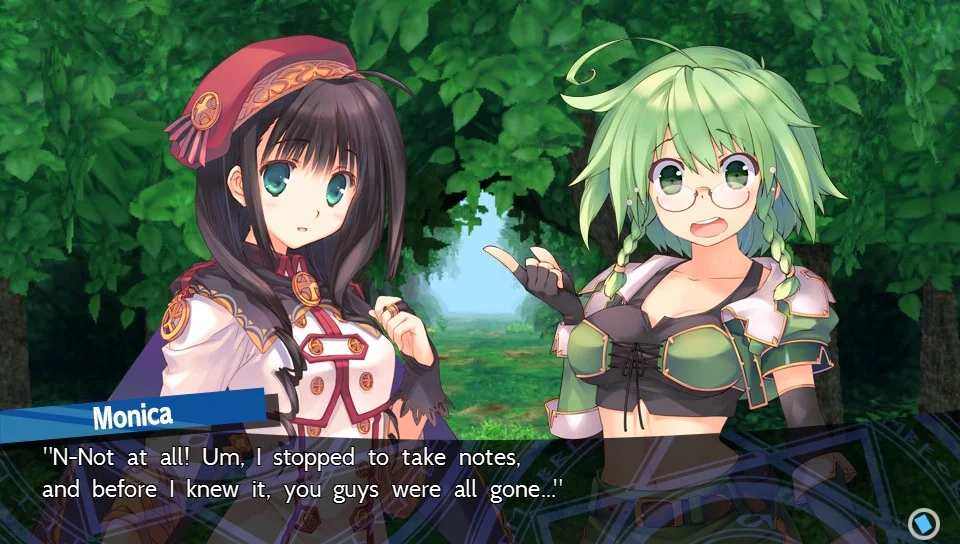
One of the aspects that I really enjoyed in Dungeon Travelers 2 was the random occurrences that happen in the dungeons. Sometimes you’ll come across shops, food vendors, and blacksmiths that can enchant your items. This can help give you that extra boost to keep going, which will prevent you from having to return to town. It’s advisable to always buy one thing from the food vendors to help restore your party's HP, TP (the Dungeon Travelers equivalent to mana) and motivation, which will increase the frequency of group attacks. These group attacks can really help the speed of your battles and allow you to progress a lot quicker.
One negative aspect that you are sure to run into while saving the world is that your bag only has 30 storage spots which can fill up quickly. You can throw some items away to free up space, but discarding items is always tough because you never know what you’ll need later. Luckily, back at your guild you can store up to 999 different items. It is highly recommended that you use this storage for items that you can’t use in the field because any drop from an enemy when you have full bags is gone forever.
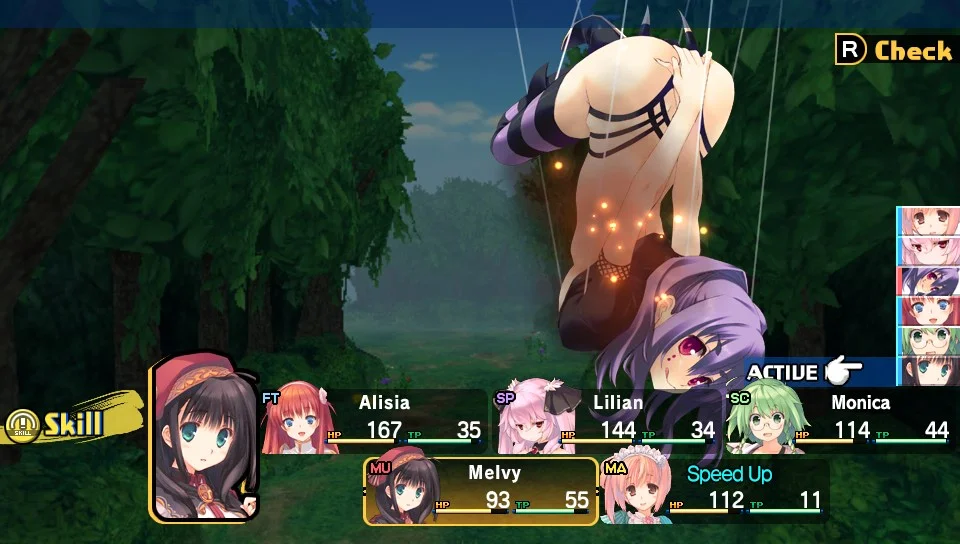
As you progress through the game you start to pick up more party members with specialized classes. They will start off as one of the main classes, Fighter, Magic User, Maid, Spieler, and Scout. Once you reach level 15, you can choose to branch into 2-3 subclasses, and then again at level 30 where you can choose between 3-4 advanced subclasses. This customization of characters is incredibly deep and gives users the chance to really tailor their style of play. I personally like to play with a much more physical damage approach, but other people may enjoy more magic based gaming. A quick tip would be as soon as you hit level 15, get ready to switch your class, and head out to the field to see how your character’s new skills are in action. Once you experience their skills, head back to the Royal Library and reset your character to another class just to see which one feels better. This will prevent you from leveling a character that isn’t as effective as you may like. Dungeon Travelers 2 gives you the opportunity to respec your character’s skills, but you can only reset your level to 1, 15, and 30. Leveling to 20+ with a character you end up not liking and having to reset to level 15 will set you back some precious progression time. I ran into this when I hit level 30. I was absolutely demolished by a boss. I decided to reset my characters and focus on leveling specific skills instead of spreading out my skill points into multiple categories. Having the option to customize your characters and resetting their skill points is a welcome feature because you never feel stuck. There is always the option to make adjustments that will improve your squad.
Some of the classes may seem fairly straightforward, but there are a couple unique ones that really set Dungeon Travelers 2 apart from other JRPGs. If you’re a seasoned veteran in the genre then you’re probably used to having a fighter for your main source of physical damage, a Magic User for healing and magic spells, and another source of support damage. This is the case, but when you add two new classes, the game gets really interesting.
The Spieler and the corresponding intermediate and advanced classes rely on random chances that will affect the battle. When you cast one of the random spells you may damage your enemies, heal yourself, or buff your partners. The Spieler’s normal weapon attacks are on par with the other secondary damage classes, but having the random spells make the class both different and a lot of fun. I’d recommend playing around with the Spieler to see what feels best for you. I tried out the Doll Master class, which gives you dolls that attack enemies or heal allies randomly. I like the idea, but I felt like I wasn’t benefiting as much as I’d like. I switched to the Trickster and felt much more in control of what was happening, even if it was random.
The Maid and her subsequent classes are easily my favorite in the entire game. Her abilities to recover HP and TP, as well as boost Experience make her essential to any team. While the HP, TP, and EXP spells were the ones I felt were most important for my party, she also has defense, speed, critical rate and other support spells that will help you along get through what can be a pretty difficult game. The best part about her skills is that they don’t require TP. The fact that you can restore someone’s TP without using TP, gives this character a huge edge. Once you get into the more advanced classes you can start singing songs that will restore HP and TP every time it’s someone’s turn. This huge boost will sometimes make it feel like you are in complete control of the battle and in Dungeon Travelers 2, that is a feeling you want.
There are a lot of aspects that go into the battles. Each character’s speed, weapon speed, chant speed, and enmity ( which is how often a character is likely to be attacked) are all variables that you want to consider before heading to a dungeon and it can really turn into a numbers game.
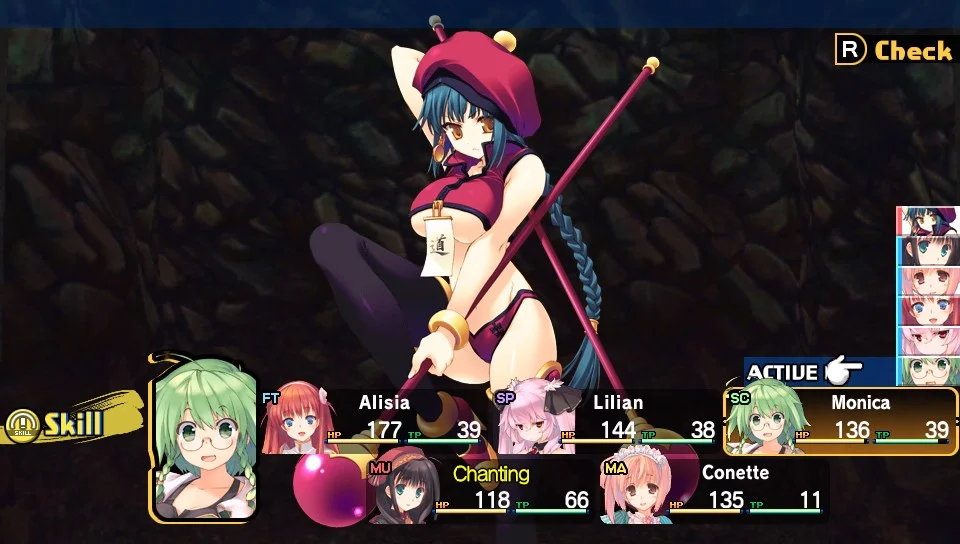
You definitely don’t want your healer to have a high enmity, or higher enmity than your fighter classes. You also want everyone to have the highest speed possible so they can attack often, but you want your chant speed down so spells don’t take too long to cast. This may be confusing without actually playing the game, but the tutorials will give you long explanations that you should really pay attention to.
As you naturally progress you’ll find better items. Every point counts, but then you’ll start to get pieces that have resistances and bonuses on them. These are great, but eventually you’ll be faced with replacing one of those bonuses with a piece of armor that has no bonus, but higher defense and you’ll really sit there and wonder what to do. You could always keep both in your bag to try out, but that goes against your bag storage and it turns into a much bigger concern. Maximizing your attributes by making slight sacrifices will happen and you’ll only hope that you made the right decision.
Once you get the hang of the battles, things will get easier. This is not to be taken for granted. There is always a chance that your healer or fighter will be obliterated with an instakill attack and you’ll have to tough it out without them. Even with four remaining members, if my healer or fighter went down it was a struggle to get through the fight. Dungeon Travelers 2 really makes a point to make every member feel just as important as the other. The moral of the story is take care of your party members and they’ll take care of you.
Overall, Dungeon Travelers 2 will give you between 60-80 hours of gameplay. You will find yourself shocked by the deep customization in both the characters and equipment options. There is plenty to do, but patience is required. There will be times where you are sitting in a dungeon wondering where to go next, but once you figure it out you’ll feel an incredible rewarding sensation. I highly recommend this game to anyone who is looking for a challenge and isn’t afraid to stare death in the face.
4.5 out 5
Thanks to Atlus for supplying a code for review.