

Stygian: Reign of the Old Ones Review
The experience of playing Stygian: Reign of the Old Ones is frustrating in the best way, just like any exploration of a Lovecraftian world should be. The turn-based RPG from Cultic Games is set the fallen city of Arkham and is heavily inspired by H.P. Lovecraft’s short stories about fish people and tentacled atrocities.

Release Date: September 26 2019
Platform: PC/Mac
Developer: Cultic Games
Price: $29.99
The experience of playing Stygian: Reign of the Old Ones is frustrating in the best way, just like any exploration of a Lovecraftian world should be. The turn-based RPG from Cultic Games is set the fallen city of Arkham and is heavily inspired by H.P. Lovecraft’s short stories about fish people and tentacled atrocities.

Stygian’s main character journeys through Arkham which has somehow been pulled to an alternate realm of reality, searching desperately for a way out of this literal hellhole. As you play you will encounter several unsavoury characters who will offer to help you on your quest, either through sharing your goals or through being offered an ongoing supply of cigarettes (the currency of the world). Wandering though the dark setting, it almost feels as if you have become a character in the original stories.
One of the things I enjoyed the most while exploring Arkham was the amount of interaction I was forced to have with both the city and its residents. Frequently in Stygian it wasn’t clear where to find my next clue so my character was forced to ask around, with the interactions varying wildly based on the choices made I had made in character creation. Despite the city’s somewhat claustrophobic size, I still felt lost while trying to work out what my next step should be, with my journal only offering vague clues. As someone very familiar with Lovecraft’s work, I felt that invoked the confusion and dread so often felt by his main characters in a very effective way.

Unfortunately, some of the other ways that Stygian invokes that confusion are slightly more problematic and frustrating. At the time of writing this review, Stygian still suffers from quite a few bugs, including a combat glitch with brings the game to a grinding halt. While the developers have announced they are working on a patch to fix these bugs, right now they seem to be exceptionally common in both my and other player’s experiences.
Another problematic element of the game is just how closely it sticks to H.P. Lovecraft’s original short stories. As Lovecraft was writing in the early 19th century, his stories feature many out-dated points of view, which most modern adaptations have chosen to not include. On the other hand, Stygian features quite a few problematic ideas about race from Lovecraft’s work, seemingly without any reason. The game’s dialogue also quite frequently assumes that the player character is male, despite offering a choice of genders during character creation. Whether these things were included by accident or design, both these elements made me feel quite alienated from a game I would have otherwise enjoyed.

But when these problematic elements weren’t at the forefront, it was hard for me not to enjoy playing Stygian. The world of Arkham is realised through some unique 2D art and despite not having voice acting, it contains some of the best sound design I’ve encountered in recent years. I found the heavy footfalls, smooth jazz and unearthly noises all combined to create the soundscape of a city that was both unsettling and familiar.
Overall, I found Stygian: Reign of the Old Ones had the potential to be a pretty great experience for someone who, like myself, enjoys the world that H.P. Lovecraft created. Unfortunately, at the time of publishing this article, that experience is severely marred by bugs and some rather problematic writing choices. I would also suspect that those unfamiliar with Cthulhu and his tentacled brethren would have a hard time becoming as invested in the game as I was. In the end, this game has potential for those who love Lovecraft’s work but not really anyone else.

Pros
Interesting story world filled with chaos and confusion
Excellent sound design
A story that feels like it could have actually been written by H.P. Lovecraft
Cons
Still contains quite a few glitches at the time of writing this review
Contains content players may find offensive
Not a good starting point for those unfamiliar with the Cthulhu mythos

Where The Water Tastes Like Wine Review
There’s something a little bit magical about Where The Water Tastes Like Wine, and I’m not entirely sure what it is. The game focuses on developing stories based on the main character’s experiences as they drift across a fantastical version of America. Throughout the game your character encounters a range of different people from different places. This gives the game an almost unmatched depth. There are very few times I’ve fallen in love with the world of a game quite so much, it felt almost painful to leave behind such a fascinating place when the game ended.

Release Date: February 28 2018
Platform(s): PC/Mac
Developer(s): Good Shepherd Entertainment, Dim Bulb Games and Serenity Forge
Price: $19.99
There’s something a little bit magical about Where The Water Tastes Like Wine, and I’m not entirely sure what it is. The game focuses on developing stories based on the main character’s experiences as they drift across a fantastical version of America. Throughout the game, your character encounters a range of different people from different places. This gives the game an almost unmatched depth. There are very few times I’ve fallen in love with the world of a game quite so much, it felt almost painful to leave behind such a fascinating place when the game ended.
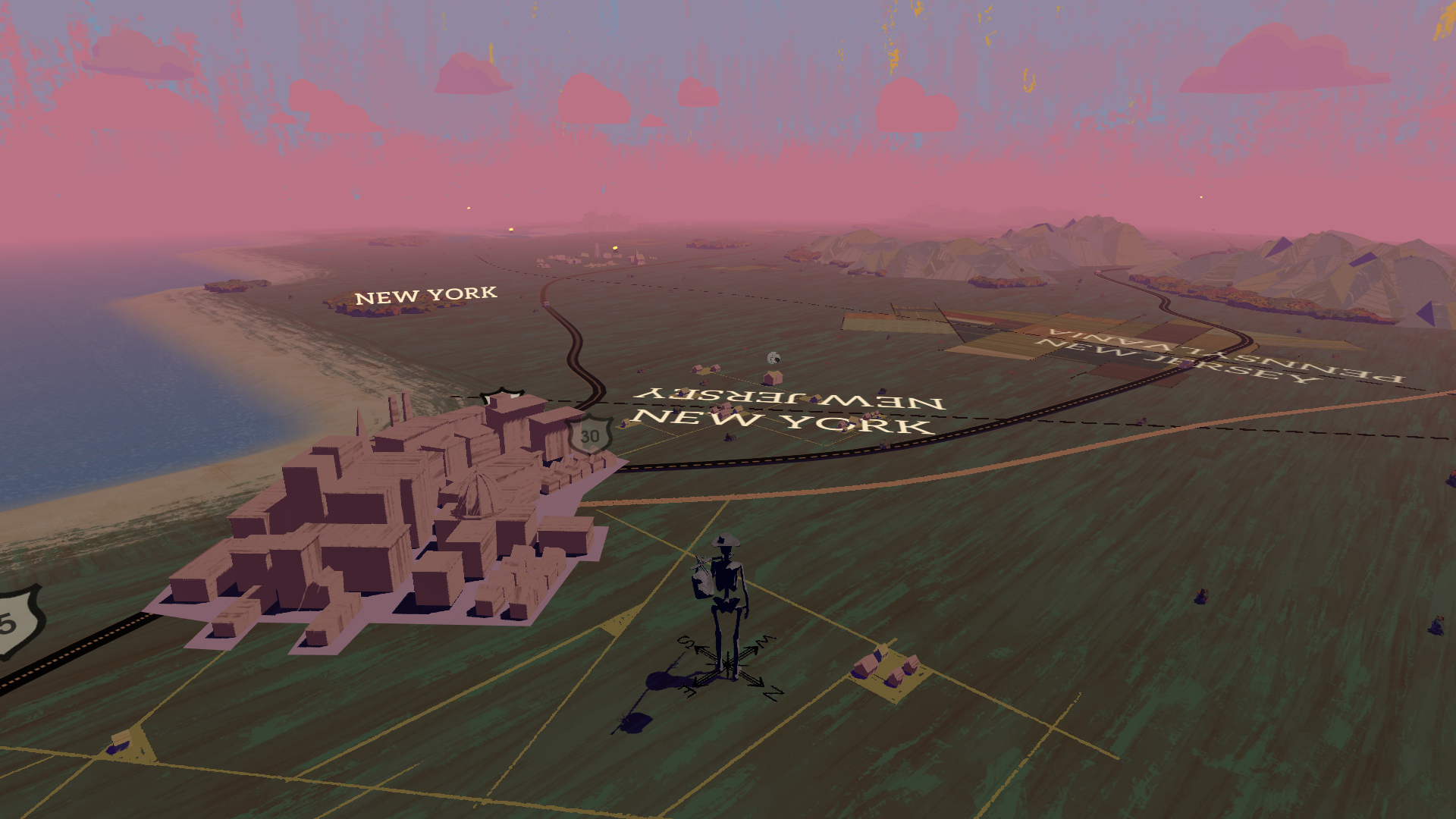
Where The Water Tastes Like Wine is a combined effort from Good Shepherd Entertainment, Dim Bulb Games and Serenity Forge. Each developer contributes their own elements which together create an original and cohesive world. The first thing you notice opening the game is Serenity Forge’s incredible visuals. I couldn’t help but be drawn in the distinctive style of artist Kellan Jett’s illustrations combined with the 3D rendered map which the player journeys across. These visuals are combined with a stunning soundtrack by composer Ryan Ike, which constantly changes to match each regions’ culture and history. One of my favourite parts of the game was travelling across the country and hearing the different version of the main theme play. These elements combined make the simply realised world of Where The Water Tastes Like Wine one of the most immersive in recent memory.
However, the true strength of a game about stories is always going to be the stories it tells. In Where Water Tastes Like Wine, your character is settling a debt by travelling across America to collect different stories, with the most important being the real stories of the people you encounter. From a disillusioned and disowned veteran, to a union miner running from his former employer, to a flirtatious card shark, every character you share your campfire with is absolutely fascinating. Running into a character you’ve previously met and being able to reveal more of their story feels like meeting an old friend after a long time apart. It’s also genuinely satisfying to know that by sharing the stories you’ve experienced you can give them a break from their problems, or enable to see them in a different light.
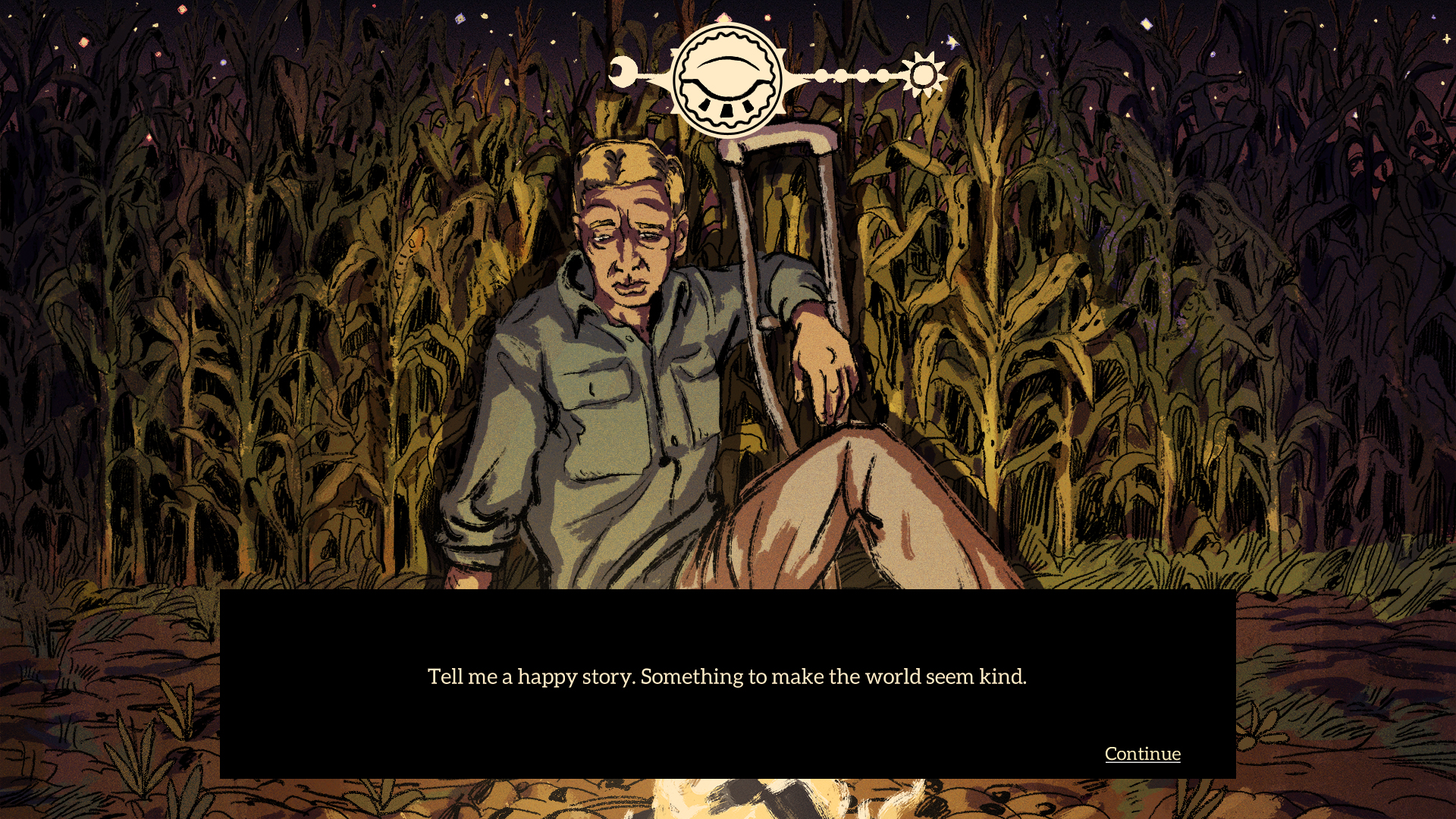
But Where Water Tastes Like Wine is not without its issues. It doesn’t ever fully explain how to actually play it. While I love the game so much I’ve played it three times already, I’m pretty sure I still haven’t figured out how everything works. The game does make some attempt to explain it to you, but in trying to keep with the poetic tone, the instructions come across as incredibly vague. One of the worst offenders is the whistle mechanic, which has you try to whistle along to the song playing in order to walk faster. Unfortunately it never actually explains how to change the notes, or even how to know what your character is going to whistle next. This is a problem that continues across the rest of the game, with many elements of gameplay having to be worked out by trial and error. I often found myself needing to restart the game because of this. It was confusing and somewhat annoying, but wasn’t enough to break the immersion of the game.
Ultimately Where Water Tastes Like Wine is a brilliantly immersive experience, despite a couple of flaws. I’d highly recommend it for fans of magical realism, urban fantasy or just anyone who loves telling and listening to stories. It’s something I can see myself going back to again and again. In fact, I’m going to head back to another campfire to meet another drifter with another story right now.

Pros:
Beautiful, original visuals
Fascinating, immersive world
Great writing and characters
Fantastic and interesting soundtrack (quite possibly my favourite ever)
Cons:
Controls aren’t explained
Can be slightly confusing
Thank you to Good Shepherd Entertainment, Dim Bulb Games and Serenity Forge for providing us with a review copy.