

DestinyQuest: Infinite Part 1 Review
Do you like reading? If so, you are going to be moderately entertained with DestinyQuest Infinite! Don’t like reading? You will probably be moderately entertained with DQI as well. In fact, I would go so far as to say most people would moderately entertained with DQI.

DestinyQuest Infinite : Part 1
Moderately Entertained
Now, I’m not saying the game is bad, nor am I saying the game is good. For the 7-13 hours I played, I was moderately entertained. There are three main areas that should be examined to explain my critique: Playability, or how easy to is to control the flow of the game; Story; and Execution of the Goal. Once I explain those, I think you would tend to agree with me.
Playability
As far as moderately entertaining games go, these might be some of the easiest controls for the scale of the game. Combat is simple. Click one of four buttons, most of which are disabled at any given time, and let the game handle keeping track of stats, items, enemies, etc. Fairly straight forward. However, after a certain point of being equipped incorrectly, I hit a sort of wall. With the random chance of rolling, combined with the overwhelming power of the enemies, I died. And died. And died some more. So I tried the next mission path in hopes to get stronger. And died there as well. I’ll talk more about that later though. The point I am trying to make is that they handle death fairly well. In an effort to be like a Choose Your Own Adventure book, they did what everyone did while reading those books. They bookmarked the page before the choice so when you screw up, you don’t have to read the entire book again. This makes it so it isn’t too hard to keep going when you die.
Navigating the world wasn’t that bad either. There is a simple, color-coded map that you actually get a lot of info from just by looking at it. The warmer the color means the faster you have to be in order to tackle it. Gray means it is already done. Locations are clearly labeled, and more details can be found by hovering the mouse over them.
Interacting with non-player characters is easy, but a little lacking. There are some dialog choices that you can click through to get what answers or information you can, and then you leave them alone. I mean, all games do this, but for a CYOA (choose your own story), it is a little bit of a let down. I wish it was a “talk to the bar keep OR the shadowy figure in the corner” sort of deal, where you actually have more subtle branches earlier in the game. But, I can see where that might have a chance of barring the overall story if the player completely bungles things.
Main Map Screen
Story
Speaking of bungling things, I did just that. In reading a short synopsis of what the game is supposed to be, I thought I would be able to resolve subplots the way I wanted them to resolve. Instead, I’m pretty sure I have to either be extremely lucky all the time on rolls or be a selfish jerk the entire game to get better gear. I thought I was going to be okay when the suggested speed was 3 and I had 3 speed. I was not. And I couldn’t go back and try again. So, I hit my wall, and chose to stop. I’m not going to spend another several hours getting back to where I was. How does that tie into the story? Well, for something with the possibility for lots of branches and play-styles, it is infuriatingly linear. I guess when they say interactive story, they mean you need to play over and over again until you find the “correct answer” to the story.
Execution of the Goal
What does this mean? It means, from what I can tell on their website, the creators were trying to make a story where you can add in lots of little paths that all combine into one massive story. Well, instead of lots of little threads being wound into one cohesive string of a story, I feel like there are lots of layers peeling off of the main story, and you have to get the main one. Of course, I remember the old CYOA stories being the same way, but I feel like this could have been much better than those; a way to make one big story to follow while small choices for allow for variation.

Example of Choices
With all that in mind, I have to reiterate my earlier point. This game is still moderately entertaining. You can pick it up for 5 minutes or 5 hours and still make plenty of progress to the end. It captures the core spirit of a Choose Your Own Adventure book, while allowing for the details a computer can afford. Also, for you paying attention to the titles, there is indeed a part two! This is only referring to part one of three of the series. And, while I don’t have a complete grasp of the series, they say that you can jump right into part two and be able to keep up. So, I will brave that and write another review on their improvements to that.
Score 3 out of 5
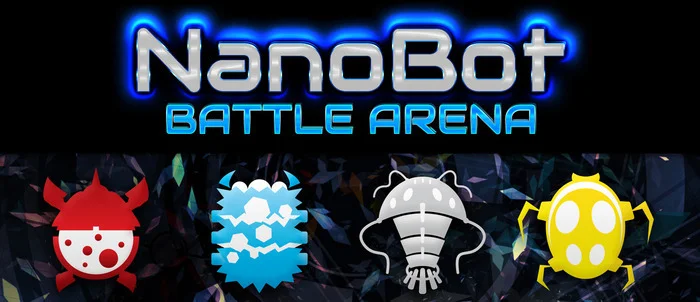
NanoBot Battle Arena Review: Othello Meets Chicken Fighting
A review and unboxing of Derpy Games new tabletop card game NanoBot Battle Arena.
When I first looked at NanoBot Battle Arena by Derpy Games, I genuinely had no idea what to expect. For those of you wanting a quick verdict: I say the game is one you can sit down and play a couple of rounds before getting tired. I would also recommend playing with up to 5 friends, 3 being optimum. For those of you in it for the long haul, I would say there are really 2 main things to talk about: presentation and execution.
The presentation of the game was great. When I first opened the box, the contents were very neatly packed and tightly sealed. There were 120 cardboard tokens in 8 cardboard sleeves. Each sleeve contained all 15 tokens from a single faction. The tokens had decent heft and were shaped well. The art took up the full piece on both sides: one side dark and one side light. My only complaint is the faction icon on the token. It is really small, and the faction icon is on the corresponding faction cards, which makes the icon important. The tokens and are color coded however, so the problem isn't that big of a deal. That brings me to the cards. There are, to my knowledge, 96 total. Each faction has 6 level-1 cards, 4 level-2 cards, and 2 level-3 cards. The levels determine the effectiveness of the card.
I do have some complaints about the rulebook. I personally think it isn’t very well organized. I remember trying to find what to do in the event of running out of cards in the deck, and trying to find if we should reshuffle or not. The rule was buried under some section that, while it worked, would have been more easily found under another heading. The text is also incredibly tiny, as if they didn’t want to pay for the extra sheet of color paper. The art also seemed a little less vibrant as compared to everything else, but was still useful and coordinated well with the rules they were explaining. As much as I harp on the rulebook, it explains the rules well enough, and covers a lot of weird questions you may ask. Overall, it is a good rulebook that is concise.

As I said, the rulebook does a good job explaining the rules. However, the best way to learn anything is by doing it. My first time playing the game was a little confusing. For the complexity of the rulebook, a turn consists of few steps.
1) Play a tile.
2) Play a card.
3) Draw a card.
4) End your turn.
That’s it*. That’s the game. This is both terrible and great all at the same time. It is terrible because, when it is not your turn, there is nothing to do. If you play with lots of people or with people that need to think, it can get slightly stale after a game or two. It is great because, once you get into the flow, a turn lasts several seconds. It really lets you have a fast paced game, which fits into the small narrative that Derpy Games has tried to establish. The tiles have directions, and you win by having the longest connected chain of tiles. You can place anywhere except at the end of an opponents chain, unless it is also at the end of your chain. So, how can you beat the person in the lead? That’s where the cards come in. The cards have all sorts of zany abilities, ranging from disabling opponent's cards to converting tokens to your side. Overall, the most fun card lets you take a token and teleport it to any valid space on the board. The most fun cards are surge, which lets you remove a few cards at the end of one of your chains, and a card that lets you teleport tiles. However, some cards are clearly inferior to the others.

A small group of 4 players near the end of their game.
Freeze and Growth are those inferior cards. Frost has the ability of letting you prevent another player from playing random cards for one turn. While interesting on paper, it doesn't actually do too much. Sure you mildly inconvenience an opponent, but your turn can be better spent affecting the play area instead. If you could at least see what cards they had, then it would be something worth considering just to get a feel for what that person is planning. Of course, the game is so hectic and changes so much, even that isn't very powerful. Growth is also a very interesting card… on paper. The card lets you play additional tokens based on the card’s level. Taking into account the faction advantage for playing as the Echidna faction, you can play up to 4 additional tokens on one turn. That sounds amazing. However, there is no down side for other players using it against a player with the faction advantage, unlike every card in the game. Considering that most cards can almost, if not entirely, nullify any use from those extra tokens you would have gotten by the time your next turn comes around, you essentially just wasted a turn. Of course, that’s only 2 of the 8 factions, so I just suggest ignore those exist, or make some house rules to buff those cards’ abilities. Those cards aren't a big deal, however, because games don't usually last long enough for there to be a big need for much strategy for much past the next turn. In fact, I'm not sure it is even possible, considering the board can literally be in a completely different state by your next turn.
Keeping in mind that organized chaos is part of the game, this is actually a fun game. You have to live in the moment, and choose something you feel is good based on what HAS happened, not on what you anticipate WILL happen. That is a major drag if you have lots of players, because then your moment takes too long, or if you don't have enoughplayers, because then the chaos isn't there. This is still a nice change of pace from a lot of strategy games. Too many games in the genre are decided in the first couple of turns, and this game does a great job at sidestepping that. There really is no way of know who will win until that last tile is placed. If you are looking for a fun game to purchase, I would suggest NanoBot Battle Arena, with the caveat of holding off on getting more than one pack until you actually play the game and make your own judgement.
*This only applies to the base version of the game.
If you wish to purchase the game, head on over to Derpy Games. Thanks to Derpy Games for supplying a copy for review!