Hell Architect Review
Hell Architect is a standout among survival games. With its relaxed pace, wicked humor, and unusual setting, the game draws you in, and then its forgiving attitude towards death and relatively easy to understand supply chains and production lines make it one of the few welcoming entries to the genre.
Release date: August 18, 2021
Developer: Woodland Games
Publisher: Leonardo Interactive
Platforms: PC
Price: $24.99
I’m bad at survival builders. I want to get that out of the way immediately. I can’t tell if it’s just an attention span problem, or whether it’s the highly technical details that I just can’t get my head around. That isn’t to say I don’t love them. They’re a hotbed of micronarrative and emergent systems, and when you find a creative solution to an issue, you feel really, really, clever. Hell Architect is a standout among survival games. With its relaxed pace, wicked humor, and unusual setting, the game draws you in, and then its forgiving attitude towards death and relatively easy to understand supply chains and production lines make it one of the few welcoming entries to the genre.
Hell Architect is what’s referred to as a “survival builder” game. As a junior manager in Hell, players are tasked with guiding a growing band of sinners through various objectives and extracting their suffering. This lets players build larger and more efficient structures as a way to increase power and resources. To do this, gamers attend to their sinners’ needs (building them up gives them more hopes and dreams to crush) and eventually bump them off, sending them back to Limbo and giving the player “essence,” essentially soul energy that can be used to make larger structures. Along the way, gamers will dig for artifacts, research better structures, and figure out how to run a thriving Hell where they can torture all sinners to their heart’s content.
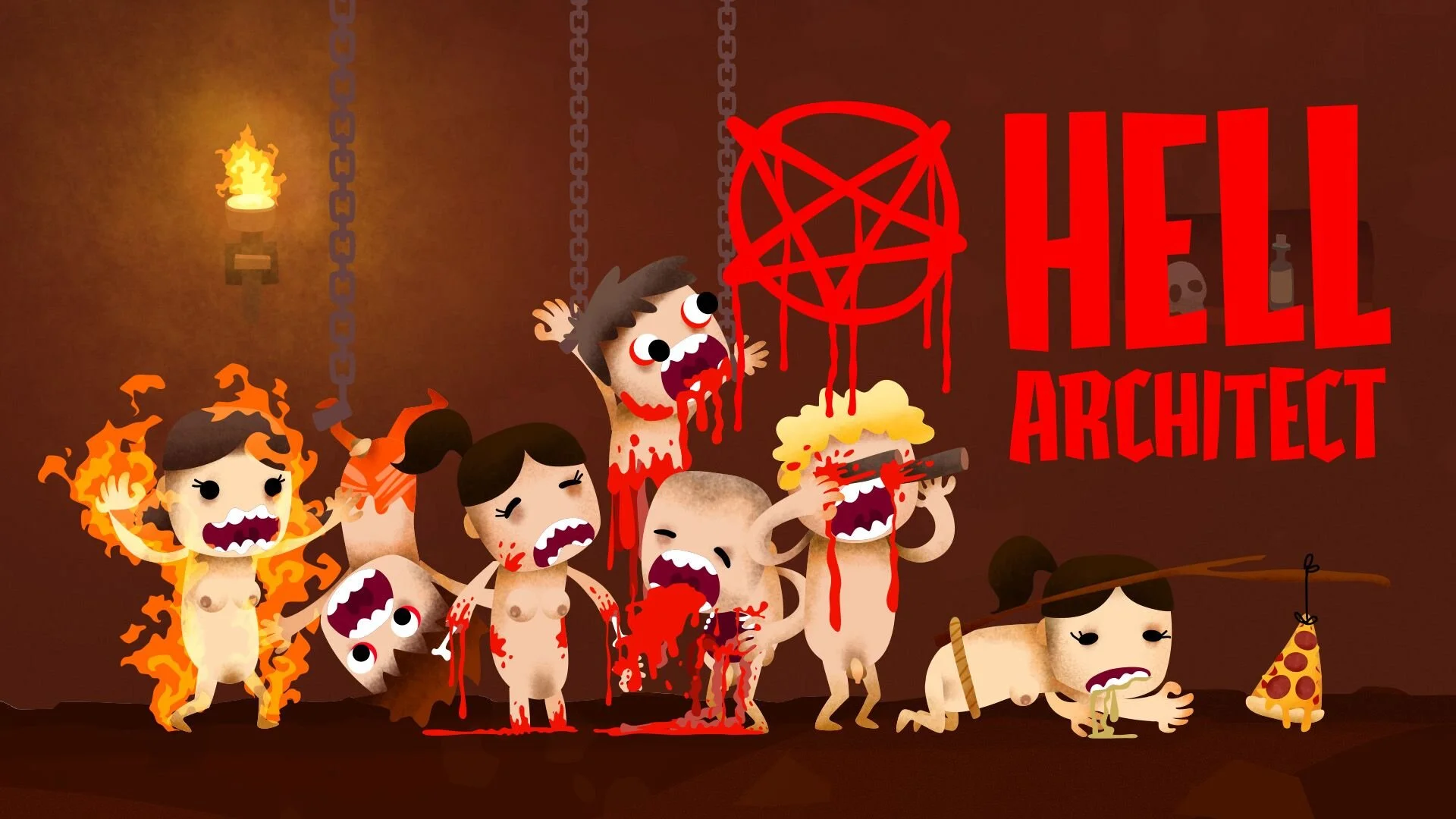
Hell Architect lives and dies mainly on its atmosphere and setting, so it seems like as good a place as any to start. A lot of the theming is excellent. You’re given control of your own personal corner of Hell to do with as you wish, gleefully forcing sinners to mine out their own torture chambers and make utterly repulsive food and drink for each other. The gross, edgy, and downright scatological humor of the setting is completely on display, whether it’s every one of your sinners working in the nude with only fig leaves covering their naughty bits, the HR devil who assigns you tutorial tasks while snarking away about how he wants to stop having to hold your hand, or the fact that the usual food and water that survival builders require take the form of “mystery meat” and “sewage water” respectively. There are even legendary sinners and demons you can use to augment your existing flock of unfortunate souls. It’s the sort of game where suffering is a resource, and the kind of game where with a single right-click, you can select one of a number of ways to send your sinners back to Limbo, murdering their physical form once again.
And honestly? That takes a lot of the usual stress out of the average survival builder experience. Sure, there are the usual supply chains and the occasional problem where you have to move your base structures around because your sinners can’t move all the way back up through the chambers you dug, but on some level, it’s okay when they die and go back to Limbo. It’s Hell, after all. You’re about as much an administrator as you are a kid with a magnifying glass, playing with ants. In weaponizing the death mechanic, it actually feels a lot less frustrating to play Hell Architect than it does a lot of other survival builders. If someone annoys you, or won’t go where you need them to, just bump them back into Limbo and either pick up a sinner who will, or bring them back when you feel like it. You even get resources for doing so, incentivizing you to zap them to death in a variety of fun ways (seriously, it brings up a wheel with multiple choices). The systems are easy to understand, the writing is sharp, and while the resources aren’t obviously tallied at times, the clean interface allows for enough management that you’re able to figure out what’s what.
The game really needs this catharsis to bridge the gap between its faults, though. Frequently, your sinners will stand around even when there are tasks that need to be done, or complain their needs aren’t being met even if there’s a path back to the base-camp area they’re just refusing to take. It turns managing needs and pathfinding into a slog, one where all your sinners are either too invested in doing the tasks queued for them, or not invested enough, or simply don’t bother to reach the place they need to be. It can get frustrating, especially when you’re forced in some missions and objectives to dig deep into the furthest reaches and your sinners tend to think it isn’t worth the hike. It’s a little annoying at times, and can bog down the pacing. Survival builders tend to be games of urgency and infrastructure, and while Hell Architect is heavy on the infrastructure (there are entire supply chains for sinner needs), it’s a much slower-paced game than, say, something like Oxygen Not Included. This isn’t always a bad thing, but occasionally it can just take a long time to get anywhere.
The slower pace and occasionally nonsensical AI behavior don’t mar the game too much, though. Hell Architect is the kind of slower, chilled-out, forgiving experience the survival builder genre needs. With the reputation the genre has for being unforgiving and obtuse, Hell Architect manages to be forgiving enough to new players and approach the genre with the atmosphere and sharp humor the concept deserves. While it might be occasionally frustrating and the pace (even with the usual time controls speeding things up a little) might be a little slower than the average game, Hell Architect is a must for anyone who wishes to get a good starting grasp on the survival builder genre.
Final Score:
The Good:
- Remarkably chilled-out and forgiving for a survival builder
- Excellent setting and sense of humor, even if it can get a little on the edgy side
-Wide range of things to do without being too obtuse
The Bad
- Incredibly slow-paced even at its top speeds
- Sinners will sometimes completely ignore what they’re supposed to be doing in favor of something else, sometimes to their detriment
- Gross-out humor wears on you after a while
"Perhaps It Is Crueler To Let You Live" - Hands-On With Conan Exiles
It's been almost a week since FunCom released their fantasy sandbox survival sim, Conan Exiles. And the prognosis is...better than initial launch. The game looks great, and the loop of scavenging and survival is well worth it, sure. It's also the only game with (and this is obligatory since it's been the only news coming out about this game other than the lag info,) an endowment slider so you can choose the size of your character's breasts, or, if you are so inclined, pendulous lower extremities. But while the game has a lot of interesting systems and some absolutely gorgeous graphics, the extreme lack of balance, lag and rubberbanding issues, and just downright uncooperative AI mean that this game will have a lot of polish to deliver before its final release.

The following article may contain mature images inappropriate for those under the age of seventeen
It's been almost a week since FunCom released their fantasy sandbox survival sim, Conan Exiles. And the prognosis is...better than initial launch. The game looks great, and the loop of scavenging and survival is well worth it, sure. It's also the only game with (and this is obligatory since it's been the only news coming out about this game other than the lag info,) an endowment slider so you can choose the size of your character's breasts, or, if you are so inclined, pendulous lower extremities. But while the game has a lot of interesting systems and some absolutely gorgeous graphics, the extreme lack of balance, lag and rubberbanding issues, and just downright uncooperative AI mean that this game will have a lot of polish to deliver before its final release.
Conan Exiles casts you into the ancient and brutal world of Hyborea as an Exile, one who has committed terrible crimes (procedurally generated for each new character) and been thrown out into the forgotten wastelands, fastened to a cross to die. The player is then saved by Conan, who leaves them naked and unarmed on foot in the middle of vast ruins hewn from jet-black stone, to gather sticks, rocks, and plant matter until they have enough resources to get themselves clothing and tools. They then must build and upgrade their equipment, gain experience, and eventually rise to assert their dominance over the savage world, provided a crocodile doesn't bite them in half, forcing them to find their body all over again.
Yes, friends, it turns out that not being Conan or one of his allies in a Conan story isn't all that much fun. A lot of the early game is spent running from literally everything, because everything will kill you. Arguably the least dangerous two enemies are the giant bat you meet in a scripted event, and the "imps," nude guys who look like a hunchbacked Toxic Avenger and can't take you out unless in a pack. Even the under-equipped AI-controlled "exiles" who run around on the PVE and single-player instances of the game can take you out. The game is punishing, make no mistake.
But this highlights one of the major issues with the game. While brutality is all well and good, and is in fact a major feature of the Conan world, the sheer size of the difficulty cliff makes it annoying to play. Enemies will chase you across the map, and even after breaking line of sight. Also, none of them seem the slightest bit interested in anything but you, which means you can be standing on a rock trying to catch your breath and get around things, and suddenly be surrounded by enemies who are only interested in killing you. Moments after leaving the starting desert in any direction, you are swarmed by some fresh horror, which immediately kills you and drops you in the starting desert again.
This necessitates either finding your dead body to loot it in a very dangerous area, or starting all over again from scratch. It's frustrating, but much appreciated over the system where you would lose all your items, weapons, clothing, and any structures as well as everything else, which has since been patched out. However, with the hyper-aggressive enemy AI, this is still a dangerous proposition, and one difficult to enact. You will end up making a lot of stone pickaxes and stone axes to get through the early part of the game, and sometimes it isn't worth it.
Aiding and abetting the enemy AI is a system that doesn't register hits when you attack and some serious lag and rubberbanding issues, leading to such moments as an ibex who will stand still while you hit it, never once registering that it's hurt, only to teleport a mile away and start running like crazy. Enemies will drop you in four hits, regardless of armor or how much damage you deal to them with the same weapon they're using. Sometimes, I even saw people walk across water or through rivers. The lag gets even worse on the online servers, which, I should caution to remind everyone, are the entire point of the game. That you get your open ended Hyborian adventures in a world with real players and real player-created content. Which is nigh-impossible to play.
And all of this really ticks me off, because the game is great. It feels really satisfying when you win a combat and then butcher your kill for parts. It has bizarre moments, like harvesting human adversaries for food and hides, meaning you can be wearing human-crocodile hybrid pants. It's satisfying to gather and make things. It's even cool figuring out the past of the Wastes from the sinister glowing tablets hidden throughout the world, or trying to go to the distant spires you can see from locations. It's a fun game, cloaked in the worst nightmare of hardcore survival game nonsense. It's an awesome concept hampered by extreme performance issues.
Wait until this one comes out of early access. FunCom is working tirelessly to fix what's broken, and when it finally comes out of early access, the result should hopefully be an intriguing adventure in the brutal world of ancient Hyboria. Until that time, I suggest watching the patch notes intently until the game it is now becomes the game it could be.
Conan: Exiles is currently in early access. The reviewer received a complimentary copy for this hands-on look
The Culling Early Access Review
There's not much to say about The Culling, really. It's the kind of game that, if you like arena-based deathmatch shooters, you will probably like. If you don't like multiplayer arena-based deathmatch shooters, you will not like it. That's pretty much the delineation.
Granted, as far as arena-based deathmatch shooters go, I like it a lot more than most, but it's going to be pretty clear when I describe the mechanics whether or not this is your kind of thing.
There's not much to say about The Culling, really. It's the kind of game that, if you like arena-based deathmatch shooters, you will probably like. If you don't like multiplayer arena-based deathmatch shooters, you will not like it. That's pretty much the delineation.
Granted, as far as arena-based deathmatch shooters go, I like it a lot more than most, but it's going to be pretty clear when I describe the mechanics whether or not this is your kind of thing.
The Culling is a game that functions on a simple premise: You have signed up (or maybe been coerced) into the internet's leading game show, a deathmatch where you are packed up in a crate and dropped on a tropical island to murder complete strangers with a variety of implements, most of which you will have to make yourself. When you are murdered, you are out. No respawn, no "back to start," you can spectate, or you can bounce.
So that's pretty much it. Simple. Run around, kill other people, don't get killed.
But what makes The Culling interesting is how it deals with those details. First, everything involves an in-game currency called FUNC. Want to craft something? You need FUNC. Want to heal? FUNC. Access the higher-level airdrops you can call in? More FUNC. It kind of allows for prioritizing your sources for the most part-- it might be better to save up and get the airdrop rather than opening the crate near the center of the arena, or even better still to roll your own weapons and avoid using much of the currency at all, saving it to heal. The ability to craft weapons also adds some strategy, allowing for both ranged and melee options.
And melee is actually now a huge part of the game. The Culling does away with the usual run-n-gun in exchange for tense melee fights between you and your opponents, with the optimal tactic seeming to be a "hit and run" approach where one swings wildly at their opponent, or turtles while waiting for an opening, constantly moving in and out and in and out in an attempt to gain the other hand. It's a marked change from bunny-hopping and circle strafing (though people who have tried that met the business end of my taser pretty quickly).
Also, the sound design is amazing. This may be one of the few FPS's I play with headphones on, because sound matters that much. You can hear the direction your opponents are coming from, the whirr of nearby cameras, and just about everything else. It's also direction-dependent, with sounds popping up in the proper location, allowing you to plan or run away when someone gets too close. It feels like the noise has reason and body, which adds another dimension over the usual run-n-guns.
And finally, the game actually has a good sense of humor. While the callouts might get annoying and repetitive, there are some amusing moments, and the tutorial doesn't actually make me want to rush through it immediately. Overall, it's not bad.
I'm looking forward to seeing the finished product when all is said and done. There are some good ideas here, and while the single arena offers no real variety, it's nice to have something familiar and figure out the ins and outs of where you find yourself. The game definitely could benefit from more models and better options, but in its current form, it's beyond solid.
This game was early access. The reviewer was provided with a release code.